Carl Vonderau: Storytelling, With An Award-Winning Crime Fiction Author
Carl Vonderau has made many mistakes in his professional writing—and he wants you to learn from them. His savvy advice includes: Use the senses; evoke emotion; get your readers and viewers to empathize; find the conflict and success; show transformation; and a lot more. You’ll find him at CarlVonderau.com.
We’re the #1 Podcast for Nonprofits, With 13,000+ Weekly Listeners
Board relations. Fundraising. Volunteer management. Prospect research. Legal compliance. Accounting. Finance. Investments. Donor relations. Public relations. Marketing. Technology. Social media.
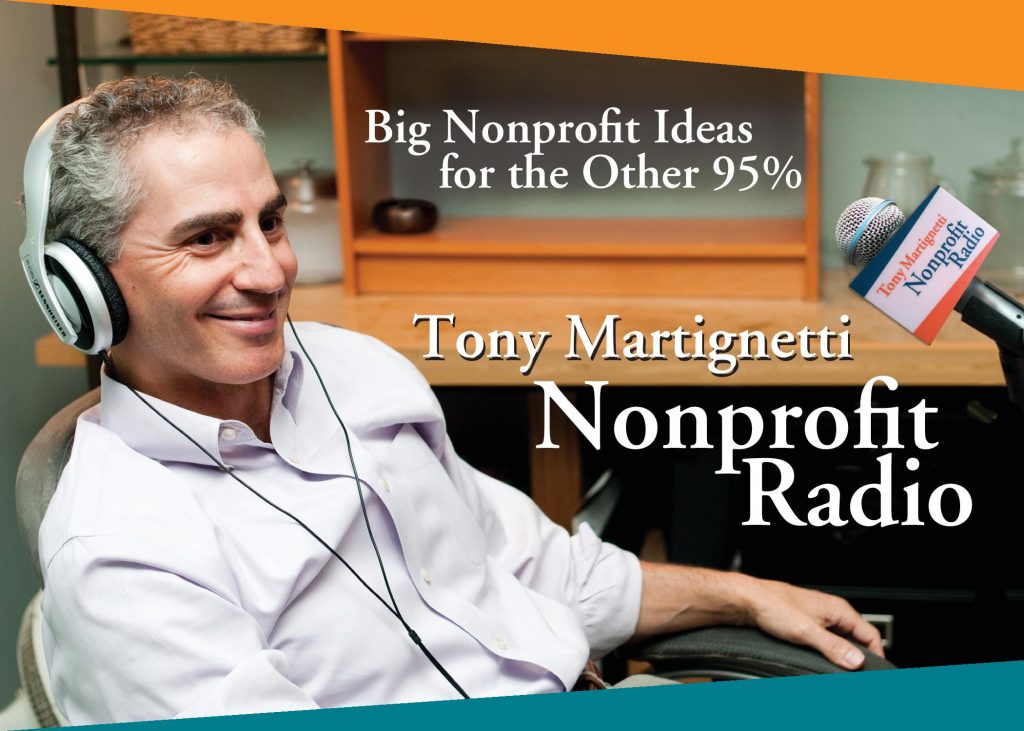
Every nonprofit struggles with these issues. Big nonprofits hire experts. The other 95% listen to Tony Martignetti Nonprofit Radio. Trusted experts and leading thinkers join me each week to tackle the tough issues. If you have big dreams but a small budget, you have a home at Tony Martignetti Nonprofit Radio. View Full Transcript
Welcome to Tony Martignetti Nonprofit Radio, big nonprofit ideas for the other 95%. I’m your aptly named host and the podfather of your favorite hebdominal podcast. Oh, I’m glad you’re with us. I’d be hit with methemoglobbumia if you took my breath away with the idea that you missed this week’s show. Here’s our associate producer, Kate, to tell us what’s coming. Hey Tony, this week it’s. Storytelling with an award-winning crime fiction author. Karl von derro has made many mistakes in his professional writing, and he wants you to learn from them. His savvy advice includes, use the senses, evoke emotion, get your readers and viewers to empathize, find the conflict and success, show transformation, and a lot more. You’ll find him at Karl von derro.com. On Tony’s take 2. Tales from the gym. Rob gets flirtatious. Here is storytelling with an award winning crime fiction author. It’s a pleasure to welcome to nonprofit radio, Karl von derro. Karl is an award-winning author of crime fiction. Inspired by his father’s commitment to their local YMCA, Carl began working with nonprofits. As he aged and got much better at storytelling, he helps other organizations be more successful using the lessons he’s learned from writing novels. You’ll find Carl and a storytelling primer you can get for free at Karl von derro.com. Welcome to nonprofit Radio, Carl. Thank you so much. Thank you so much. It’s, it’s gonna, it’s fun to be here. I’m glad, I’m glad you’re having fun already. We’re not even 2 minutes in. Outstanding. All right, so it’s all, I hope it’s not all downhill from here. Like now’s the fun, and then, and then it’s all a steep decline, uh, for the next 2 remaining 40 minutes. Try to have a, have a good novelistic ending, uplifting, right? Very good, yes. I do like to leave with some inspiration and empowerment, but the fun that’s the fund certainly can. I’m sure it will. I’m sure it will. Um, so we’re, you know, we’re here to get some storytelling advice from, uh, a master storyteller, uh, award winning fiction author. Tell us about your most recent book, Saving Miles. Sure, I write about crime, but I don’t just write about crime, I write about dysfunctional families who have to come together to survive crime. And so I’m really dealing very much with family, and in this book I’m dealing with a family with a very rebellious son. He’s uh having so many problems that they have to send him to a residential treatment center. And when he comes back he seems to be totally changed, uh, but in fact he sneaks off to Mexico and gets kidnapped. His father, a very successful banker, uh, and his wife who’s involved with a nonprofit, have to come together and get involved with money laundering in order to save him. So nothing like money laundering for a good family story. Saving, saving miles, M Y L E S. Miles is the son that uh that you’re talking about. All right. um, what, what brought you to the crime and family overlap, uh, genre? Yeah, I was always interested in crime fiction because, you know, I, I liked plot and but now I’ve gotten more deeply into character and I find that crime amplifies any problems in a family and you know I’ve got a family. I’ve been married for 40 years I’ve had a number of, you know, we’ve gone through a number of things and um I, I wanted to deal with that in this book. Uh 20 years ago we had to send our son to a residential treatment center. And um he came back and, and now he’s changed 20 years later, but I wanted to put some of that experience in the book. Now, like with nonprofits, you know, you have a lot of these stories, but you need to get permission from the people who the stories are about. So I got permission from him to use some of that material in the book itself. It and it helps me deal with character as well as getting deeper into what makes a family. Uh, not function and what makes it thrive. That’s why I do that kind of fiction. Are you working on something now, or saving miles is recent, so maybe you’re taking a break. No, I’m not. He’s not. No, no, here’s a saying in the, in the fiction world you get your whole life to write your first book and you get a year to write your second one. So, so there are a lot of pressures to keep writing. So I’ve got a book out that we’re trying to sell to publishers now. And then I’ve got another book I’m trying to complete. So, um, these, the, the first three books, I, I did another book before that, uh, my first book called Murderabilia about, um, about what happens to the son of a serial killer and how does he overcome that kind of stigma, uh, especially when he’s accused of the same crime, so. Is that the book that uh where you started learning your lessons? You, you, you’re, you’re pretty open about learning storytelling lessons. Yeah, that’s why we’re here, we’re here to learn from your, from your what you’ve learned, but what was it that first book Bderabilia? Yes, it was, you know, um, what I found is that I have, uh, really gotten to be a competent writer by being by going through a lot of failures and over and over again, and each one you learn a little bit and on that book, you know, I’ve been years I’ve been writing, I’ve written other books but nothing close to publishing and then I went to a writer’s conference. With Jacqueline Machard there and she wrote this book called The Deep End of the Ocean which was the first selection of Oprah when she first started doing books and she said, look, I will help you but I had to pay her, of course, but uh, so she helped me with a lot of the elements of a book, um, and you know what I find is if I, I’ll tell you the rest of the story because it’s not an easy story to, to become a published author. So you know I worked with her for a couple of years. She introduced me to her agent in New York, founded an agency. He liked the book and wanted to represent me so you know, I think, well, I’m gonna be a bestseller, you know, that’s what’s gonna happen. Well, he had his assistants read over each draft and it would take him 3 months to respond to what the objections they had and for me to try and fix it. After a year, he said. You know, I don’t really think I’m the right agent for you. So a year and didn’t submit it to any and here’s what else he had, he said. He said, I want you to know this is, I’m very serious about this, and in my 10 years as an agent, I’ve only done this 3 times. So, so is that supposed to cheer you up? Yeah, you’re at the bottom, you’re among the bottom of his 10 year career. Yeah, yeah. So, you know, so, so what do you do? Give up? Please tell me, first of all, please tell me the premise is, is, is wrong. You’re joking, right? This is a joke. No, don’t, you’re not serious about this. I’m at the bottom of your 10 year career. You know, I, I, I had a lot of responses I could have made, but I didn’t. I can think of a few colorful ones. So, so then I thought, well, you know, I gotta really learn how to pitch this book. And so I went to a course on how to pitch a book and I got it down to one sentence, you know, you elevator pitch for a book and every author needs this just like in a nonprofit that you’ve got to be able to tell somebody quickly. What you’re about, what your book’s about, and for an author, it’s a publisher so they can sell it to distributors and so I did that and then I went to this writer’s conference and these writers conferences, you know, you have all these wannabe writers like me standing around trying, hoping that the agents and the acquisitions editors will ask you a question. Please, please, please ask me a question. So this agent turns to me and she says, OK, describe your book in one sentence. I had it. I did it and you get this reaction which is like gold to a writer because she and this acquisition center said, oh. That’s all it was, but it’s gold. So she became my agent, and she’s still my agent. So then we had it, we found a publisher, which was a good publisher, um, a mid-level publisher. Two months after we signed the contract, uh, their parents said, well, we’re getting out of the mystery book business. So they still represented the book. What do you do then? Do you start over and try and find another publisher? We decided to stick with them for this book. OK, so the book was, you know, was good, it was getting good reviews. Uh, there was a conference in San Diego called the Left Coast Crime Conference where they had an award for best debut, and I was nominated for it. This book, Murderabilia. So I thought this is great, it’s in my hometown. I can sell this book, you know, I have a good chance of winning this. The conference starts and a day later it’s canceled because of COVID. So you know all these things are, you find that all the the spade work you’ve done sometimes pays benefits for you don’t for ways you don’t realize and so it was the the prize was the voting was done virtually and the book won the award and this agent who I still have was much better suited to me than the original agent was. So, what I found is, you know, it’s important to be a good writer, but more important than any of that, and I know all your nonprofit audience knows this, is the most important skill you have is being tenacious. And just keep going and keep learning. So that that’s my story about how I became a a published author. OK. OK. Well, we need, we need to go deeper on uh on storytelling and the arc of the story, and, but, uh, tenacity, yeah, you’re right, tenacity, I mean you, you turned down by funders, whether they’re individual or institutional all the time, you know, of course, every ask is not a yes, I’d love to, or even a oh. I love that, you know, so, uh, tenacity is important, tenacity in, uh, in building our teams, good people leave, we wish them well. We, we grin and bear it, uh, but we, you know, we have to keep building the team. The other thing is, listen. Because when people people turn you turn you down, sometimes they give you a nugget that will really help you in the next people you pitch. Well, it may, yes, and it may even help you with them because I’ve often said 6 no’s and you’re halfway to a yes. Right. So, you know, you may be able to come back to them with something a little modified or maybe when the timing is better. Now, the timing might be 2 years from now, which is not what you were hoping for, but, uh, you know, so, yes, you’re right, it may help you with a future solicitation or even a volunteer ask or something, but it could help you with that individual or that couple or that institution. As well in the, in the future. So, yeah, uh, absolutely listening, um, I guess I could have said I didn’t really, I wasn’t paying attention to what you said, but that’s, that’s so hackneyed, you know, what did you say? I, I didn’t, I didn’t catch it, you know, that, but that’s so old, you know, that, that I try to, I try to be a little more, uh, little more original than than that. So let’s, let’s, um. You know, I’m like, I feel like I’m, uh, like, uh, oh, captain, my captain. Uh, I’m in, I’m, I’m at the foot of the master. Award-winning storyteller of, of fiction, but we need to, we need to translate that to our nonfiction, nonprofit stories. Where captain, you know, where, where do we, what would you like, let’s start off like the first, yeah, think of first. Let’s start off with the basics here first, OK? So what you’ve got, you’ve got a lot of tools to use as a storyteller, but the basic thing you have to do is emotion. You’ve got to and the emotion, you as a storyteller, you can feel the emotion yourself, but that’s not important. The important thing is to get your listener to feel that emotion. And so, you know, how do you do that? That’s, that’s the key to all of this, um, you know, and you have personal stories, you have stories about your organization, you have stories about people that your organization’s helped, you have numbers, you have all these things that you can use, but when you go down to the basics of a story, you’re starting out with a conflict. Of something that happened to characters who are likable. So, um. The first thing is, you know, you can you can you describe who you are or who the narrator is, um, and you can say they were successful in everything. All they’ve done is successful, but that doesn’t reach a listener as much as starting from the bottom of how that you’ve had to fight out of something this something has happened that challenges that character challenges you as the as the narrator. So for instance, you as a nonprofit, you could say, you know, I wanna help kids or or I wanna help diabetes, but you could also say that, you know, I had a close friend or my father who had diabetes when they were young, and that motivated me to do, to do well, and I was always helping him. I became, you know, I, I went in, uh, I became a successful accountant, but what really touched my heart was going back to what it. Killed the closest my closest friend, my father. That kind of thing immediately um connects you with the listener or the reader, because it connects you with them emotionally. It also connects you with um curiosity, you’ve raised a question. You know, how did you do this? How did you use that experience? To to be successful. And by raising that question, you’re also promising that listener that you’re gonna give them an answer to it. Uh, yeah, and, and, and likable too you said a character, some something something bad has happened to a character that’s likable. How can we not like you, you know, your, your, your best friend was your father. And now you want to help others not lose their best friends. Yes. So I mean, you could say, you know, I went to Harvard, I graduated summa cum Laude. I was the top of my class. I was the first, I was the youngest partner at my law firm and every client I’ve helped, um, has been successful. I’ve been the leading money money getter in my company. You as a listener, what do you think about that? Do you like that person? Yeah, it sounds haughty, right? g bragging, insecure, um, and you think, do, do you want that person to help you? You kind of, maybe admire them, but part of you wants them to fail. But if a person is gone, if a person is gone from failure. To success, then that listener thinks, OK, I can identify with that. Everybody’s been afraid of failure or has failed, and they think, what lesson am I going to learn from you that might apply to me. And they also want an emotional payoff, which they may not even know, but they want to feel the emotion of that success at the end of your story. So these are kind of some of the the basics on it. And when you, when you look at it, you have that conflict, you have a plot, you know, as to what problem motivated that character, your organization or you as a person forward. What did you learn that helped you, and this is what your listeners is gonna take away and extrapolate from, and how did that transform you? Um, and this is, you know, what a story has to has to tell. Um, here’s, here’s the story. Mark Benioff, Benioff of, uh, Salesforce, yeah, he, um, you know, he was like the youngest executive in Salesforce. He went to Harvard. He was programming at 15. You know, uh, he, he could start off with all of that when he introduces himself, but the way I read he introduced himself was the thing that really punched me in the gut. It was when my mentor fired me. From a company he had invested $2 million in and took away my shares. That was led to my growth. So Hits you emotionally, raises a question. And he’s gonna give you the answer. And your listener will, will, will wait for that answer. They want that answer, you know, uh, and you better deliver it. You talked about uh telling 1st, 1st person stories, but we’re gonna be writing about. People or animals or a forest. Uh, uh, that, that was, you know, it might not even right, so it may very well may not even be human, may not even, well, it’s certainly, it’s living, but not, not in human form. How, how does your advice translate to, to writing in 2nd, 2nd or third person? Well, you still have the point of view of that person and, and that is the way that person looks at the world, the way they talk, and so you can, you can identify and you can sympathize with that point of view when you talk about that person. Like me, I, I talked about Mark Benioff. He isn’t, I’m not him. When you’re talking about the forest, you know, the work that they do, um, I like to get it on a human level, so you know what is, what has your progress done to for people? How, how has that helped people and specifically how it’s helped people? I don’t know, does that answer your question? Yeah, it starts to get to, or even if it’s a forest, even, I mean, the forest is living and presumably the people we’re writing about care about the we’re writing to, care about the living forest, so the forest has life in it. It has insects, it has plants, it has animals, it has rodents, it has predators and prey. Uh, yeah, OK, um, animals in your audience again, you know, I mean, if your audience is very much back to nature, they love the beauty of the forest, they love, you know, all the animals, etc. that’s what you want to concentrate on. But if your audience is about helping people, then it’s got to be about how the forest helps people. OK. Uh, so let’s dive in a little, a little deeper on some of these. So the, the conflict, something, something that’s happened. Or is going to happen to to someone who’s likable? Can you say more about setting up setting up the conflict? Yeah, yeah. OK, so, um. Robert McKee, who is is like the guru of scriptwriting in Hollywood. He says basically a story starts out with balance, something knocks it off balance, you know, changes everything. The hero then takes it on him or herself to solve that problem, uh, is transformed and then rescues the castle, whatever. So, conflict has to be something that changes everything. Um, it can be internal, like that person, uh, has anger issues or can’t see the forest for the trees. It can be an organizational problem where they have the wrong philosophy. It can be a leadership problem, where people aren’t getting along with the leader, um, it can be an external conflict. And interestingly, um, I think you were in the Air Force, so one of the um one of the uh principles in the Air Force is that um there’s nothing like a good enemy to make a good plane. And so, um, the idea that your enemy because of you’ve had to compete with them has taught you what it is to be successful. I think that’s something that a lot of people miss out on in their stories, um, a a good enemy. The enemy could be the, maybe it’s the illness that we’re fighting the disease or the illness. It could be, it could be animal uh animal abandonment. Could be the donors you’re approaching. You’re approaching it the wrong way. Could be your messaging, you’re doing the wrong messaging. Could be because you’re not distinguishing yourself enough from all the other nonprofits, right? That you don’t have a distinct enough message. It could be because you’re not being likable, you know, or I, you’re, you’re just not, you’re not, um, reaching people. The number can be a lot of things, the enemy. When we’re writing, it’s OK to write informally, right? And, and also I, I just wanna make sure we’re, we’re, uh, we’re, I want to make sure that listeners know that we’re, we’re conscious that they’re not, uh, writing novels, they’re writing like 250 to 300 words, maybe a newsletter article, could even be just 50 words for a sidebar or something. So they’ve got to condense. Your advice into somewhere between 50 and 300 words. 300 words is even is even long these days, but let’s let’s say at a narrow outer limit of an insider newsletter where people are actually reading your 300 words, whether it’s print or digital, um, so we, we’ve got to condense this down, we don’t have the. Well, I, I would say the luxury, you might say the challenge of writing 55 or 60,000 words. So where, what was my point? What was the point of that? What do you do when you, when you’re limited by the length? Yeah, you know, there’s something called flash fiction where people do this and people write short stories, but we’re we’re even shorter than you. The short story. We’re writing a blog post or a newsletter article or sidebar, right, but it’s still got, it’s, it’s like a scene in a way, in a book because a scene has to have a beginning, a middle, middle and an end. There’s got to be a change in the scene. There’s got to be a point of view in the scene. Um, there’s gotta be a voice in the scene. Who, who’s telling this story, what, um, uh, what’s distinct about that voice. So, you know, when you’re telling a story in 300 words about one of your clients or someone that your nonprofit has helped. Um, What was the issue? What was the key aspect that changed this person? How did they show that how they were changed and how does it apply to you as as well as others, and you can do it in 300 words. Um, you just have to be very, you have to pick out, uh, only the right details and the and uh the right things to describe. Does that make sense? That becomes the challenge, yeah, because we we wanna stuff so much in because our work is so important we want readers to know the detail you gotta know the details of what we did and then it becomes focused on us in our us and our nonprofit and our work instead of focused on the. The person or the animal or the forest that we helped that that’s where the focus should be, right? Not on, not on how good we are and how successful we were we’re, we’re obviously part of the story because we’re the change agent, but, but don’t focus it on yourself and your work. Right, right, and you can, and we wanna stuff it with detail because we want everybody to know how much we do for every single. Tree But the reader or the listener, they, they can’t absorb all that detail. What they want is one detail that sticks with them, right? And so, you know, one tree, you just what tree can you describe in one sentence that illustrates the problem. And this is the problem we want to solve, and how did that tree change? If you can do that, it’s great. Um, oh, it, it, it kind of gets into what objects are, you know, um, uh, one thing that isn’t used a lot in stories is objects, and objects really can communicate a lot about change in character. Like what? What do you mean? But like, like, so, well, just, you know, for tree we could substitute, it was an animal or it was, it was a person, or you. Uh, that was a diabetic. It was a person with, um, with a, with a carcinoma, you know, what, so we’re substituting, but, but flesh out what you were saying about, uh, here’s a, here’s the objects. Here’s a, here’s a real story, OK, from 9/11 and a woman whose husband worked in one of the towers and it was her birthday on September 11th. Um, he went to the tower and she never saw him again. Several weeks later. Um, the people had uncovered the rubble and they uncovered his car, but they didn’t want to open his car without her there because she was his wife, and it was a matter of, you know, of respect. So they opened the trunk, and inside the trunk, they found a wrapped birthday gift, a birthday card, and one rose. Do you need to say any more? Mm mm. Yeah. So those are the kinds of details you’re looking for. I mean, Joan Didion had a detail where um the objects convey love. Yeah, yeah, very much, very much, you know, you can find it uh in uh Little Women, um, Mr. Lawrence has a piano that he loans to Beth, but it’s, and he’s cold and Beth is sensitive and it gives you something about Mr. Lawrence, and then he gives the piano to her and then you find out his dead daughter played that piano. I mean. Look how that illustrates love or Joan Didion talked about um uh in one of her, her fiction pieces in Latin America to describe the hotel, she said she went year after year and the postcards never changed. You don’t have to say anything about the furnishings or the places, yeah, you just know it conveys, all right, all right, so be savvy about the use of objects. Um, go ahead. I want you to continue and people like contradiction, um, you know, the, the, the, the tree was beautiful, but its roots were rotting, you know. So why that raises a question. And what did you do to solve that question? And what one thing? Um, was the key to solving that question, what one change. That’s very good. Did you just think of that or do you use that all the time, and the root rotting roots that’s why you’re a fiction. Yeah. Yeah. The the the animal looked, uh, you know, the, the, the, the kitten looked, the, the kitten was purring, but her paws were bloody. Yes, well, from abandonment because she had, she hadn’t been cared for and right, but what? Yeah. Here’s another example from John le Carre. OK, so you can inform people or you can connect with people, right? And, and I think, um, uh, Lynn Bohart, I listened to his, he talked about this too. So here’s the informational the cat sat on the mat. And here’s connecting the cats, here’s a story, the cat sat on the dog’s mat. Uh, there’s a, there’s a conflict. Yeah, yeah. It’s time for Tony’s Take two. Thank you, Kate. There was something today, this very day in the gym, and it was, it was kind of cute. It was sweet and cute. Um, our friend Rob, you’ll remember he’s the uh former Marine, Semper Fi. Um, works out in the gym. I see him all the time, many times a week. And just as I was getting, getting uh set up on the elliptical, I was just getting started, like I was in my first minute or so early, and that’s the first thing I do in the gym is the elliptical. So I just got in there. Um, and he’s chatting with a woman whose name I don’t know yet. We, we, we, we’ll uncover it eventually. They all, they all get identified or identify themselves, uh, eventually. So he says, there’s a problem with my phone. It doesn’t have your number in it. I thought, oh that’s kind of hokey. I don’t know. I don’t know. It’s just, I mean, we’re adults here. I don’t know. It was, it was kind of sweet in the same way, like, it was a little bit like he was embarrassed, you know, like I was like a teenager, an adolescent. There’s a problem with my phone, it doesn’t have your number. So, and then he, and then he jumps right on, you know, he’s kind of, and then he starts to backpedal a little bit. Uh, is it inappropriate if I ask you for your number? Yeah, it’s like, you know, it reminded me of uh being in the 8th grade and I asked Michelle Bernardi to go to a movie and then I said, no, but you know, you’re probably very busy. And, and we, we never ended up going to the movie. Um. So, so she said, so she says, no, it’s, no, it’s only inappropriate if you ask inappropriately. So I thought that was just kind of a sweet. like adolescent type exchange. I don’t know, you know, the guy’s a former Marine, um, simplify. So, so, uh, she gave him, uh, she gave him. Her number. And then later on this morning, Rob. Semperify was also then he then he was talking uh chatting up uh another woman. Um, and she was talking about her cooking, and she had, she had some fresh homemade sourdough bread in her car for, for some reason. I didn’t catch why she’s driving around with sourdough bread in her car. Uh, maybe she’s got to make a delivery to the food pantry or something. I don’t know, but, and, you know, he’s going on and, you know, like flirting like, oh, I bet your cooking is really good and You know, so she ends up going to the car to get him a loaf of this, the homemade sourdough bread. So he walks out with this loaf of sourdough bread. So now, then he’s asking, well, what, you know, what kind of wine do you like? I have a lot of wine at my house. And she said, uh, Reds and Pinot Noir, this, this woman drinks uh Pinot Noir. By the way, her, uh, her birthday is October 26th, I learned. We’ll get her name later, as I said, you know, and eventually we’ll come. Uh, Rob’s birthday is October 24th, so they have a birthday within two days of each other, both Scorpios, they made that point. And, uh, and then at the end, you know, so then he’s, so he’s got his bread now, and then they continue working out. And then he’s, as he’s on his way out, he says, uh, to the bread lady, uh, I’m going for a, for a coffee, uh, if you’re not busy, you know, like, you know, but he doesn’t really say, do you want to come with me and say, if you’re not busy, so again, you know, like, Soft, very soft ask, very soft teen, teenage ask. And she said, uh no, I, I, I, and then she hesitated a little bit. I wasn’t sure if she was telling the truth. No, no, uh, I, I, I have to get my hair cut at 11. I don’t know. It sounded, it sounded weak. I, I don’t know. Maybe, maybe she was being truthful, I’m not sure, but, and then, you know, that, and then that was it. Uh, so, but Rob getting a little flirtatious, uh, coming on to the ladies a little bit at the gym. Uh, when I, when I find their two names, uh, they, they both are frequent attendees at the gym. Uh, I’ll certainly report their names, I’ll let you know, but, uh, you know, it was, it’s kind of cute, but a little tragic also, poor Rob. Simplify That’s Tony’s take too. Kate. No, he sounds so charming. I think, I think the younger generation would say, uh, like he’s got a lot of riz, like charisma. Oh, really? Really? I, I don’t know. OK, uh, that’s interesting. Riz, he’s got Riz. I never heard that, of course, because, uh, you know, he’s got a lot of Riz. I, I don’t know, it didn’t come across to me as Riz. It kind of came across as a little, little sad and tragic, but, but, but cute also, but still, you know, the guy’s 45 or 50, I mean. You know, we’re too late. I know, but uh there’s a problem with my phone, you know, come on. That’s a little sad, I think. Well, that’s that’s Rob. That’s Rob. I’ve lost my phone number. Is that what he said I’ve lost my phone number. Can I? No, he said there’s a problem with my phone. It doesn’t have your number. OK, he’s he’s trying. I think that’s cute. It’s cute is the way I see it, yeah, I’m not sure about charisma, but riz Riz, I have, I have to try to use riz in a sentence now, but nobody I talked to will know what it means. They’ll say, what? What do you mean? Cause nobody I nobody I talked to is gonna know riz. I better not. I’m a baby boom boomers trying to talk like Gen Z. It’s embarrassing. It’s embarrassing. I, I think I’ve never done, I, you know, I think about it sometimes when I’m writing a LinkedIn post, like, I’ll try to use something colloquial. I can’t, I can’t think of an example right now, but I, if I type it, I delete it. Uh, now, it’s, it’s, I’m a baby boomer. I’m stuck with that. I’m not gonna try to be, uh, a Gen Z or, or even millennial, you know, just. Use my language that it’s embarrassing. It’s like, it’s like, uh, it’s like an old guy who can’t get out of his sports car, you know, like you got, you know, it’s humiliating. So, don’t try to be something you’re not. Just, you’re a baby boomer, just stick there. That’s it. Like, stay in your lane like I would say we would say stay in your lane, stay in your lane. Well, we’ve got book who but loads more time. Here’s the rest of storytelling with an award winning crime fiction author with Karl von derro. Formality, I think a lot of people think, I don’t think this is unique to nonprofits, but That’s where all our listeners are, that you have to be formal, you know, there’s a maybe we learned it in uh elementary school, English composition class or something, uh, you know, that. There there’s a, there’s a formality. We have to write a certain way and not write the way people talk. I, I, but I, maybe, maybe that was, maybe that was right. 50 years ago or so when I was in high school, but I don’t think it’s true anymore. Do you, do you agree that writing has, is, we can write the way people talk and that, and that’s OK. Absolutely, absolutely, and Mark Twain did it, right? You write the way people talk, and that’s what because uh people believe you, they, they think, you know, you’re not doing something staged, you’re not talking from a PowerPoint presentation. Um, it’s your voice. Are you humorous or you not humorous? Um, uh, do you like to describe things a lot? Do you like to use numbers? Do you not like to use numbers? Now, this is your voice, and this is who you are, and that’s and if you don’t use who you are, then the people won’t think you’re credible, um, cause they can tell. They can tell when you’ve memorized a pitch, you know, um, and here’s something else. Oscar Wilde said, be yourself, everyone else is taken. Yeah, I’ve heard that. Yeah, yeah. So that’s you’ve, and that’s what appeals to people and part of being yourself is being vulnerable enough to tell, you know, what problems you’ve had and how you’ve overcome them. It’s not all a good story. Yeah, say more about the vulnerability. I, I admire that, you know, some. There there’s a strain of thought that to be vulnerable is a sign of weakness. I think it’s exactly the opposite. I think if you’re vulnerable, it’s a sign that you’re strong and confident and, and able to open up and, and explain, share your vulnerability, explain what what went wrong, what you did wrong, how you failed, how you let someone down, etc. whatever, whatever it might be, how you let yourself down, but. Say, say more about the, the, the empathy that comes with vulnerability. Right, right. Well, when you tell someone how you failed, they know you’re being true. You wouldn’t lie about that, you know, so they immediately trust you. And they felt the same way, probably at one time or anothers. Plus you’ve raised a question, because they know you’re gonna tell about how you, how you became successful afterwards. So you’ve raised a question, how did you do that? What lesson am I gonna learn from that, from this guy who’s just like me. And how can I apply that my own in my own life, you know, or in my own nonprofit. So when you say, you know, you, uh, you, OK, so here’s another story from a a reason to survive, which was arts, and they’re here in San Diego, and they would do, um, art therapy for kids in high school, so they could discover who they were and they have the confidence, you know, to be successful people. So they had all these programs that were in buildings that they owned with art and theater and performance, and then COVID hit. So you can talk about that, you know, I mean we were gonna go, you could say we were gonna go bankrupt because of all of this, you know what do we do? It all depends on kids coming in to see us and personally in front of us. So what did they do? They changed it into a virtual program and they sent out arts kits to all these kids that they could do at home and take virtual classes and they actually expanded their business. So you start from vulnerable, you know, we had the totally wrong, uh, wrong strategy and how we made it into the right strategy. Um, you could talk about, you can be personal too. I worked 7 days a week, 12 hours a day. I, um, I didn’t, I couldn’t talk with my wife. I was gonna have a heart attack. Um, I was, uh, you know, I was hyperventilating, um, I was yelling at my kids, um, and then I realized I had the wrong personal strategy about how to make a business successful. Mm You know, you and that personal side of it connects right away. You can do it about how um how you started out, and, and this is this is something else when when um to reach somebody emotionally. You can start about how bad things were, but you can also use some writer elements in it, in terms of, uh, when you, when you label an emotion. It loses its power. So when you describe it, what happens then it gains power, and how do you do you can do that through the senses for one thing, um, and most people use sight entirely too much, um, there are the other senses you can use as well in in making the listener feel your story. When uh so somebody described in my in my primer, they said when. Let’s see, when we first started out, um, the only clients we had were, uh, insects. We were in the basement of a building. The floors were slanted, it flooded. The only uh clients we had were insects and rats. We, we maxed out our credit cards, you know, you’re getting a feel for. You could even do it farther by saying, well, it smelled musty, it was so cold in the winter, we all, we, we grassed our cups of coffee to get warmer, you know, you could, um, say, um, the, the loneliest sound in the world was there was no telephone ringing. So you’re using all these senses to describe how bad the situation was without ever labeling it. And that’s something you can do as well. I probably got a little bit off the track of what you asked me. I can’t remember. That’s all right. I will go back to some, no, it’s valuable. I mean this is all, it all translates, you know, it’s just we’re, we’re, it translates to our work. Um, The um It’s interesting that you, you pronounce the word uh primer. I I learned it as primer. It’s a primer. You didn’t learn it as primer? No. I don’t know. I’ve got it wrong. I’ve always you know, in prime prime numbers, so you think primer, yeah, prime. I don’t know, we’ll have to check, uh maybe it’s, it’s both. Um, I may be wrong. I don’t think I am. See, you’re more, you’re more willing to be vulnerable than I am. It’s always been primary in my life. How can I say I might be wrong? I can myself up that way. It’s gonna I can’t do. I am a writer and I don’t even know how to pronounce something. I’ll never be a successful writer. No, I, I may be wrong, but maybe it’s both. The evolves. That’s one thing that I’ve learned at 63, I’ve learned language evolves. Uh, words that used to mean one thing now mean the complete opposite sometimes, like something was, was hot or cool, and you know, now it’s it, things have language has evolved, so it could very well be. Primer is just as bona fide as primer. OK. And one could be English and one could be American. I don’t know. Yeah. What’s in, I’ll even, uh, I’ll I’ll I’ll even be generous. Uh, tell us what’s in your primer at uh Karl von derro.com. Oh, OK. Well, it’s, it’s about 40 pages long. And it’s all about the elements of how to tell a story, and it’s, you know, written in one page summaries of each element of how to tell a story, and there are examples from other people and throughout. So you can see how someone is actually used this, um, you know, one of them is like, do you lose credibility by admitting weakness? So how do we set up a story? What should we know about the hero’s journey? Um, what about sidekicks, you know, and these are all the elements in the story, um, the nitty gritty inside story description, which we’ve been talking about. It’s not everything you described, but the one thing that that illuminates everything. Let’s amplify one of those, so, so tell us more about sidekicks. Yeah, yeah, Sidekicks is something we all could use a little bit more of, you know, um. Here, here’s an example, um, in the Cheetos, uh, they had this, um, Cheetos hot Hot Cheetos from Frito-Lay. OK, so how did that originate? Um, and here’s, that’s another technique of storytelling, you’re telling where you’re gonna end up and then how do we get there. Um, so the uh CEO of Frito-Lay said, look, uh, we’re all gonna be CEOs of the company. And all of you were open to all your suggestions. So there was a janitor there who was Hispanic, and he went in to buy some Fritos, and he took it home and he put on his, his own seasoning into these Fritos, and he said, you know, it’s much better this way, and the company never has thought of this. So here’s something else you have to have as a nonprofit or anyone. You what we call it the protagonist in the story is they seize the sword, they take the sword to do battle, right? And he called up the CEO and said, I want to make a presentation to your board. So he went, they, they were open-minded, and they went in and he showed them the sample of what he had done and became one of the most successful brands in the company’s history, and the CEO said, It’s time for you to put down your mop. So, you know, stories like stories like that. So he was a sidekick and the CEO was not afraid to emphasize how the sidekicks saved the company. You know, in stories, sidekicks are often doing all the wrong things, but they almost always come up with one key, um, one key inspiration that saves everybody. So When you tell about how a sidekick in your organization really helped you solve something. You’re validating them, you’re elevating them, you’re establishing your own uh bo bona fides as as a leader. And you’re inspiring people to, you know, um. Wanna wanna wanna be told the next story, wanna be the character in the next story. So I think it’s underused. That example that you just cited, uh, is, I think is very instructive that occasional stories about your own work. Yeah, you know, they can’t dominate your feed or, you know, but, but occasional like insider stories. I think, I think that that lets the let’s the donors, potential donors, the volunteers, the potential volunteers, other whatever other stakeholders you might have, maybe even some of the people who work for work who you work for, the beneficiaries that you’re working for, let’s people inside a little that that goes back to the vulnerability, right, a vulnerability, um. Set some emotion, but you know, occasional, you know, I, we don’t, we don’t want to dismiss it as as navel gazing or you know, nobody’s gonna be interested, nobody’s gonna be interested in the, the way the sausage is made. That’s another way of writing off the, the insider story. But I think an occasional insider story. Again, makes you vulnerable and, and lets people in to your work. Yes, absolutely, absolutely. And we’re all sidekicks, and we all maybe go from sidekick to leader, you know, and then we, then we mentor our own sidekicks, other people’s sidekicks, who are gonna continue the mission of the organization and, and they’re gonna take it in ways that you never dreamed of. That’s what you want. Um, here’s another story of, of like a a sidekick. Um, there was a kid here in San Diego who, um, he was poor, he wanted to go to college, he didn’t have a lot of money. He went, he worked at Burger King, um, and after graduation, he was in his gown, he went to the Burger King, where they all, all his friends were working, and he saw it was really crowded. So he got behind the counter in his gown. And uh he started serving people and one person came there. And she was so impressed with how courteous he was and how willing he was to help that she started a GoFundMe account for him. It, it got $180,000 and this kid’s college education is taken care of now. Who was the sidekick there? I’m not really sure, but she was kind of, and they were both but he was kind of, and they both were leaders at the same time. Yeah, he was a sidekick to his friends. That’s what brought him in and then he jumped on the other side of the counter and she became his sidekick. And uh and he hopefully we will become a leader, you know, well, he was a leader because he, uh, how many kids would go in their gown and help at Burger King? I mean, that’s real leadership. Yeah, yeah. Yeah. Uh, uh, leave us with, uh, something else, uh, something we haven’t talked about or something you want to go deeper and, you know, again, our, our listeners are all in small and mid-size nonprofits. Writing 50 to 300 words. What else, what else would you like to share that, uh, we, we haven’t, we haven’t covered or covered? Yeah, OK, so I think um knowing your audience, we haven’t talked about. So as a novelist, what’s your genre? Who’s your audience? Who are your readers? It’s not what do you write about? Who are your readers? And when you tell a story and you go to a donor, who’s that audience? And what are they interested in? Um, Abraham Lincoln had a famous quote, If I had an hour to cut down a tree, I’d spend the 1st 45 minutes sharpening my ax. you know, so all that preparation is really important. Um, what does that person stand for? What are they involved in, um, what of your stories are going to reach that, that person, um, what, figure out the five questions you wanna ask that person before you even get in there, um, and then you have a, you have a, you have some stories. You maybe have 5 stories that you’re not, you think they might apply, but you’re not sure until you get that acknowledgment from that person as to what they’re really interested in and what they’re passionate about because that’s where you’re gonna connect emotionally and then tell that story and how it connects to their passion. Then it gets you into something else we haven’t talked about, which is the ask. Um, I think a lot of nonprofits are really good at storytelling, they’re not so good at the ask, they’re not so good at using numbers, but. How do you then transition from the story into the ask, you know, and it’s all about we and us, um, making that transition. So, you know, uh, for the kid in Burger King, um. We want to help teenagers like him become a hero like he was, and we we’re looking for people that can invest with us in doing that and we uh we think you might you might really be uh a good investor in that. So you go from we to invest, we’re not asking for money, we’re asking for investment, and you are now part of the story because, and then you get to the bigger message that we’re gonna change San Diego that way, you know, some kind of bigger message to the story. Um, if you want to in part in my book, um. If you want to see somebody that really knows how to tell a story well, um, there was a TED Talk by David Miliband, who um is in, was in charge of the um refugee organization, and it’s an 18 minute TED Talk. And you will see how he uses personal, how he uses other people’s stories, how he uses facts, statistics, how he use messaging, how he uses bigger message, how he transforms it into a, I’m telling you to it’s us together and how it’s important to you as a person. It’s all in 18 minutes. It’s really good. David Miliband. Yeah, yeah. OK, um, you know the name of his TED Talk? Uh Uh, it’s refugee status. Let’s see. Well, here I got it right here. I’m sorry to. Um, International rescue Committee is in charge of, and it’s the refugee crisis is a test is a test of our character. OK, well, and IRC is a charity itself. International Rescue Committee. All right. Yes, yes. All right. Well, we will, uh, we can check out David. And uh we can check out your primer. See how generous I am saying I said primer. I said primer twice. When I, when I know it’s dead wrong. No, no, yeah, maybe it’s uh Premier Fosse. We’re gonna look it up and uh they’ll know who’s right. It might be both, but I’ll, I’ll, I’ll be so generous as to say it a third time. We can check out your primer. At Karl von derro.com. You can check out your, your latest novel, Saving Miles, Miles by Carl Vonnro. Yes, and, and on the website, go to the newsletter and it would you have to subscribe to the newsletter supposedly to get the primer, but it’s right at the bottom there. You can download it. OK, we just, you just gave us the pro tip. We, we don’t, but we to join your join, join Carl’s join Carl’s newsletter, uh, join his email list, join the list because then you’ll know about the new, the next book that’s coming out, um. And I do every, every, every one I do um a description of a um a financial scam that’s happened somewhere and I haven’t done one on a nonprofit. I think that would be really interesting. All right, let’s not, right, sometimes the financial scams get too much public press, too too much mass media, and then people think, uh, I don’t, I don’t think that’s a good idea, Carl, because nonprofits are under such pressure now. How about doing an uplifting, do an uplifting nonprofit story, because Congress and led by Marjorie Taylor Green is so they’re so nonprofits and scams and, and Elon Musk called us uh uh a Ponzi scheme. Don’t, don’t do a negative story. Do, do, do financial crimes on Wall Street. Do an uplifting nonprofit story, please. All right. How about that, please? I, I’m, I’m, I’m asking, I’m asking, I’m asking the, uh, my captain, please do, do, do the uplifting. If you’re gonna do a nonprofit story, make it a positive one. All right. All right. Karl von derro Karl von derro.com. Carl, thank you very much. I knew this was gonna be fun because a couple of a couple of several weeks ago we had storytelling, but it was from a PR. Uh, a PR consultant perspective, which was valuable. She was very, very good. Talked about local media and think, but I, but when I saw your pitch about, uh, you know, storytelling from the award winning novelist perspective, I knew it would be. Equally valuable and and and very different than anything we’ve ever done so thank you thank you for bringing that to us. OK, well thank you it was fun. Like I said, it was gonna be fun. The fun did continue. It’s still fun now at the end. It’s still fun. OK, good. And it was fun in the middle too. It didn’t wane and then become fun again. It was fun in the middle is what every novelist. No, we didn’t have that. No, we had a consistent, no, it was linear, linear probably logarithmic growth in fun. I would say not even just exponential. Yes, it was logarithmic fun growth. I’m sure of it. All right, so we’ll leave it there. Thank you very much, Carl. It was a real pleasure. Thank you. Yeah, same here. That was it. Thank you so much for inviting me. My pleasure. Next week, the value of nonprofit journalism for your work, with Mother Jones CEO Monica Bauerle. If you missed any part of this week’s show, I beseech you. Find it at Tony Martignetti.com. Our creative producer is Claire Meyerhoff. I’m your associate producer Kate Martignetti. The show’s social media is by Susan Chavez. Mark Silverman is our web guy, and this music is by Scott Stein. Thank you for that affirmation, Scotty. Be with us next week for nonprofit Radio, big nonprofit ideas for the other 95%. Go out and be great.
Megan Castle: Fundraising Storytelling To Show Your Impact
Lots of nonprofits don’t have direct monetary impact to promote their work. If that’s you, Megan Castle has practical tips and strategies to collect and distribute quality, down-to-earth stories from your real supporters. She’ll help you engage your audiences, increase donations and save team time. Megan is CEO of Soapboxx. (This is part of our coverage of the 2025 Nonprofit Technology Conference.)
Patty Breech: 5 Common Email Marketing Mistakes And How To Fix Them
Yes, email performs well. Period. But you want your email campaigns to perform best. Are you making typical mistakes with inducing folks to join your list; welcoming them; bloating your messaging; talking too much about you; and, in who’s sending? Patty Breech explains these common mistakes and how to correct them. She’s founder and CEO of The Purpose Collective. (This is also part of our #25NTC coverage.)
We’re the #1 Podcast for Nonprofits, With 13,000+ Weekly Listeners
Board relations. Fundraising. Volunteer management. Prospect research. Legal compliance. Accounting. Finance. Investments. Donor relations. Public relations. Marketing. Technology. Social media.
Every nonprofit struggles with these issues. Big nonprofits hire experts. The other 95% listen to Tony Martignetti Nonprofit Radio. Trusted experts and leading thinkers join me each week to tackle the tough issues. If you have big dreams but a small budget, you have a home at Tony Martignetti Nonprofit Radio. View Full Transcript
Welcome to Tony Martignetti Nonprofit Radio, big nonprofit ideas for the other 95%. I am your aptly named host and I’m the podfather of your favorite hebdominal podcast. Oh, I hope you loved last week’s show, the 750th. Great fun. Great fun. Hope you’re with us. And I’m glad you’re with us this week. Because I’d suffer with duodnitis if you inflamed me with the idea that you missed this week’s show. Here’s our associate producer Kate with what’s on the menu. Hey Tony, I hope our listeners are hungry for more of our 25 NTC coverage. Fundraising storytelling, to show your impact. Lots of nonprofits don’t have direct monetary impact to promote their work. If that’s you, Meghan Cassle has practical tips and strategies to collect and distribute quality, down to earth stories from your real supporters. She’ll help you engage your audiences, increase donations, and save team time. Megan is CEO of Soapbox. Then 5 common email marketing mistakes and how to fix them. Yes, email performs well, period. But you want your email campaigns to perform best. Are you making typical mistakes with inducing folks to join your list? Welcoming them, bloating your messaging, talking too much about you, and in who’s sending. Patty Bree explains these common mistakes and how to correct them. She is founder and CEO of The Purpose Collective. On Tony’s take too. Beware of this planned giving scam. Here is fundraising storytelling to show your impact. Thanks for being with our 25 NTC coverage. That’s the 2025 nonprofit technology conference. We are all together at the Baltimore Convention Center where our coverage is sponsored by Heller Consulting technology services for nonprofits. With me now is Megan Cassle, CEO at Soapbox. Welcome, Megan. Thanks. Excited to be here. You are. I am. I’m glad to hear it. Your session topic is show. Don’t tell your impact using stories as a foundation of your fundraising. Uh, first, before we get into storytelling. Your advice and uh strategies around that. Why don’t you just share what the soapbox about the CEO? Sure, yeah, so is a software platform that was built for nonprofits to help different organizations collect and share stories from their supporters for advocacy purposes, fundraising, marketing, really anything that you would want to use user generated style storytelling for. So our mission is really to help organizations that often have low capacity. Low resources, low budgets, collect stories that are really authentic and not highly produced like a style videos, but people sitting on their own couch in their own living room talking about ways that they’ve been impacted by policies or different things in their own communities and leveraging those stories for nonprofits to be able to use them for a number of different ways. So is your background as software developer or nonprofits or both? Good question. Uh, my background is in journalism and nonprofit marketing. Yeah, so I started off as a journalist, but this has really been an interesting intersection between storytelling and marketing in my current role because we do a lot of storytelling, of course, but with a lot of different nonprofits we’re working with a little over 70 but um it’s a lot of marketing too because once you get the stories, how to get the stories and how to share the stories is all about marketing. Right. Um So you’re um. I guess your your session is about uh helping nonprofits that don’t have a direct uh monetary impact to to share with with folks uh so the easy case, you know, for $5 a day you can buy lunch for children or pay for spay neuter, etc. so folks that don’t have this kind of monetary impact. So what um what types of organizations are you focusing on in your session? Yeah, so it was hard to come up with the learning objectives because I think there’s a lot of different ways that we could go with this, um, but it sounds like you read the description. That is true that it’s excellent work, homework you listen to some of our episodes. I listen to. preparing for each other. Trying to be as eloquent and analytical as the rest of them. Um, but yeah, so we work with a lot of organizations like I said that are doing advocacy work and it’s really hard to show that there’s like a tangible impact to that kind of work which often deincentivizes donors, not only to donate more amounts but also to donate more frequently or become a reoccurring donor, things like that. It feels in a world of instant gratification it’s really easy to want to donate somewhere where you know exactly what essentially product you’re buying for that and when it’s an organization that says that they’re going to work on economic justice or childcare policy and maybe that’s a 15 year fight or something that we’re still fighting for, it’s really hard to prove that those donor dollars actually went to something that’s making a real difference in their own community. And beyond that, even just proving that it’s something that’s going to impact their family as an independent person and not just like the whole of America. I think a lot of these things become very abstract, so being able to tell somebody that. By donating this $20 on a reoccurring level, it’s gonna be something that’s gonna impact your individual family is something that’s really, really difficult for nonprofits to prove and through storytelling I think that’s really the only way to do it is being able to have people that they can relate to and that seem like a real person and a real human kind of show the impacts that they’re actually making on like a daily or yearly or quarterly kind of way. I there any kind of Uh, infrastructure, uh, I don’t mean that technical sense, but like processes that we need to have in place before we can start to get, you know, these down to earth good, good stories, valuable stories. Yeah, I think that there is. I think a lot of organizations often go for quantity over quality in this sense and that. They also because they’re usually the bandwidth of the capacity that these organizations have for marketing or communications is has a big play here. I think a lot of the times when you say you need to be collecting stories, the first thing that nonprofits think is they’re like oh we don’t have a person for that, we don’t have the capacity for that, we don’t have a video crew for that and you really don’t need any of those things. Um, it’s something that a lot of Almost everybody in the world has a smartphone with a camera on it and it could be accessible for them to be able to record something right there that can help your organization make a really big difference, um, but also meeting people where they are I think is really important. So if it’s a written story that comes from email or it’s a comment on Facebook that you can kind of use to turn into a story or potentially contact that person on an individual level to get a video from them later, I think that’s great. Um, that’s really what our tool has done in a lot of ways is just make the storytelling more accessible to people so it doesn’t feel like such a heavy lift to do it, but I think in terms of the idea of like what kind of process we can have, I think like I said, meeting people where they are to make it incredibly easy and being OK with it not being perfect. I think a lot of organizations want the really polished like end of year wrap up video that looks beautiful. And costs like 80 for a 3 minute video that they can use for a bunch of different things, but truly the most impact we’ve seen with the stories that come in are often like I said, like somebody sitting on a couch in their own living room talking about how expensive childcare is and how a specific organization can maybe help that. um. Very low production value, high sincerity, right? People speaking from the heart, genuine, not actors like their hair is messy doesn’t matter what the lighting is. I mean, as long as they can be pretty well and it’ll be. Yeah, maybe they have a cluttered kitchen behind them or kids running around in the background yelling and that’s all the better. Uh, people feel the same way about editing the videos when they come in. There’s gonna be a lot of ums or ahs or any of these things in them, and they’re always like, well, how can we cut these out so it has a higher production value, but in the end that’s how we all talk on a daily basis, so making it seem really conversational and relatable is actually a lot more impactful than having a highly produced video style ad. Um, you just complimented, uh, nonprofit radio without knowing it because I don’t edit out ums and ahs and somebody on a previous panel today said, uh, you know, there are video editors, I mean audio editors, and there are that you can just give your file to and they’ll, they’ll spot the ums and ahs. and I said no, but that’s human. You know that’s the way we talk and I want a conversational show, you know, uh, we’re, it’s not David Muir. And I I think it’s easier for people to follow along if it sounds like a conversation than it is if it’s like perfect. I think, yeah, I don’t you think it’s easier to follow too? I do. I mean if it’s we’re used to dialogue, right? I think that we’re used to having this is we’re having a conversation right now that I could have with valid. I think your podcast is the best podcast. On the market, yeah, but you’re gonna make me sound perfect, right? Yeah, there’s nothing to do. OK. Alright, so we’re talking, the point is it doesn’t have to be high production value, right, to be sincere. I mean you were saying you think it’s more listenable, more approachable it’s more approachable, right? It is, yeah, and I think, um, just to repeat myself again, I think meeting people where they are is really important. I think a lot of nonprofits have the issue also that their donors aren’t always the same people that their organization is impacting. So creating like networking capabilities or just like being in the community and making partnerships with community members that are maybe working on the ground with people that you are impacting is a really good way to connect with people to get stories, but this is also something when we talk about this we want it to feel, especially my session is specifically about fundraising, how to use storytelling to increase your donor dollars and we don’t want this to feel exploitative. It shouldn’t feel like something that’s like we’re gonna use your really personal story about Medicaid or something like that. able to get donor dollars. It should be something that feels really empowering. People are really struggling out there and that’s why nonprofits exist, right, is for the common good of people that are having issues or things in their in their world that they need help with. Um, so empowering people to uplift their voices is Really, I think in a lot of ways empowering to them but it it it works really well for nonprofits as well, but it should feel like something that they’re a part of and we often see that organizations that include their donors or people impacted in their own storytelling um are actually usually going to donate more because now they have an attachment or like a sense of ownership in the organization because now they’re a part of it. It shouldn’t just feel like something that you’re going to use in a fundraising ask but. It’s also something that the staff is listening to when you’re working towards your mission and like creating operating values and all these things of having member voices. All right, so, um, after we’re, uh, conscious and reaching out to folks where they are, we, we see a potential, you see a potential story you mentioned maybe a Facebook post or something or some social post that is a potential story, uh, what’s where, where do we take from there? How, how do we how do we reach out to the person. Again, now from our perspective, sincerely nonexploitatively, but you know we think that there could be something there that would encourage others to to support. Yeah, that’s an interesting question partially because for the the work that I do specifically we work with so many different organizations and they all have a little bit of a different approach for this because their audiences are so different. I think a really common way we see it is people that are already on a list like a marketing list obviously if you have like a really big email list sending out and ask for stories is really helpful. I like to do anybody that’s already taken an action so donors are obviously great. I think giving money is like the highest bar action so even in like a donation receipt email that they receive, you can include an ask for storytelling there, whether it’s a Google for asking. For a written story or a link to something where they can upload a video or something like that. I think that’s a really good way to do it. Same thing with live events. If somebody is willing, especially in our day and age where everything is virtual, if somebody is willing to physically show up at an event for you, they’re for sure going to be willing to record a 20, 32nd story of something that they’re dealing with because they obviously have a deep value or attachment to your organization. In terms of like at the events you could ask them right there. We have a lot of people that do that, absolutely, and it helps just add like a little bit of fun to the event too like I don’t know, you go to a wedding and there’s like a goofy photo thing, you know, like people like to do that kind of stuff and it. There’s a lot of different ways you can do it. It doesn’t even have to be a video. It could just be a photo or something. Um, I think that too is like having a little bit of a user journey is often helpful. You don’t need to go from 0 to 100 right away. It doesn’t have to be like, we heard you have this issue, we want to get a 30 minute interview style story with you. It could be something like we would love for you to even like signing a petition, like, so you sign a petition first. If they sign the petition, you send them an ask for a written story. And then after they sign on a written story, you could even just send them back their written story and ask for a video. Um, that’s actually advice that I got from uh somebody named Felicia at Mom’s Rising. That’s the way that she does user journeys to get videos on soapbox and it’s been really effective for them. So it’s kind of like again meeting them where they’re at and then asking for like a little bit more every time um and getting them into something that they feel really comfortable with. Although the journalism part of me is like if you see a comment on Facebook of somebody saying something, I personally would reach out to them personally and ask them like just in a message or something, we saw that you wrote this, we’d really love for you to get involved and I think that’s a good way to do it. It’s not saying we need a story from you to use for this thing, but saying we would love for you to get involved um with our mission and it will help us in these ways are great strategies gave us like half a dozen. Methods of gathering story whether it’s an event, uh, you know, face to face, uh, or, uh, or virtual, um, other, uh, so this is, you know, I mean this is, I think this is the part where it it may break down like there’s we see potential but we don’t. Take advantage. We don’t, we don’t reach out to the person, not take advantage of the person. We don’t take advantage of the potential that’s there to, to support our mission, you know, we just kind of let it go or, you know, oh that that sounds interesting, and then we’re on to the next post or something, you know, or I’m glad that glad she said that, but then nothing more comes of it, um. So anything else at this at this stage that um yeah I mean I think storytelling has to be intentional like you’re saying, I think people will even like hear the things that I’m saying now and be like, well, maybe we’ll think about it or like it’s gonna take effort. It is something that you have to like consciously think about. It’s kind of like. I, to be honest, I think about this a lot like fundraising. If you, they say on average it takes 7 touch points before somebody will actually donate, it might take a couple of different touch points before somebody’s actually going to give you their story, but if we asked once for donations and they didn’t do it, no fundraiser would stop asking, right? Like you have to come up with other strategies to do it and once you come up with a strategy for storytelling that really works for your specific audience and your organization, it can really help make those asks a lot easier so it is worth the effort. Um, I do think though it shouldn’t feel storytelling shouldn’t feel like something that’s sort of parallel to the work that you’re doing, it really should feel integrated. It shouldn’t feel like, well, I really need a second staff person or something to be doing this. It should be something that feels really in line with the fundraising and the marketing strategy that you already have like for nonprofit to have a marketing strategy that doesn’t include storytelling, I think. a really big loss. Um, it should feel very integrated in that and if you’re doing it correctly, it shouldn’t feel like it’s like the work for 3 people. It should feel like it’s integrated into what you’re already doing. It’s part of the process see something that could be valuable. You talked about the journey, the content provider journey, you didn’t call it that, but uh. I don’t know why I’m using jargon. I have jargon tail on my own show, and I’m, you know, no, but it’s a journey for the person. They may not be a content creator. They are for you, but um. Yeah, no, it’s very like low lift in the beginning. Like it could just be a photograph we just use the post that you just quote the post that you just wrote something like that. You’ve already written it we use it on our website. Can we quote that in an email in a newsletter? That’s a really compelling story. We’d love to put that as a pull out quote in our next newsletter. People love that kind of stuff. Yeah. And people will feel special about it and then they might even share your newsletter on their own social media because they’ll be like, look, I’m quoted little vanity, yeah, we love to brag about ourselves, especially if we’re given a good opportunity. Look how we become validation personal validation now we’re the and there’s no humility on this podcast, um. OK, so now we’re at the right, so we’ve gathered some content. Some folks have said yes. Some said no, but that’s OK because like you said, we wouldn’t stop asking if it was fundraising. So we’ve got some, got some stories, different formats, um, suppose it’s just, well, you suppose it’s just a written story and, uh, we got their authority, their consent to use it in a newsletter. Anything more that we thank them. I just wanted these little mechanics. We thank them before we ask them if they take a further step like write a paragraph or something or a little fuller story. Any anything else we should be doing? Yeah, I think. Not to use the classic, it depends, but I think it does depend a little bit on like. It does kind of a little bit come down to capacity and volume like we have some partners that will be collecting hundreds if not thousands of videos at the same time. So it’s really difficult to be able to have a personal touch with like each of those individuals, right? Um, but I do think having like an auto triggered this is where tech comes in like having an auto triggered email that can go to every person that submits it saying thank you for the the video or the submission and also telling you, telling them what you’re gonna use it for. I think it’s really helpful. um I think a lot of nonprofits fall into abstract when they talk about use cases where they’re like we’re gonna use this for like tech justice or like. You know, fight this economic disparity, um, but that’s not really telling them what you’re actually going to use their story for and what it’s actually going to do and that kind of falls into that impact part is like now they feel like they’re submitting it to a black void that’s never gonna happen, um, so telling them like this is potentially going to be featured on our social media or embedded on our website like do something that’s actually going to tell them where to look for it. I think it’s often really helpful and deeply incentivizing for them to want to submit it and also potentially want to submit again in the future um and to share it, which is helpful. Um, but yeah, otherwise like we see a lot of people that will put stories on, yeah, like embedded on their website or like we work with a lot of member organizations if you’re looking for members, um, have members talk about what they like about your organization and embed a bunch of videos on your website under the membership page or take action page. um, yeah, otherwise. Mechanics, I guess it just it so depends on the on the people. I think if it’s a small group, like if you’re asking 5 volunteers, we have a lot of organizations that will do this even with just volunteers. They just have volunteers talk about different things and ask their friends to submit stories. If it’s like a group of just a few, I think even like a handwritten note thinking them or something would be amazing. I’m a big fan of handwritten notes. I think a handwritten note or like maybe a discount on like an event registration or something or a free event registration or something, a t-shirt, anything like that. I, I, I think it’s important to steer away a little bit from being like here’s compensation for recording a video because I do think once you compensate people will kind of say whatever you want them to say and it does affect the authenticity of it a bit. Um, but providing them a t-shirt with your logo on it, I think it’s a gratitude. It’s like some of these stories that we’re collecting are really personal about people’s use of Medicaid or gun violence or abortion care and so for people. to put themselves out there and really do that for you to be able to make a difference at your organization I think deserves a thank you in some way. And that’s how you’re building engagement, right? Like so you want them to be a donor in the future like you’re just building a relationship with them and they took a really big step so you should take at least a medium sized step to meet them. You got a good story, you can share? Um, let’s see. Yeah, we have, uh, I mean we have lots of places that are using it really effectively right now. I think I keep mentioning Medicaid because it’s so topical that we have 4 or 5 organizations right now doing save Medicaid campaigns um for advocacy purposes. Um, we work with the National Education Association, um, and they’ve been doing a lot of getting a lot of stories from educators about why public education is important, why the Department of Education is important, um, things like that which have been really great. Um, we worked with, trying to think of like volume over over quantity a little or like quantity over quality. Uh, we have some places that like I said, we’ll collect thousands of videos on our platform for something like Color of Change collected thousands of videos after George Floyd’s murder, um, on our platform, basically just saying that they like stand with the family and that things need to change, um, but then on the flip side of that, we have an amazing organization called. Community catalyst that they work on health justice and they’ve been getting a lot of really, really amazing stories about medical debt that have actually like done a lot to impact policy and we talked about personal stories. I mean, medical debt now you’re now you’re saying to the world that you’re suffering financial difficulties, things are challenging for you and that’s, that’s very personal. I mean, a lot of the stuff we’re talking about is we talk about abortion access and that’s also a deeply personal. Um, they specifically do a really good job of, I think you can use storytelling in a really tactful way to distill really difficult information or like policy, right? Like. We’re not, not all of us are really well informed about what certain policies will mean for us on a day to day basis or like for our family and community catalyst in particular I think does a really good job of taking like high level decisions and distilling it down to what it actually means on a human level through storytelling. They did a campaign about nonprofit hospitals and I had no idea like what the impact of nonprofit hospitals were before they did this campaign. Um, it’s something that almost everybody has in their community, but we’re not really aware of, um, so storytelling is a really powerful tool to be able to change those kinds of things. Um, have you done your session yet? I haven’t. You haven’t. It’s coming. OK. OK. I know I’m giving away all my tips. This is not gonna nobody listens to this podcast. Um, no, we have 13,000 listeners. That’s amazing. It’s good. It’s a, I’m grateful to have that many people listening each week. Um, otherwise, yeah, otherwise I would have asked you, uh, some of the questions that you got from the audience, but, um. So, uh, leave us with something that uh we haven’t talked about yet or maybe amplify something we did talk about, but you wanna go a little deeper. Um, with some encouragement. Leave us with something good. Yeah, um, I think a big reason why just like a little bit of my own story I guess like I went to school for journalism and a really big part of that was um making sure that voices are being heard that aren’t normally being heard by the mainstream media or just different things and I think in nonprofits it’s easy to target people that have like a really good story or um are already active or have a community following or things like that but I think some of the most impactful stories are the people who have tried to tell their story a lot of times and felt like it never has gotten heard and so they just stopped telling it. Um, that was a really big part of my sort of like journalistic career was um talking about the um so I’m like stumbling a little bit I just haven’t talked about this story in a minute but. Um, was talking about the healthcare access and like federal funding access on Native American reservations in rural Montana during COVID and they had like absolutely no belief that the federal government was going to be helpful um through IHS funding at that time and they there was no coverage in Montana about what was going on in those areas um through like funding. And it was a really big sort of like catalyst for me to be like I just want there to be a really accessible super easy way for people to not only tell their story but feel like that story is being heard um and like actually get used for something that could be impactful. So that’s sort of really like a big part of why our company is the way that it is now is just feeling like everybody has the same opportunity to tell their story in a meaningful way. Megan Castle, CEO of Soapbox, thanks very much for sharing all your ideas. Yeah, thanks Tony. It’s been. Thank you, my pleasure and thank you for being with Tony Martignetti nonprofit radio coverage of the 2025 nonprofit technology conference where we are sponsored by Heller Consulting. It’s time for Tony’s steak too. Thank you, Kate. I have to thank our long time listener and fan of nonprofit radio, Cheryl McCormick. She’s Been with us for many, many years. She’s CEO of the Athens Are Humane Society in Athens, Georgia. And she alerted me to a planned giving scam. That has been run in two charities in Canada. And the exact same thing, storywise and. Document wise happened at. The Athens Are Humane Society. What happens is they’re preying on small charities that would get excited by a $95,000 planned gift. And they promised to send you the check, and, but Cheryl and her team had some suspicion about the, the way the conversations were going and the strange email address was an AOL address, but the person was claiming to be an attorney. And there was no obituary for the person that they claimed had died. There was no will available. So these are the things that raised their suspicion. Uh, the, uh, $95,000 check did arrive. To the Humane Society, but Cheryl and her team had figured out the scam in advance because they found some news coverage of the exact same scam run against two charities in Canada. And I did a LinkedIn post, if you want to go back to my, look at my LinkedIn posts from last week, you’ll find a link to the news coverage of that, uh, that scam against the two Canadian charities. What is the scam? They send you the $95,000 check, then they tell you, oh, you made a terrible mistake. We sent you too much money. We need you to wire back 70 or $75,000. You were only supposed to get 20 or 25. You wire the money back. And after that, the $95,000 check bounces. And you are out the money that you wired them because they’re long gone. So Beware. Uh, it’s people preying on small charities, uh, who would get excited, you know, uh, well, any charity, I think would get excited by a $95,000 gift of any type, planned gift or, uh, lifetime, immediate gift. Take your time. Now you’re aware of this scam, but generally, Trust your intuition. Do your due diligence, research. If you’re not sure about something, don’t say yes. You know, you don’t have to urgently accept a gift. Of any type, whether it’s a lifetime gift or or planned gift. Take your time. Make sure you Do the research. Because there are some folks uh taking advantage of our community, which Boils my blood. It was miserable. We we’re gonna fucking. Scammers picking on our community. Damn you, damn you scammers. That is Tony’s take too. Kate. We hear that scammers would be going after small nonprofits and not like. Rich people, they can do both like Jeff Bezos or something like Amazon and yeah I think they’ve got enough, uh, Bezos, but uh you can do both. It’s not mutually exclusive. So, I want folks to be aware that there are people preying on nonprofits. My favorite scam is the one that dad got, your brother, he got in the, in the mail that. He was like some long lost relative of some prince overseas and he has to like claim money or something and he’s like royalty now. Yeah, yeah. I think he told me about that. He asked me, I think he asked me about that at the time. That was a few years ago. Yeah, I remember we’re we’re descended from royalty or something like that, yeah. Martin Etis. The Martignetti uh science, the uh the. The, the Duke and Duchess. Oh yeah. I, I would be the duke, your dad would be the duchess. Well, we’ve got boo but loads more time. Here are 5 common email marketing mistakes and how to fix them. Hello and welcome to Tony Martignetti nonprofit radio coverage of 25 NTC, the 2025 nonprofit Technology Conference. We’re all together in Baltimore, Maryland. Our 25 NTC coverage is sponsored by Heller Consulting technology services for nonprofits. With me now is uh 33 timer back on nonprofit radio, Patty Bree, founder and CEO of the Purpose Collective. Welcome back, Patty Breach. Thank you so much for having me. I’m pretty sure it’s, I think that sounds right, yeah, it is, um, and this year. Your NTC session is uh 5 email marketing mistakes you’re probably making and how to fix them. That’s right. Uh, I think you and I kicked off our uh NTC journey with, with the, uh. The the with with an email journey, your your your email welcome journey, isn’t that what it was called your journey, yeah, that’s right. I’m a little bit obsessed with. OK, yeah, that the previous session attributed the 55 email journey to you and you’ve got exact time frames and first one should look like it came from the CEO or what like it was personally prepared. Yes, we’ve been through that. Um, so, uh, the 5 email marketing mistakes, why don’t you just tick off the 5 and then we’ll be happy to go into detail. Go ahead. What are the 5 you’re probably making mistakes. Yeah, so the first mistake has to do with how you’re collecting emails for your list and that is the mistake that you’re probably making is that you’re just asking people to subscribe to your newsletter. Um, the second mistake is that after you convince someone to subscribe to your newsletter. Um, you do nothing. You answer that with silence. Even just one email would be great, but a lot of people don’t have that. OK. Um, the third mistake is that your your emails are trying to do everything. They’re just they’re way too full. And the 4th mistake is that your emails are talking about you not talking to me. And then the 5th mistake is that your emails are not coming from a person. OK. Uh, some of these sound familiar, like talking about you, you, you like, you like it donor centric, donor focused, not about us, the work, about you, the donor, but we’ll get to that. That’s number 4. I’m jumping ahead, but some, some of these sound familiar, including the, uh, how you’re welcoming the welcome series. OK, but let’s start with number one, how you’re, how you’re collecting what what what’s, what are we probably getting wrong there again? Yeah, so I think um most of us are probably just putting something really simple on our website that says subscribe to our newsletter or join our email list with a little box to put your email in and I argue that that’s not very compelling. Nobody really wakes up in the morning thinking I need some more newsletters today so uh I’m gonna go to this organization’s website to get my fix. I’m so glad they asked me to join an email list I was really hoping to do that today. Um, so I encourage organizations instead to invite people to be a part of a movement, um. You know, include a call to action that’s really inspiring. What is it that you’re offering people like is it that you’re gonna provide stories of hope in their inbox every day which all of us could use a little bit more hope in this day and age? Is it um that I mean politicians are really good at this if you go to their websites and see what their call to action is on their email newsletters, it’s things like you know we’re gonna. We’re gonna dream big, we’re gonna fight hard, we’re gonna put power back in the hands of the people, like really inspiring messages where you read that and you think, yeah, I wanna do that. Absolutely, sign me up. Um, what pop-ups, uh, light boxes, what do you feel about, are, are, are pop-ups and light boxes, are they antiquated? No, pop-ups are still, I think those are good. Can you, can you do those like, well, you said it for like 15 seconds on the site and then it pops up or how do you feel about those? if they’re not good then say, say you’re, I’m out of, I’m out of line. No, I think those are great um I think what you said is really important like wait a little bit before a lightbox shows up so you can either do that with a time delay or you can do it with scroll depth on the page depending on your website so I think something that’s annoying is when you go to a site and you’re trying to read. Whatever it is you came there to read and like almost immediately something’s in your face and you’re like I was trying to read that like get out of here. I came here for a 1015 seconds with the info that I wanted 15 seconds in the world of websites is actually a long time to spend on a page so if you’re delaying something that long, great, like at that point someone if they’ve been there for 15 seconds, they’re probably interested in you enough to sign up for your email. But you want to know what your average time on the. On the site is, I mean, if it’s, if it’s 8 seconds, that’s, that’s pretty bad actually. If people are, people are leaving your site after 8 seconds, that’s bad. Well, now you know what, it it depends on the reason they go though if they, if they, if it was a search and now, now that brings in the Google AI summaries that is that is now reducing organic, uh, organic hits right because we’re getting it from the AI summary we don’t even scroll past that, but if you get past that and people came with a specific question and you’ve got the answer. Um, they might only be 10 seconds. Yeah. Yeah. They might only be 8 seconds on your home page and then click through to a different page. Um, so yeah, I think, I think lightboxes are great. I would just make sure they’re not immediately in your face. OK, OK. Um, right, so you wanna, you’re trying to draw people into your work in inducing them to join you, so not just get a, get a get a weekly. Yeah, you’re inviting them to be part of something bigger than themselves, joining a movement, solving a problem, being a part of the solution, being inspired, that’s really the call to action that I want every nonprofit to have on their website for their email newsletters. I have a good friend. Credit her because I’m gonna use her material, uh, Sherry Quam Taylor. Uh, we spent a lot of time together on LinkedIn. And she says that her advice is that you’re not giving. To us, you’re giving to the cause through us, so it’s 2 versus through. You’re giving to. Uh, solving world hunger through Feeding America or you know, um, etc. you know, do you, do you buy into that or you’re welcome to agree with Sherry disagree or disagree I should say. No, I definitely agree. Yeah, I think that’s that’s totally right. One of the examples I use in the presentation is a. The action that says let’s end malaria. It’s from an organization that’s working and you know it says like we believe this is possible. Join us. Like we’re we’re going to get rid of this disease. Let’s do it. And so the people who are signing up for that email list and donating to that organization. They’re trying to get rid of malaria. They’re like, Oh, is that what you guys are doing? I don’t know who you are. I want to get rid of malaria, you know, that’s the one thing I’ll join your list because, yeah, no, no, absolutely, alright, something bigger, right, something big, the bigger cause. Yeah, right, right, that’s the sort of inducing, uh. An opening relationship, you know, hear from us regularly. OK. OK. Um, so how are you welcoming? Uh, here we are now. 5 email, the, uh, the ubiquitous Patty Breach, uh, purpose collective 5 email welcome journey. Is that, is that what this is? How are you welcoming folks after the first one? I’m sorry, after they say yes, I will, I will, I’ll take your email. Your, I’ll take your newsletter, sorry, yes, I’ll join your newsletter. What should happen first thing. Yeah, so what I like to point out to people is that the journey that it took for someone to give you their email address, that didn’t happen in a minute. They probably, you know, first heard about you through word of mouth or some other means and so they maybe spent some time poking around in your social media. They liked what they saw, so maybe they ended up on your YouTube channel watching some longer form videos, maybe they popped over to your website, read even more about you, looked at your blog, and then decided. Yeah, I like this organization. I like what they’re doing. I wanna be a part of it. Here you can have my email address so that process that might have been days, hours, it was like by the time they give you their email address they are fired up about you. They’re like, yes, I’m in, sign me up, let’s do this let’s end malaria or whatever it is and if we’re not meeting that enthusiasm with our own excitement then it’s a really missed opportunity. So I recommend sending at least one email that just says yay, you’re here, you made a good decision, welcome. OK, OK, uh, that’s at least 1. Let’s let’s review the uh the 5 email welcome journey. You we we’re not gonna go into the 35 minutes that we spent, uh, 2 years ago, uh, no, 3, no 2 years ago. Yeah, this is the 3rd. Um, but you know, remind us what the, what this ubiquitous journey looks like. Yeah, so the idea is to capitalize on the window of opportunity immediately following someone’s action. So I recommend sending 3 to 5 emails starting as close to immediately as possible, so at least within the 1st 24 hours after this action. And going up to 3 or 4 weeks later. So, um. You can send as as many or as few as you like in that window depending on your team’s capacity depending on what you feel like you have to say um but I recommend starting with something simple that’s like congratulations we’re so glad you’re here you made a good decision, welcome to the team, yay um and then from there you can go into um more content that. Talks more about what it is that you do broadly, but we always want to make sure we’re giving someone something of value, so saying like. Um, here’s our most popular piece of content that we put out in the last year. We thought you might like it. Everyone else told us it was really great. Have you seen it? Have you seen this video? I’ve read this blog post, um, you can invite people to come hang out with you if that’s appropriate, like, hey, we have events we’d love to see you at one of them. We have volunteer opportunities we love to meet you, um, something that’s like really drawing them in to the work and making them feel like they’re an important part of what you do. And if you want, you can throw in a donation ask as one of those emails as well. So the, the second one, not certainly not the first one, no ask in the first one that I have your attention, can I have your money? Alright, so 2 or 3 you could put it in. OK. It could be, it could be a different ask too. It could be a volunteer ask, could be a sign, uh, a petition is a ubiquitous one. Survey, maybe you have a survey about your interests that are all valid calls to action, right? Absolutely, yeah, and they’re like I said, they’re very fired up about you at this point, so it’s an excellent time to ask them for something like this. And the second one initially joined 2 to 3 days after that initial action and the first one came within 24 hours. OK. OK, why don’t we suppose we’re we have the capacity for a 555 step. what are we doing in 4 and 5? Yeah, so, um, I would say that the time between emails should basically start doubling so you wanna have one email immediately, a couple days later another 15 days later another one, a week later, another 12 weeks later, the last one. Um, and I think you can’t tell too many stories in these email welcome journeys, so I like to do, um, you know, a simple welcome message for the first one, tell a story of impact meaning here’s the story of lives that are being changed thanks to supporters like you, like this is what the work that you’re making possible now that you’re part of this community. Third email can be some call to action like volunteer with us, come to our events, take our survey, make a donation, whatever it might be. 4th email tell another story, and then that 5th email it could be another call to action like we want you to read this, we want you to watch this video, we want you to donate if you haven’t asked that yet, whatever it might be. OK, thank you. Good overview of the welcome journey. All right, that’s how you should be welcome, but your advice was at least 1. That’s not just the regular newsletter, at least one personalized thank you, yeah, you’re with us. Thanks so much. Yeah, exactly. I mean it can be overwhelming to think about creating a 5 part series, so maybe just start with one, just at least get that going. OK, um, your emails are too full, too much, too dense. What, what does this look like? What’s, what, what are we probably getting wrong here? So, um, it sounds like you could have called this most likely like 90% chance that you’re getting these wrong instead of probably, but you’re being, you’re being thoughtful to to the community. You’re probably getting this wrong, but overwhelmingly likely. All right, what, what’s the matter with our, our dense emails? Yeah, so one of my mentors describes marketing communications as like throwing ping pong balls at people and so if I were to throw 72 ping pong balls at you at once, you might just like cower in fear like what is happening? You probably can’t like focus on catching one of those, um, and I think a lot of times that’s what our. Emails end up being like in the nonprofit world it’s just information overload it’s just this this this this this this this and this and it’s like whoa this is like too much I I don’t know what’s going on in this message and a lot of times also I think they fall into this category that I like to call the phone call to mom which is if you could imagine. You know, a mother figure in your life calling you and saying like, hey, how are you? What did you do today? What did you do yesterday? What did you have for dinner? Where are you going tomorrow? This is a phone call from mom, that’s a better way to describe it. Yeah, but I think it’s better if the rare as that is, we know mothers never pick up the phone. No mother’s phones outgoing calls. They only they only receive calls. Uh, but if you know, but the, the phone call from hell or the phone call from mom. OK. Um. So that type of reporting. Of like this is what our nonprofit has been doing we bought new computers our CEO won an award that is only interesting to your mom. No one else wants to hear those kinds of updates so um I really challenge nonprofits to look hard at what they’re putting in their email newsletters and see if they can cut it down to just things that are relevant to their supporters like a story of impact could be relevant. And saying like you know here’s this wonderful uplifting story that we wanted to share with you it’s so heartwarming, it’s so inspiring and you’re a part of this work with us so thank you for being here and also you know inviting people to come to an event sharing a resource that might be helpful to them. That’s the type of content that I’d like to see more of in these newsletters, and it could be really simple just three pieces of information in an email. You could even just do one. You could have a newsletter where you send one topic, one story. You can do that. OK, yeah, your supporters don’t need to know everything, right? Like you serve a rack. We moved the server rack, uh, out of the ladies’ room. Now the devoted server closet. Thank you for your support. Alright, uh, yeah, see, the audience likes our idea. That’s the, uh, keynote keynote session going on in the background, but we persevere. Um, OK, yeah, so take a deep edit to your, your bloated emails like, so is it. All right, so some info just doesn’t need to be shared, like the, the, the new laptops and the server rack. That doesn’t need to be shared. But if, if, if we feel the information is relevant. Are you saying it’s better to maybe send more frequent emails that are less dense? Exactly, yeah. So if you’re an organization that is frequently updating your constituents, maybe you have a lot of events, maybe you have a lot of free resources there’s a lot going on. I would recommend sending more emails that are shorter. OK, what’s the maximum and maybe there isn’t a hard rule uh maximum number of emails. Let, let’s not even say a week. I mean, in a month. How many, how, how many would be too many, thank you, in a month. Um, that’s a good question. I don’t know that there is a hard and fast rule. You could go weekly, so that would be 4 in a month. Um, you could send 2 a week if you have a lot to say, if there’s a lot to update your supporters on. I wouldn’t do 2 a week if you’re just repeating the same content across those emails. Um, you might get people starting to to tune out, but if there’s a lot going on, yeah, weekly emails I think. All good. What’s your advice on uh resending to non-openers? Um, yeah, great question. That I think um it’s about time. It’s only 18.5 minutes in. You got a decent question. All right. That can be a good strategy, um, that has more to do with your Deliverability like getting people to interact more with your messages, um. My answer to that also I think would depend on like what is the bandwidth of your team’s capabilities and if getting the newsletter out the door is already a lot of work and it doesn’t really feel possible to go back and resend to not like that’s just too much on top of everything then I think you can skip it. OK, I mean, I, I think it’s an auto like just click click a button. Depending on your email provider, yeah, it can be. I use MailChimp. I know it’s, it’s an option. Just tap the button and then they’ll ask when do you, you know, when do you want to resend? OK. Uh, all right, so you’re not opposed to the idea. No, not opposed. OK, all right. Um, but you’re not enthusiastic about it either. Yeah, I mean, I guess. I have mixed feelings on it because I think that. I think that sometimes we can get a little fixated on the people who are not opening our emails, people who are unsubscribing. I hear this a lot from nonprofits they get. Um, they’re hurt by the people who are unsubscribing from their email list like why are these people leaving like look at all these people who don’t want to hear from us anymore like this is hurting our feelings, um, and I really want our attention and energy to go to the people who are opening your emails and are engaging with it like those are your supporters who are happy to hear from you. They’re excited about what you’re doing. And the other people who don’t want to read your messages, don’t wanna open them, don’t wanna be on your list, that’s fine, let them do whatever they want. Let’s focus on the people who are excited. OK, all right, very positive. The positive purpose collective, um, I guess the other thing you could do is look at how the resend does. If it’s very low, then you, then you’re just annoying people a second time. But if it, I don’t know if it does like 20, 20% or more. Of the the non-opener, now we’re now the population is the non-openers of the first one. I don’t know if it does 20% or more. That’s that worthwhile? Yeah it was probably worth sending, but it’s like 2 or 3%, people are, you know, they’re blowing you off a second time. Don’t resend again. I don’t know. How about this thing. 6 months later you’re getting the same email you got. All right, don’t do that. That’s another one you’re definitely doing wrong. If you’re doing that, you’re, that’s definitely a mistake. OK. Um, all right, so that do we cover email density, there’s almost only so much capacity in. Could be just 12 or 3 if you feel it’s necessary, but certainly no more than 3. And same thing with calls to action, right? Are you, you’re you’re a subscriber, I think or believer one call to action per message, right? Yeah, yeah, keep it simple. Um, click rates are, I mean, famously low across email. A good click, an amazing click rate would be 10%, meaning 90% of people are not gonna click on your email. And so I think we can do ourselves a favor by making that one click really count and just have the one call to action. So rather than saying you know you could do this or that or this or that like sometimes that creates decision fatigue and people choose nothing or not even just 2, not even 2 choices. I mean you could, you could definitely do too like um something that’s common is to include a donate button in the footer of every newsletter so maybe your call to action in the body is something different like. You want people to register for an event. That’s your main call to action. I think it’s fine to keep that other donate link in the in the in the body, keep it to one or QR code you like QR codes. Um, yeah, I love QR codes. I don’t know how often QR codes are effective in emails. Sometimes you’re on your phone that’s right. Most emails are opened by phone, right? It’s a very high percentage. Yeah, very true. OK. Right, those are more for social website. Yeah, or paper, you know, if you have like a poster somewhere, if you’re handing out a flyer QR code is a great way to get someone online really quickly. Yeah, you’re absolutely right. The vast majority of emails are on the phone, so you’re welcome to say no. Uh, talking, talking the subject matter, that the pronouns are wrong. Too much us and we and not enough you and us together. All right, expand on your, your thinking there. There’s the team. Here’s the team together. Purpose Collective, all three. Julia and Michelle just joined, uh, watching, watching the CEO. All right, you’re getting content. All right. Digital content. Don’t put too much in those emails though. Don’t fill those emails. All right. I told them, I told them in the previous, I’ll probably run these back to back week one will be probably be them with panel of three with uh, with, uh, Michelle Julia and, um, and Sarah from Brack, um, and then, and then this, this will probably be, will probably follow. I told them. Uh, you’re overexposed. The purpose is overexposed. Like every year now we got 100% of the team is on two different sessions. Next year it’ll be 4 people and you’ll want to bring them all in one sessions, yeah, so you need to sponsor. What you need to do is start sponsoring the podcast. That’s what. That’s what should be, says sponsored by Heller Consulting should be sponsored by the Purpose collector. So put that in the budget for for 2026, or even a spot opening, uh, even this summer. So you don’t have to wait you have to wait till next year. All right, so all three of you have heard it now. Yes, you do. All right, um. we’re we’re looking I think is what we’re probably doing wrong. So you might have heard me say this before. I believe the most important word you can use in any of your marketing is the word you and it’s really understandable how we end up talking too much about ourselves too much we focused language. Um, it makes perfect sense. We, we wanna show our supporters that we’re doing a good job. We wanna. Make a strong case for why our organization matters um we wanna prove that we’re doing what we said we would do with your donations um but unfortunately that can come across as um I mean one it can make it seem like we don’t need any support because look at us, look how great we’re doing we did this and we did that. Um, but the other thing is it doesn’t really invite the reader in to say you have a place here and you’re a part of this. It’s just, I mean it comes across as bragging like look at us, look at what we did, we did this and we did that and we did this other thing and now we’re doing this and we also did that. Aren’t we great? And so it’s a simple shift to just use more you focused language. So you know thanks to your support we’re able to do this um you’re changing lives, you’re helping to make the world a better place, um. I like it that you’re doing the work, not that you’re supporting us in doing the work because they all know that they know they’re not on the ground. They know they’re not visiting the homeless camps. They realize that they don’t do that. They know, but you can see it’s not like lying, you know, you’re, you’re, you’re saving lives, you know, whatever you’re improving the climate in Detroit. You know, it’s it, you don’t have to use the, you know, where you’re helping us do it. Yeah, exactly. And also you know just more gratitude when you when you add more language you end up with more gratitude statements like thank you so much for being someone who cares so deeply about this thank you for for making meaningful steps towards this goal thank you um I think that can really help your emails feel like. They’re relevant to the reader. It’s not just me talking about myself at this organization, it’s me saying to you, you matter, you’re a part of this, you’re really important, couldn’t do it without you. OK, OK. Um, email is not coming from a person. Yeah, so, um, I see this a lot where an organization will put the nonprofit name in the center line and the subject line will say something like spring 2025 newsletter and that just feels very corporate feels very one size fits all it feels like you know we’re just this. Nameless faceless organization that’s sending you an update. I think it’s much better to remind people that they’re humans who work at your organization, so put that, put a person’s name in the center line. You can still include the organization after that name if you want to. Um, but say you know this is from Patty Breach and sign the email as if it was from me, Patty Reach include my photo, you know, put something in there that shows people there are real human beings doing this work and we those real human beings, we want to talk to you are very important supporter and we want to send this message to you from us. Um, I think that personal touch can really help people feel more connected to the work that you’re doing, feel more connected to your team, and in the presentation I I include a screenshot that I pulled from my own inbox a few days ago where it’s just like corporate message after corporate message it’s like a receipt from the parking structure where I left my car to come on this trip and it’s like Toyota sent me. An email and Verizon sends me an email. It’s just like we’re so used to getting these meaningless corporate emails from companies. So if you put a person’s name in the center line, I think you’ll really stand out in the average inbox. I’m sorry, the line. Yes, yes. OK. OK. Yeah, right, right, yeah, Tony Martignetti. I do that. OK, good. I got 1 out of 5. Uh, no, this is not about me. Uh, all right, valuable, yeah, yeah, it’s, it’s the person and then you could say like CEO. I mean I’d be more apt to open a CEO’s email than, you know, if I get maybe I wouldn’t say director of development. I’d probably just leave that out. But yeah, a person, right, that’s a simple one. That’s a simple one. How do you feel about the uh yeah, using the name, you know, like addressing, you know, hello, hello Patty or you know, hey Patty or something like that I think it’s a really good idea, you know, you know, you know, the person didn’t write it personally, safe bet, you know, unless, but hey Patty, you know, hi Patty, you know, you’re into those dear, dear, yeah, yeah, great. OK. Even just even just first name yeah um Seth Godin says that what our supporters want most is to be seen and so to use someone’s name is one way you can say like I see you I remember you, I know who you are glad you’re here. Yeah, right, and now it’s person to person if the sender is a person and uh they’re saying hello yes exactly. How do you feel about uh leaving it there with personalization? That’s great. Is that right? Yeah, OK. Patty breach spelled like uh spelled like breech birth, not like breach, not like breach of contract breach, yes. Founder and CEO of the Purpose Collective. 5 email marketing mistakes you’re probably making and how to fix them. That’s what we just talked about and we are sponsored here by Heller Consulting. Technology services for nonprofits. Um, thank you very much for being with our 25 NTC coverage. Next week. Congrats, you’re a manager. Now what? And facing feedback. If you missed any part of this week’s show, I beseech you. Find it at Tony Martignetti.com. Our creative producer is Claire Meyerhoff. I’m your associate producer Kate Marignetti. The show’s social media is by Susan Chavez. Mark Silverman is our web guy and this music is by Scott Stein. Thank you for that affirmation, Scotty. Be with us next week for nonprofit Radio, big nonprofit ideas for the other 95%. Go out and be great.
You can stop relying on conventional wisdom passed on through webinars and conferences. There’s a plethora of quantitative research on how to optimize storytelling to get your best fundraising outcomes. What is social emotion, how do you evoke it and why should you? How much story detail is not enough or too much? Better to talk about individuals or groups? What does the research reveal to maximize Planned Giving fundraising commitments? Professor Russell James of Texas Tech University walks us through what the research shows.
Donorbox: Powerful fundraising features made refreshingly easy.
Porkbun: Looking to grow your nonprofit? You need a .ORG domain name from Porkbun.
We’re the #1 Podcast for Nonprofits, With 13,000+ Weekly Listeners
Board relations. Fundraising. Volunteer management. Prospect research. Legal compliance. Accounting. Finance. Investments. Donor relations. Public relations. Marketing. Technology. Social media.
Every nonprofit struggles with these issues. Big nonprofits hire experts. The other 95% listen to Tony Martignetti Nonprofit Radio. Trusted experts and leading thinkers join me each week to tackle the tough issues. If you have big dreams but a small budget, you have a home at Tony Martignetti Nonprofit Radio. View Full Transcript
And welcome to Tony Martignetti nonprofit radio. Big nonprofit ideas for the other 95%. I’m your aptly named host and the pod father of your favorite abdominal podcast. Oh, I’m glad you’re with us. I’d be stricken with anaplasmosis if you ticked me off with the idea that you missed this week’s show. Here’s our associate producer, Kate with what’s coming? Hey, Tony, it’s quantitative fundraising research. You can stop relying on conventional wisdom passed on through webinars and conferences. There is a plethora of quantitative research on how to optimize storytelling to get your best fundraising outcomes. What is social emotion? How do you evoke it? And why should you, how much story detail is not enough or too much better to talk about individuals or groups? What does the research reveal to maximize planned giving fundraising commitments? Professor Russell James of Texas Tech University walks us through what the research shows on Tonys take two, Don Bon Jovi were sponsored by donor box, outdated donation forms blocking your supporters, generosity, donor box, fast, flexible and friendly fundraising forms for your nonprofit donor box.org. Here is quantitative fundraising research. It’s a genuine pleasure to welcome back. Russell James to nonprofit radio. He is a chaired professor in the Department of Personal Financial Planning at Texas Tech University. He directs the on campus and online graduate program in charitable financial planning A K A plan to giving. He has published research in more than 75 peer reviewed scientific journal and law review articles. Russell has a law degree. He’s the author of several books, including the storytelling fundraiser, The Epic Fundraiser, the Primal Fundraiser, the Socratic Fundraiser. And I don’t know where this title came from inside the Mind of the Bequest Donor and Visual Planned Giving. Uh Those are outliers and there’s a new book coming. We may talk about that. If he’s willing, Texas Tech University, you’ll find at TT u.edu and you’ll find Russell on linkedin. Welcome back, Russell. It’s good to see you. Thanks so much. Great to see you as well. Tony. Thank you. It’s been several years since you were on nonprofit radio. I regret that I regret that it’s a mistake. I’ll try not to uh make a second time. Um Would you like to say anything about your uh upcoming book or is it a complete, it’s a secret and we can’t talk about it. Uh So the upcoming book is called the Biblical Fundraiser, helping Christians enjoy their wealth and uh certainly taking AAA very specific perspective on that. Not something that I teach here at a state university, but something that is of interest to some folks So, uh, uh I’ll be happy to share that one as well. Uh The first of 2025 should be available. I’m sharing it with a few beta readers right now and, uh trying to get all the kinks worked out and I’m, I’m one of them. I haven’t done yet but, uh, but I will, am I too late? No, no, no, you OK. I thought not. Right. I, I’m, I’m not gonna be able to read the entire book, but I will, I will read some and I will give you my honest feedback to, uh, the biblical fundraiser which fits in line with your, most of your other, your other titles, the Storytelling Fundraiser, the Epic Fundraiser, et cetera. So the biblical fundraiser. All right. So we’re gonna like to talk about some, the research, the research, see what’s, what’s fantastic about having you is that this is not, well, this is kind of the way I learned it well, you know, the way we’ve always done it is, um, uh, you know, the way I’ve always done it, you know, is the way fundraisers will sometimes say. So we have empirical research. Uh and I often cite your research um in uh in my trainings. And so we, we wanna talk about the research today in uh use of use of language, some things to talk about topics, to talk about topics to steer clear of et cetera. Let’s start with empathy uh in, in storytelling. You, you’re uh you emphasize that this is really essential for people to get that motivation to give the empathy. Yeah, absolutely. So, you know, this is not a shock, right? The idea that uh our philanthropic or charitable impulses are going to involve uh empathy, I think it helps to understand a little bit about the processes behind making that happen. Because really our goal in this space is to evoke a clear image that will generate some kind of a social emotion like like empathy. Uh Now, if we’re gonna do that, I like to talk about the idea that what really helps is to make it specific, make it simple and of course, ultimately make it empathetic. So, so we do have to create this internal visualization to, to really trigger those kinds of social emotion if we don’t, uh it’s it II I like to put it this way um in order to get people to feel something, we, we’ve got to first help them to see something. And that means we’ve got to present that clear image. Of course, what they see ultimately must be empathetic. Otherwise they’re not going to be moved to do anything but oftentimes in our messaging, even that first part is where we trip up and you even have neuroimaging research to to to back up. But see this, this is empirical, this is not, this is not, well, I feel like this, you know, it has intuitive appeal So it’s just, you know, that’s what, that’s what we should do. You have neuroimaging research to back up a lot of what you just said about people seeing something and then feeling. Yeah. Absolutely. So this is an area where we see what I like to call triangulation. In other words, lots of experimental research, different people get uh exposed to different things and we see how they uh how they respond, how do they give or not give. But also some of the things that I do. So here at Texas Tech Neuroimaging Institute, we’ll stick people in brain scanners, have them make charitable decisions, volunteering decisions. Uh Even uh I I do a lot of work in plan giving. So we’ll have people do their estate planning while they’re in the brain scanner and ask them about including different charities and, and through that process, we learn about what does it look like in the brain when people decide to be veritable? And it turns out that one of the important components of that process is an internal visualization uh for those uh planned gifts, gifts and wills. It’s really about an autobiographical visualization that is people kind of taking an outside perspective on themselves. Uh But we see it in other research, even with smaller gifts, it’s it, it really needs to start with creating that imagery or vision that is going to then lead to the social emotion. And that doesn’t mean that the communication must itself be visual although that’s fine and can be helpful. It it more means that a person can internally visualize what the impact of their gift is going to be. So I I’m I’m dying to know what this brain scanner device looks like because most people who are not, who are most people who are writing charitable checks, you know, do not have a brain image scanner, you know, in their home. So, so how do you uh you know, you’re trying to recreate the giving experience as best you can in a, an experiential, I mean, experimental, you know, research setting. What does this look like? Is this a room that people walk into? And the room is equipped with image imaging devices or are they, you know, like a little bell code or what are they, what are they in while they’re research subjects? Exactly. So this is exactly the sort of thing you would walk into at a high end hospital. This is, it’s called, it’s an MRI machine. Uh And the person physically uh is laying on a table goes into the MRI machine and then the way it works, we actually have their head in the center of the MRI machine and they’re looking at uh what is actually a mirror but that mirror projects uh what we can put on a screen. And so anything you can see on a computer screen you can see in that and then uh uh they have uh a different response buttons so they can make choices and you set it up to make it as real world as possible. So for example, if they were making as real world as possible, putting aside the fact that they’re laying on the, laying down their supine in an MRI scanner, set that aside. It’s as real as setting that aside. And part of what we do is we make sure that they’re used to the environment. We have them. Um Yeah, and answer questions on various other things. So it, you know, isn’t like strange for them by the time we’re getting to the things we are interested in. Um And so how do we make it realistic? Well, with, with small dollar decisions, we make it real money, right? We make it like this, they, you, you, this is an amount of money that you’re getting paid. You can choose to share some of it because you, you get paid at the end of the process or you don’t have to share some of it. Uh Then with the estate planning, part of it is to say, hey, we’re gonna mail to you legally valid last will and test no charge to you. You just got to answer the questions while you’re in the the brain scanner. So, so those are some examples of how we try to make it real decisions. Um As we are scanning a variety of these uh uh these processes and the thing I like to emphasize there is that what we see is triangulation, meaning that we’re not the results that we’re seeing in the brain scanner are connecting with, they’re triangulating with what we’re seeing from experimental research. Sometimes even what we’re seeing from data uh in uh in uh large surveys, that sort of thing. And that’s when we start to get more confident about the answer. Say no, no, this is, this is true. You can look at it through widely different methodologies and uh you come up with the same answer, that’s where we get more confidence about those answers. I see, right? So each, each of the three legs of the triangle is supporting the other and that, that leads you to the most uh most confident conclusions, right? I can give you an example uh of, of that uh in uh in plan giving if you’d like. But uh so, so just to kind of give a short story, don’t tease us. And then, and then we go on to a different subject. I do have a question for you about the brain scan. Uh But give the example that you’re thinking of. So, uh there was a really cool in depth qualitative research of uh this was done by Dr Claire Raley in the UK, of people who had included a gift to charity in their wills asking them about what motivated them to do. So why did they pick those organizations and one of the ultimate conclusions of that was, it was really about the donor’s life story, right? It was about, it wasn’t so much. The next project the charity was doing, it was about connection to the life story. Then when we scan that same type of decision making process in the brain scanner, we see that what predicts including a particular charity is a dramatic ramp up in uh brain activation in brain areas that you might call visualized autobiography. These are regions of the brain that uh that tend to activate when people are mentally traveling back in time or thinking back across their life. Uh So they’re internally visualizing while taking an outside perspective on themselves. So then we take both of those things and we use it in an experiment where we were testing uh about 30 different ways to phrase the charitable gift in a will uh and trying to come up with what are people most interested in doing in the phrasing. And it turns out that um we could really increase people’s interest. We, we start with our sort of best base performing phrase, which is to describe it as a gift and a will rather than some of the more technical terms we could use. But we could ramp that up if we ask them about their interest in a gift in AAA charitable gift and a will to support causes that have been important in your life. And in fact, when we add that phrase on to almost any plan, giving description to support causes that uh to support causes that have been important in your life. It really ramps up people’s interest in making those kinds of gifts. Well, what we, what we’re doing is we’re trying to trigger, by the way, we’re phrasing the question, a life review process because look, nobody wants to be that guy who says no causes have been important. My life, right? It makes you think about your life review, connections, your life story, connections to different causes. And we know from the brain scanner, that’s what triggers these decisions. So that’s an example where we get all three different kinds of research, in depth qualitative brain scanning research and experimental uh uh testing. And uh we can come up with something that’s functionally useful. It’s time for a break. Imagine a fundraising partner that not only helps you raise more money but also supports you in retaining your donors. A partner helps you raise funds both online and on location. So you can grow your impact faster. That’s donor box, a comprehensive suite of tools, services and resources that gives fundraisers just like you a custom solution to tackle your unique challenges, helping you achieve the growth and sustainability, your organization needs, helping you help others visit donor box.org to learn more. Now, back to quantitative fundraising research. I I gotta pull on this thread even though it’s a digression. I still gotta I gotta pull a little more. Is there, do we know anything about age dependency? So if you’re, if you’re, if reflecting back on the causes that have been important to you in your life is, is a, a valuable phrase to add the more years you have to reflect back on. So if you’re 60 are you more likely to be moved by that phrase than if you’re 30? So we didn’t find an age difference in that specific phrase, but we found a related age difference. So one of the things that can really ramp up interest in uh a gift and a will uh is if we ask people about, do you have uh a family member who would have appreciated for a deceased family member or would appreciate your support of this kind of a cause? And if so tell us about their connection to the cause and then if you match that with the opportunity to make a uh a gift and a will in honor of or in memory of uh that, that loved one, that process actually dr can dramatically ramp up interest in leaving a bequest gift to an organization. Now, two things about that one, that process is significantly more impactful for older adults. And it’s not so much that when they have a family member connection, especially with a deceased family member that the uh that the hit or the increase in interest is so much greater. It’s that as people age, they’re more likely to have deceased family members who um they have these connections with. And it turns out that deceased family members more powerful connection than living family members. Uh And it, it tends to be um ceased ascendants, uh not descendants. Uh And in particular, female ascendants uh tend to drive these uh these kinds of things. So, so that’s an example where we have an intervention that is age dependent For exactly the same reason that you mentioned uh that they’re more likely to have those kinds of connections, have those folks who have died in their lives. So it sounds like mother and grandmother. They, they, they would do, they would do much better than uh son. Yeah. Yeah, exactly. Friends don’t work. Uh Descendants don’t work. But ascendant uh uh grandmother number one, then aunt, then mother uh father was statistically insignificant, father, fatherhood, statistically insignificant mother, less significant than aunt or grandmother. Yeah. As the more you move up then and part of it is just that we don’t leave money to those people so we can use a gift because we, we wouldn’t give it directly to them. OK. All right. Let’s go back uh back to where we were. I, I asked you to, I, no, it’s my fault for uh pursuing the digression. But uh all right. So now back to the brain scanning. Uh is there an MD in the room with you? I mean, in case the person needs some anesthesia or something or they freak out in the MRI or have you preceded people who are? Ok, in MRI machines. So, um we have, uh, so the research that I’m doing is just part of the Texas Tech neuroimaging Institute. And of course, I’ll have a co-author on all of these that, uh that has worked with this and so sort of pre-existing systems set up for those, uh, those sorts of things. But yeah, we’ve had some interesting things and, and in fact, one of the things that we do, uh, just for such an event, uh, because we schedule people for these, you know, 45 minute sessions and all of that. And we, we pay for the time, which is expensive time on the machine is I’ll hire grad students to just sit there and do homework all day because if somebody freaks out in the machine presses the button says, I don’t, you know, I can’t do this, I’m out. We need to have somebody that is, uh, that is going in there as well. So that does happen from time to time. Is it true that charitable giving activates the same centers of the brain as, uh, eating chocolate or is that the hypothalamus or the, the pleasure centers and eating chocolate? I always see the two, not that often, but through the years, I’ve seen the two analogize charitable giving and eating chocolate, but activates a pleasure charitable giving activates the same pleasure center. Uh, uh, is that, is that true or is that a Wives Tale? Well, you know, it’s true to the extent that, um, charitable giving is enjoyable. Uh, and so we do see activation in, in the brain and it turns out there’s some cool research that shows charitable giving is really enjoyable. But if they’re doing the exact same thing without being able to choose it, so it’s taxation rather than charitable giving, that turns out to be not so much fun. I, I know shocking result, right? Uh But uh uh so it, it, it, it does activate these reward centers. Um So, you know, I, I guess a slightly more accurate way to think of it is that it activates the reward center rather than the uh the, the same reward center, you know, in the sense of, oh, there’s one, there’s one part of the brain that only reacts to chocolate and giving, right? It’s like, no, this is the more generic network that’s used that is uh indicating a uh a reward uh in, in the brain activates the reward center. Is it the hypothalamus or do I have that wrong? Uh So that’s not what we’re seeing in a lot of our more ventral striatum and some of some of the other um uh uh areas that, that engage. But to be honest with you, most of these things like reward, uh they uh occur through a network. And so you’ll actually get activations that simul activations in multiple areas. Uh And uh and so there are different pieces that, that uh that are involved. So there tends to be networks rather than just one location does, does one thing. Although certainly if uh if there’s damage or interference to one location in a network, it can mess up the whole thing. OK. Cool. Thank you. Alright. So refining my uh my thinking through the years. OK. And my my analogizing. All right. So it’s the reward center actively the reward center. Um So, all right, let’s let’s drill down to some of the details of your years of research. Um and others, you cite lots of other people in in some of your, some of your trainings um like details of individuals in details of individuals are better than generic type individuals in in, in storytelling. Yeah, you know, so this is something that comes back to that notion that um we’ve got to create an image and it needs to be an empathetic image. Now, the challenge is that oftentimes the underlying issue we’re working with has real complexity in that issue and that complexity is true, but it’s not motivational. And so whenever there is AAA um a randomly assigned experiment between a simple story involving a single person, um this is known as the uh identifiable victim effect that people are going to give more to that and to the extent that you make that story more complex people will give less. So, so real simple example. Um if uh in one experiment where the total cost to save uh one child or eight Children was exactly the same with the story of one child, 90% of people donated for that. But if you told the story with eight Children, only 58% donated to it, and we kind of see this again and again whenever we make the story more complicated, um and it’s harder to easily visualize, uh then we don’t get that social emotional response. And when we tamp down that social emotional response, then we tend not to get given. Now, this comes up all the time. Whenever people start leading with numbers, you know, this idea of, let’s talk about, you know, the impact in terms of uh the hundreds or the thousands or the tens of thousands. And, you know, from an accounting perspective, we’d love that it sounds like impact, but that is not visiable. And so it turns out that when we lead with numbers, uh uh that is not going to engage the social emotional regions of the brain. It lets the brain know, hey, this is a math problem and we’re going to engage those math error, detecting part of the brains, the the sort of accountant part of the brains. And uh and that is not going to uh trigger the kind of social emotion that that is necessary to begin the philanthropic process. Now, this does not mean don’t ever talk about numbers, it means don’t start with numbers. You’ve got to start with that motivational image of impact. And then for some people, they’ll be interested in numbers. And so after you have kind of that motivation going of the visual liable impact, then you can tamp down their uh their error detection. Uh mathematics side by providing sufficient information or at least access to that information, don’t push it on them because uh many people uh o only need a limit, go too far. If you go too far, then you’re starting to reemphasize the mathematical again. And it’s gonna start to blunt the visualize the visual visual will get exhausting and you know. Right. So, so make it accessible and available on the data because you know, you’ll get an engineer or somebody who just loves diving into that, that’s fine. But don’t ever lead with that. We wanna, you think of it this way? Um The, the that social emotional imagery, that’s the engine in the kind of philanthropy decision making car. Whereas the math and the numbers and the air detection, that’s the brake on the car. So you do for some people have to get them to move their foot off the brake to, to, you know, at some point, right. But the point is if you haven’t started the engine, you spend all day getting that foot off the brake, not gonna go anywhere. People will not and say, oh yes, I understand. But they’re not gonna give, they’re not gonna actually do something. Whereas if you start the engine first that oh this is exciting. I can visualize it. I can see it iii I want to make this happen then it matters whether you get him to take the foot off the brake and even more. So when you add identity to the to the individual that you’re that you’re leading the story with. So, right? Like if you had name age, these those factors are will increase the giving over just, you know, just it’s just Sarah. Exactly. So anytime we can add or even worse, an eight year old, right? So anytime we can add a few and I emphasize few details that helps me create an image of the impact that I’m going to have that’s going to increase the likelihood of uh making the gift. Now, the reason I emphasize few is we find that if you just keep going and adding 89, 10 details, now you’re making it too complex. Now, uh the social emotional reaction tends to go down, it tends to get more exhausting. And so that’s why it’s that notion of you wanna have this clear, simple image that evokes the social emotional response. So what belongs like a name age? Uh I don’t know location, maybe the the town that they’re in if let’s say it’s a disaster relief or something, name age and city is that that’s not going too far. Yeah. Yeah. So, you know, in general, for example, a lot of the tests are done with uh you know, let’s say uh you just get the uh description without the name. Adding a name helps if you get the name, but you can’t see the person being able to see the person or an image of the person. Uh that helps. Um So adding a name and picture uh that is generally going to uh going to be uh uh very positive and it’s just like other good storytelling, right? If you start reading a story and it says introducing character number one and then you have like five paragraphs of details on them. Like we don’t want to read that story, right? But if you know, as we learn about the person and during the course of this, the story and what’s happening and the impact of detail here or there helps make it more emotional or easy to visualize. Then that’s helpful for the story. It’s time for Tony’s take two. Thank you, Kate. I have to say how much I admire Jon Bon Jovi. Last week, he was filming a music video on a bridge in Nashville. He saw a woman on the wrong side of the bridge railing, she was hanging on with her arms and over the water and he went up to her with one of his assistants and he, he just kind of got close and the only video we have is a surveillance video. There’s no audio to it. Uh just a surveillance video from the bridge. You see, he gets close enough, he talks with her a little bit. He gets closer and helps her back onto the right side of the railing and he gives her a big hug and they walk off together and he’s congratulated uh later on in uh social channels, you know, he’s congratulated and thanked by the police and it’s just a very heartwarming story AAA lovely story of humanity. Um Actually in the video before he goes up to the woman and starts chatting, you do see some people walking past her and they look, one person looks back but they don’t do anything, they just keep walking. Uh So, you know, a celebrity multi 100 millionaire maintains his humanity goes and helps another human being who’s uh suffering a crisis act obviously and helps her off the bridge literally. So just a very sweet story, Jon Bon Jovi. Thank you. I would say I was almost gonna say congratulations, but just thank you. Thats Tonys take two Kate. Yeah, I didn’t hear of this until you told me and now that I saw like the video and I bet she needed that hug so bad from someone and her like him giving that to her like that he just saved her. He did, he gets to live another day years from now. I don’t know how old she was, how young she was, but she still had a whole life ahead of her and he just saved that life. Heartwarming. We’ve got Buku, but loads more time. Here’s the rest of quantitative fundraising research with Professor Russell James. You also have really interesting research on, on groups if, if it’s, if it’s a group of eight and they seem individual that uh is less motivating, I guess, less social emotion than a group of eight that are cohesive, uh a cohesive group, right? And so this comes back to being able to, to envision a single character. OK. So for example, if I’ve got a story of the uh you know, the one child versus the eight, the eight is harder to visualize too much going on there. The one is uh is uh going to outperform. But if that eight or say five in one of the experiments, it was actually six Children in one of the experiments if they were described as siblings as part of a family, well then that negative effect went away because now I’m kind of dealing with one character in the sense of one group. And we see this in like really weird ways. Uh also like for example, if you’re giving to a butterfly sanctuary and the butterflies appear to uh across the video screen all moving in unison as one unified group versus they do what butterflies always do, which is to just be scattered and bouncing around people give more when it’s that group image. Uh And so this is kind of this consistent result. There’s another study that showed the same thing with gazelles. And you know, the idea is that what is an easier character to empathize with? We can’t really empathize with a dozen or 20 different characters at once. But if that 20 or 50 characters becomes a group, then we say, oh, this is a character I can identify with this group as a car character. And that makes for a better story, meaning that easier to visualize, easier to have empathy for and it generates uh more uh likelihood of giving. What about the the cohesive group versus an individual? The individual story does the individual still do better in terms of giving outcomes than the cohesive group, right? Yeah. So uh so identifiable victim effect to use the technical term always gonna outperform. Um then if it’s a bunch of uh you know, uh recipients, individuals, animals, whatever it is, then that’s gonna perform worse. But if we describe them as a cohesive group with a specific, you know, kind of uh story to that group, then that’s gonna outperform the sort of uh scattered uh you know, the numbers story I I, in other words, we’re, we’re trying to um reduce the negative impact from talking about numbers by just talking about one group. And this is, you know, this especially if it’s a family that’s a cohesive group or um you know a tribe or a uh a a community whatever that makes it. Ok. Now we’re back to the story about one character in essence. Ok. But the one identifiable victim always outperforms. Yeah. In these in these small gift decisions it does. Yeah, that’s what we’re talking about. Alright. Um Are there other layers to the research? I mean I I wanna get to talking about tax deductions versus tax savings but before we get there, uh are there other layers to the research that you wanna, you wanna share with the listeners? You know, I I think uh if I could share just one thing uh in this, I’m borrowing it from actually a script consultant uh uh Michael Ha uh who uh you know, works with not only scriptwriters but even CEO S on what their message is and he always says number one problem very simply their stories are way too complicated and this is the constant challenge in the fundraising space is how do we create a message that is an appropriate representation of the scenario? Uh So we want it to be accurate but complexity kills empathy, it kills giving. And so, so that’s always the the notion of how do we have that story be something that is uh simple, uh straightforward and uh it evokes that uh that emotion. So again, the the reason this is such a big challenge is if you let non fundraising people, administrators get involved with uh writing your fundraising copy it, they’re gonna kill it because they’re gonna make it more complex because they live in a world of complexity and they want to sort of force the donors to they need to understand all of this like no, no no that that’s we can put that, put that in the annual report. Exactly. Exactly. Alright. Alright. Um so let’s talk about including some of the mathematics uh in in terms of talking about tax deductions or tax savings, different types of gifts. Now I know I think we’re moving away from the small dollar gifts, we’re moving to the more structured, you know, planned gift like gift annuities, uh maybe stock, you know, stock gifts as well but but that’s ok, you know we’ve we’ve spent a good amount of time on the small dollar giving decisions. Um let’s go to the the the yeah the I mean the more the more nuanced gifts and and talk about tax tax deductions, tax savings. What what’s the research there? Yeah, so one of the things to keep in mind that oftentimes gets confused especially in the fundraising space is that the tax benefits are not about motivating the gift, they’re about reducing the cost of the gift, making it smarter making it more attractive. So oftentimes fundraisers um uh they they uh get bad information uh and and uh it it sort of has legs because it’s something that they sort of want to believe. Uh, but the bad information is that, uh, tax benefits don’t matter. And since they don’t matter, hey, you don’t have to learn about it. Right. So that’s a lovely message for fundraisers makes your life easier. It’s just not true. And, uh, so let me explain, uh, what I mean by that, it’s not true. Like empirically, uh, we can definitely see nationally that, uh, tax deductions make a difference. And one of the ways statistically we can identify this is that although people’s incomes go up at a dollar at a time, their tax benefits, which are based upon the income bracket, tax bracket, they’re in, don’t go up a dollar at a time. They have these hard break points that different places. So we can separate those two things and we can see where, oh, that tax benefit went way up here and the, the behavior, uh we, we see that as well. Of course, there’s also different uh things that we can compare year over year. Um We can also do this experimentally, uh just asking people about interest in, uh for example, in, in one of our studies, we compared uh asking people about, are you interested in learning about making a gift or are you interested in making a gift of stocks or bonds to charity uh versus are you interested in avoiding uh capital gains tax by making a gift of stocks or bonds to charity? Uh, and about half fold more people were interested in, in the, in the second thing. Uh, so again, it’s important to understand that what sometimes the bad information comes from this approach where you’ll have an organization or a consulting firm says, hey, we want to learn why people give and so they’ll, you know, send out surveys and say, um, here’s different reasons people give, which of them apply to you and some of them will be, you know, because I want to change the world because of my values. That’s how it’s brought up because, you know, the impact I want to make and then one of the options will be uh because I want tax benefits and people don’t choose it. No, nobody chooses that because you look, you feel like you’re a petty person, kind of, what kind of altruist am I if I’m giving for the, for the petty pecuniary reason, right? And this is in fact a very common issue in social science research and something that we’re well aware of and it’s why we don’t test things in that way. You know, if you ask people for their motivations, you’ll get the socially approved motivations. And so that’s why we test them in different ways, you know, randomly assigning them to different descriptions and notice what happens to the impact and, or looking at the uh national data. Uh and uh and all of that, so all to say that it makes an impact. It’s not the motivation but it does lower cost and price matters. I mean, look, economics, 101 price matters and whether you’re talking about smoking cigarettes or, or, uh, making gifts, price matters. It’s not the motivation but it does matter. And, and so it is helpful to, uh, to, uh mention these things. Um, can we, can I reference your graph, uh, that you, you rely on sometimes when you’ve got motivation and cost and as cost goes down and motivation goes up where the two cross that’s a giving decision. So if we can bring the cost down, then maybe a little less motivation is required. Yeah. Oh, you know, and the other way to think of it is, you know, look Tony, you could get me intensely motivated to make a $10 million gift to Texas Tech University to build a new library building. II I don’t have it. So, you know, the cost is too much, right? So you’re gonna have to lower that cost in order for me to participate. Uh This is also true, a kind of a smaller scale where uh we see that that that cost does uh does matter. And so there’s another interesting thing about that, that it’s not just about uh cost mattering, but it’s also about the way that we frame that benefit that is coming in. So for example, and this is real consistent across a lot of uh uh economic experiments and that is that if you describe the benefit as a matching where OK, you’re gonna give a dollar, then this, this other organization is gonna, you know, give 50 cents or a dollar or whatever. That is more motivational than if we describe the economically identical result as a rebate or a refund. In other words, will you give $2 and then they’ll give you a dollar back now to an economist or an accountant? Tho those are identical, right? It, the net cost is the same in both cases, the, the net to the charity is the same in both both cases, but the story is different. So if I can use terms that describe it in a matching framework, which is to say, well, you put this in and then it gets matched and that increases your impact. Well, that’s a very charitable story. And it’s also me not only being philanthropic, but I’m being uh intelligently philanthropic, I’m making an even bigger impact. Whereas if you frame it as a refund or a rebate, well, I’m a little philanthropic, but I’m also getting something out of the deal too. And so I, you know, so it kind of messes it up. Now. You could look at that and say, well, everybody does matching gifts, nobody does refunds on gifts. Like why do we care? Well, we care because the tax system is set up as a refund system, essentially a rebate system because you give and then o on your, your tax return, you know, you get this uh this uh rebate back or, or this tax benefit back. So we can’t change the system, but we can change the language that we use to describe those tax benefits. We’re not going to describe them as, hey, you make a gift and here’s the, you know, here’s the killing you can make on your tax return. This is a, a AAA great benefit to you. We want to describe it more in matching terms that your gift can become more powerful when uh you get the government to kick in their share uh through these kinds of uh of benefits. And so that’s how we use that kind of experimental research. All right, it’s fascinating. Um What about the uh what about simple gifts and wills where there, there isn’t a tax implication uh for, for the vast majority of donors. I mean, the, the annual estate, the estate tax exclusion, not the annual, the estate tax exclusion. Now is what $13.6 million I think per, per person to double for a married couple, double for married. All right. So 99.9%. So, you know, let’s exclude the uh the 1/10 of 1% that is gonna benefit from that. Uh So, so there isn’t a tax implication to making a charitable gift by will Simple charitable bequest. What do you have advice about messaging that? Yeah, so uh, so a couple of different things, uh, first, um, I will, uh, again coming from a Department of Financial Planning, uh, if we want to talk about taxes, what I’m gonna do is start out the conversation by saying, um, that, uh, you know, any of that money in your IRA or 401k, any of that that goes to your family, they’re gonna have to pay income taxes on that when they take it out. And in fact, the new rules, they got to take it out even faster than before, but any of that, that you name to go to our organization, no income taxes on any of that. Now, I mentioned that because as a financial planner, the very first dollars we want to send to charity in the estate is the qualified plan money that is the Ira 401k. Um And so they, so they don’t have estate tax issues in their estate planning, but they do have income tax issues in their estate planning. So, so that can be a way to, to get into that convert. But it is interesting how the gift and a will is fundamentally a different decision than the uh current giving uh, decision. Uh And we see that the, that the behavior itself is different as well. Now, part of the reason that it’s different is that it’s about planning for your own death and most people, um, that’s not their favorite subject. There’s a bit of avoidance that goes on with that. Um So, so there’s a couple of different things that we see here. One is what’s the most powerful way to get in a will. Honestly, it’s to just be top of the mind at the right time when some other life event happens and people are going through that process and by top of the mind, I mean, always just sharing stories about, oh yeah, people like us include gifts and wills uh all the time that uh benefit the organization and reflect their life story. And so it’s just kind of this constant communication because one thing we see from some pretty cool experiments is that uh this charitable giving decision in the will is relatively fluid like uh uh so for example, there was one experiment, 1000 people went through the normal wheel planning process. Uh didn’t have any specific question about a gift to charity. 4.9% of those people included a gift to charity. Another 1000 people had this same questions. But one extra question, would you like to leave anything to charity? 10.3% of those people included a gift to charity. So you more than double it just by being top of the mind, right? And so that is kind of the the the first step. Now there’s a second step involved if you want to get to the really major gifts or the substantial kind of uh uh inherit sentences and that deals with this second stage response to being reminded that they, we’re going to pass away. First stage response is just avoidance. Like I don’t really want to deal with that. If you get past that, the second stage response is technically called the pursuit of symbolic immortality. This is the notion that OK, I’m gonna disappear, but some impact of mine will continue you on after I’m gone. And so if a charity can provide an opportunity for a gift that reflects that person’s life story, then they’ll be included in the plan. If they can provide an opportunity that also provides some permanence or sense of permanence, that’s when those major gifts come in. Uh So, for example, uh whether that’s an endowment uh uh for a particular part of the operations, you know, at the universities, we have professorships and scholarships or in financial planning, private family foundations or uh some of the advice fund substitutes for that. In fact, believe it or not, Tony, if we go back to 2007, when the exemption levels were down to $5 million so we were able to see more of that data. This is a number that’s going to blow your mind in 2007. Um Actually a a uh when we look at the total charitable bequest giving that’s taking place 78% of the dollars for a state’s 5 million and above went to private family foundations. Now, that means only 22% are going to actual public charities. Psychologically, that’s important because we know that the private family foundation is kind of the ultimate expression of symbolic immortality. It’s named for the donor or the donor’s family. It’s legally required to follow his rules or her rules of values forever. And it’s intended to live, you know, forever uh permanently to continue making that impact indefinitely. Uh That uh even after the donor is gone. And so why that is important is to understand that any time we can replicate some piece of that private foundation experience for our donors, that’s what’s going to drive these major life investment gifts. And honestly, that, that’s actually what we see in any uh big giving. Uh not just uh the estate giving is that it will come with instructions, it is the donor’s instructions that make that gift motivational. Uh And so the, the uh study that came out about 18 months ago from case, looking at the largest gifts uh that were received from all different levels of colleges and universities, when it analyzed those largest gifts, only 14% of those gifts included even a single dollar that was unrestricted. You know, the bulk of them went for endowments, some went for buildings. We’ve, it is that sense of symbolic permanence, endowments, buildings. There’s no, there’s no, there’s no, there’s no more permanent than a building. So it’s something that reflects my values and life story that lives on beyond me. And so, I mean, fundraisers would say perpetuity, you, you, you’re the researcher and you’re saying, you know, symbolic permanence, but we would say perpetuity, maybe not in talking to donors, but in trying to uh you know, just internally trying to encourage these types of gifts that, that uh the donors values will live on. It’s interesting, you don’t, you don’t use the word legacy. So yeah, go ahead. It doesn’t matter what I because you’re the researcher. So we tested a bunch of these phrases about what, what works best. So for example, do people want to, are they interested in making a gift in a will? Do they want to read about will planning? Are they interested in making a legacy gift? They don’t want to read about legacy planning. Are they interested in a state gift? They want to read about estate planning. It turns turns out the most attractive term is simply gift in a will. Uh We will planning. Why is that some qualitative research unpacked this a bit. Uh And that is for a lot of people when we start using terms like estate or legacy, they feel like those terms don’t apply to them. They’re a bit too grand, you know. Oh, in a state that’s like for the people on Downton Abbey who go riding their ponies across the vale in the morning, but it doesn’t really apply to me. But oh, a gift and a will. Yeah, everybody needs a will. And so there is that barrier with some of these terms that the legacy is absolutely the right idea, but sometimes that the term itself can be. Um, it, it, it’s not quite as attractive. Ok, I, I can say that my anecdotal experience over 27 years doing planned giving is identical to that. Uh uh I, I’ve turned in my early years, I saw people, you know, they, they just would bristle at the idea of a legacy that, that, that’s for the, the Gates and the Bloombergs. Uh You know, now it’s for the, for the Taylor Swifts and the Elon Musk’s uh right. It’s, I don’t have a legacy, I mean, and we all do have a legacy and you’re making that point, you’re saying the concept is right? But the phrase um so I’ve, yeah. So for, for a long time, I’ve been training that that’s not the best way to talk to people about their legacy when you’re talking to folks of normal modest means, just talking about, you know, longevity and the, the importance of your mission in the community, et cetera, but not their legacy. And to agree with that. And to agree with that, e even more, one of the things we find is that you, you don’t actually have to be selling a permit its structure. You can just use permanent language to describe the impact of your organization. So this was a really cool experiment where uh people were uh uh at the end of the experiment, they had an opportunity to make a gift. Uh And it was always to the same organization in uh poverty Relief Organization. In one case, it was described as uh uh making an immediate impact on uh on the lives of people. And in the other, it was described something along the lines of making a permanent impact that will benefit people in the future. Well, it turns out that for just the normal group that wasn’t reminded of their death wasn’t doing estate planning. It was better to talk about the immediate impact. But for the group that had first been reminded of their own mortality, which of course happens in the estate planning process for that group. Uh That immediate impact message did not work at all. People did not donate to that. Uh They donate very little to that, but they actually donated three times as much if you describe the organization as making lasting improvements that would benefit people in the future. And that just sort of psychologically shows the attraction in these death related contexts of permanence. We found the same thing when we were trying to figure out how do you get somebody to make a second memorial gift in honor of a deceased loved one. You know, the first one happens at the funeral and like, ok, I’m making a gift to the organization, but the organization never gets that second gift. So what we found we tested a bunch of different messages, the most powerful message to increase the likelihood and the size of a second gift is to have an opportunity that if we hit this goal for total giving in honor of this person, the fund becomes a permanent fund. So again, that same notion of anything death related, if we can offer permanence, that is super attractive, interesting that has, that has a lot of implications for on your health care specifically where there are so many gifts in honor uh on hospice, right? Someone, someone dies in a hospice facility. And the family says, you know, gifts to in lieu of flowers, please make gifts to the hospice and people do it, but they do it, they do it once and and you never hear from those donors again. So there’s a way uh it’s not exclusive to health care, but that’s the first thing that comes to mind because there’s a death often in health care and, and uh related related work. So, all right, bringing those folks back for a second time with uh with permanence. Again, there’s that there’s that implied uh I implied uh what did you call it? No. So the pursuit is symbolic immortality, symbolic immortality. That’s right. We will catch up. And in fact, if you want to make it super powerful, then you communicate for the second gift near the anniversary of the person they made uh the anniversary of the passing of the person that they made the gift in honor of because that really elicits that kind of mortality reminder very strongly. And then that causes the attraction to the permanent outcome. Interesting. All right, this is, this is bordering on manipulative because you want to, oh my God, it’s been a year since she died. I can’t believe it’s been a year now. So you’re saying, you know, capitalize on the uh I’ll avoid using the word, I’ll avoid using the word exploit the anniversary. Yeah. So we can think of it in the sense of we’re providing this positive experience. And so when is that positive experience going to be of most interest? Well, it’s when that sense of impermanence is the strongest, that sense of loss, that is the strongest, that’s when this particular uh you know, experience or product that we’re offering, it really hits the spot when it becomes of, of most interest. I know the cynic would say you’re manipulating people, you’re taking advantage. But this is fun. It’s, it’s, I’m not that cynic. I was just, I was musing a little bit. All right. But yeah, really, you know, this is, uh it is quite valuable. Um not only the groundbreaking parts that are new but the uh unwinding of the, the old saws that are told, you know, get perpetuated at conferences. And uh you know, it’s, it’s, it’s detrimental, you know, it’s, I mean, and I i it’s it’s valuable for folks to know there is science. It’s, it’s not all, it’s not all, uh, tales from the past and, and anecdotes. All right. All right. I’d like to leave it there if that’s ok. That sounds great. Is there anything itching? Is there anything that like the tip of your tongue that we got close to? But I didn’t know enough to ask about? No, I appreciate the opportunity to share. It’s always fun to have these conversations. My pleasure. Absolutely. Russell James, chaired professor in the Department of Personal Financial Planning at Texas Tech University. You’ll find Russell on linkedin. Thank you for, for debunking myths for breaking new ground for the quantitative evaluation of uh of, of fundraising and, and, and what, what it takes for successful outcomes. And Tony, let me say I share all my stuff for free. If somebody connects with me on linkedin, I send them links to all my books for free videos, slide sets, academic journal articles, all of that. Um Some of that’s on my website, encourage generosity.com. Uh but share all my stuff for free. It doesn’t do any good. If it sits on the shelf here at the university, it needs to get out to the people that are actually making a difference in the world. All right, encourage generosity.com. That’s me. Thank you very much Russell. Real pleasure. Thank you. Next week, Amy sample ward returns for another discussion on artificial intelligence. If you missed any part of this week’s show, I beseech you find it at Tony martignetti.com were sponsored by donor box. Outdated donation forms blocking your supporters, generosity. Donor box. Fast, flexible and friendly fundraising forms for your nonprofit donor box.org. Love that alliteration. Our creative producer is Claire Meyerhoff. I’m your associate producer, Kate Martinetti. The show’s social media is by Susan Chavez. Mark Silverman is our Book Guy and this music is by Scotts dot Heimer. Thank you for that affirmation. Scotty be with us next week for nonprofit radio, big nonprofit ideas for the other 95% go out and be great.
That’s Carlos Maestas’ new book. He’s a storysmith and he’s got tips and strategies to improve your storytelling. He’s the founder of Key Ideas. What’s this got to do with Mr. Rogers Neighborhood? Come listen! Come learn.
We’re the #1 Podcast for Nonprofits, With 13,000+ Weekly Listeners
Board relations. Fundraising. Volunteer management. Prospect research. Legal compliance. Accounting. Finance. Investments. Donor relations. Public relations. Marketing. Technology. Social media.
Every nonprofit struggles with these issues. Big nonprofits hire experts. The other 95% listen to Tony Martignetti Nonprofit Radio. Trusted experts and leading thinkers join me each week to tackle the tough issues. If you have big dreams but a small budget, you have a home at Tony Martignetti Nonprofit Radio.
View Full Transcript
Transcript for 512_tony_martignetti_nonprofit_radio_20201026.mp3
Processed on: 2020-10-21T19:41:24.688Z
S3 bucket containing transcription results: transcript.results
Link to bucket: s3.console.aws.amazon.com/s3/buckets/transcript.results
Path to JSON: 2020…10…512_tony_martignetti_nonprofit_radio_20201026.mp3.847828470.json
Path to text: transcripts/2020/10/512_tony_martignetti_nonprofit_radio_20201026.txt
[00:01:37.34] spk_1:
welcome to tony-martignetti non profit radio big non profit ideas for the other 95%. I’m your aptly named host. Oh, I’m glad you’re with me. I’d suffer with pro so PAG nausea If you made me face the idea that you missed today’s show. Mommy lied to God. That’s Carlos. My Estate’s new book. He’s a story Smith, and he’s got tips and strategies to improve your storytelling. He’s the founder of key ideas. Come, listen, come learn Antonis. Take two planned giving accelerator were sponsored by turning to communications, PR and content for nonprofits. Your story is their mission. Turn hyphen two dot ceo and by dot drives. Raise more money changed more lives. Tony dot Emma slash a free demo and a free month. What a pleasure to welcome to the show. Carlos My estas. He believes storytelling is the best way organizations and people can move others to action. He’s the author of the book Mommy Lied to God. Life Lessons in Authentic Storytelling. He’s founder in chief story. Smith at key ideas, helping organizations sharpen and share their messages. He’s a stand up comedian who once opened for Saturday Night Live alumnus Dennis Miller the company is that key ideas dot Net And at Key Ideas, Inc. Carlos is at key ideas. Carlos Carlos Mast us. Welcome to the show.
[00:01:48.74] spk_0:
Hey, tony, It’s so great T b with a veteran podcast world. I I’m honored to be with you today.
[00:02:08.74] spk_1:
Oh, thank you. I’m gratified. Pleased. Pleased to have you were gonna regular some fun with storytelling? Absolutely. Um, I have to tell you, it’s a little sad for me to have to say Saturday, Saturday Night Live alumnus before Dennis Miller’s name. Because there was a time when being that would be like saying today. You know comedian Jim Gaffigan, right? He was so well known. He was He was fabulous.
[00:02:24.71] spk_0:
Yeah. Did the weekend update for exactly weekend update? Yeah. Yeah. Well, you know, I grew up watching SNL. Probably way before. I should have, you know, my mom. My mom was Was she? Her style was like, Yeah, you’re interested. Like, let’s stay up. And, you know, I probably fall asleep, you know, right before we started getting really bad. Yeah, you know, that was
[00:02:52.85] spk_1:
when it was the not ready for prime time players.
[00:02:55.26] spk_0:
Yeah, Yeah. Gilda
[00:02:57.23] spk_1:
Radner. Dan Ackroyd John Belushi?
[00:03:03.74] spk_0:
Yeah, Newman And then Dana Carvey, you know, later and eyes. And, you know, it was It was It was so much fun to watch. And so I would stay up late and probably was up till till probably the weekend update, and I’d fall asleep. So, you know, Dennis Miller was It was definitely a guy I watched. I probably don’t understand a lot of the jokes back then, but, you know, it was definitely one of the things that made me want to get into doing stand up eventually.
[00:03:29.00] spk_1:
And how about opening for him? How did that come about?
[00:04:54.60] spk_0:
Yeah, you know, opening for him was one of those Those, uh, calls you get that you’re you’re not expecting on dhe? It happened about a week before he was coming into town. And interestingly enough, it was the same day that I had a huge presentation for a group of nonprofits on and and so I had to remember what I was supposed to say in that presentation. It was called a text summit, and it was happening at Rackspace in San Antonio, and there were over 200 non profit leaders that we’re gonna be there for this event. And it was probably the biggest presentation had done for nonprofits up until that point. And then that night was the show with Dennis Miller. So I was a wreck the week before, you know, I was just trying Thio not mixed up the two presentations on dhe then and then just, you know, rehearse and try to be as prepared as I could. But I I’m one of those guys that Yeah, I am nervous until the minute I had hit the stage and I’m good on dhe Then on DSO It was just one of those calls I got and I was like, Of course, I’ll open up for Dennis Miller. And it was this beautiful, uh, really beautiful theater in San Antonio called theater. And it’s been there a really long time. Some of the biggest acts have come through and perform. There’s right on the river walk beautiful
[00:05:03.74] spk_1:
people in the audience.
[00:07:25.84] spk_0:
Yeah, so I think that it was It was so I gauge it by how much the tickets were not. The tickets were like $60 a ticket, and and I think it was their capacity there, probably around 1500. Maybe a little bit more and it was full. I mean, it was I don’t know that it was sold out, but it was pretty close to it. I mean, because I remember I was I you know, I opened for him and they started setting up seats in the front where there weren’t any seats. They were like adding seats to the show on DSO you had, You know, I kind of made a joke about it because you had these people that were in steerage at the time the rafters on, but they were still paying $60 a ticket. And then you have these these people It must have been the VIPs that they were putting right in the front. And, uh and I was like, thinking to myself, You know, you cannot bomb when someone’s, you know, paying $60 for it to get on dso I did. I did 20 minutes and I got to say it was it was a great radio and it was really cool to meet him. What? One thing I could tell you a short little story. You know, I didn’t get Thio actually meet him until he was coming on the stage, and I believe that the group that had booked him, you know, it was they were used to doing. They’re called Live Nation and they do a lot of concerts e they concerts. Yeah, huge on. But the comedy is something they do less frequently. And I know the person who was in charge of this. I think it was like his first comedy, big comedy show. And so he said, If you could, you know, finish your set and at the end, all you have to say is Dennis Miller will be here with you shortly and that’s it. You know, say thank you and say he’ll be with you shortly and someone else is gonna bring him up. And so I was like, Okay, I’m like, I can’t you know, I won’t mess that up. And so I’m thinking, there’s a break between and you know, I’m finishing my set. And then I see Dennis Miller to the right. He’s on stage, and I’m like, Oh, that’s cool. He’s like watching a little bit of show. Uh, and so I do exactly what the guy says, you know? Hey, thank you so much Dennis Miller will be with you shortly. And so then I start leaving the stage. And then Miller’s walking on stage like the worst intro You work thing you could do like he’s the headliner. Yeah, you
[00:07:47.56] spk_1:
wanted If they had told you to introduce him, you know, you would have got the crowd all whipped up. Exactly what? San Antonio, Let’s bring on the Incredible. It was a Saturday night live on them. And all you got to say was he’ll be with you shortly. He’s
[00:08:01.35] spk_0:
my I’m I’m the hometown guy. I’m supposed to get the hometown crowd. Yeah, And so then he spends the first five minutes of the set making fun of me because of the intro that he just got. And so he gets on there, and he’s like, Well, thanks for whipping them up into a frenzy. Carlos, I’m like, Oh, gosh. And you know that
[00:08:20.59] spk_1:
you got screwed. You got screwed the stagehand or whoever gave you the bad direction
[00:08:27.20] spk_0:
I had, you know, it was it was it was my nerves and not thinking. Well, maybe, you know, maybe he’s gonna bring him up, but yeah, the guy said, you know, just do this. And, uh And so I was thinking there’s some of the I p that was gonna bring
[00:08:38.82] spk_1:
it right. There’s somebody else that you don’t know. Uh, we’re gonna bring him on. No, you did. You did what anybody would have done. You follow direction.
[00:09:19.24] spk_0:
Eso Then afterwards, I got a chance that he was gracious enough, and I think he was doing probably like a red eye flight out. He didn’t even stay eso, you know, I got to watch a set from from the side of the stage and then on. And then, you know, he took a picture with me afterwards and that, you know, that was it. That was it was quick. But, you know, it was definitely one of those things that I will not forget for the rest of my life. But it’s also cool to me. It was also, you know, nice that I was connected with earlier in the day. You know what I what I really do for a living which is help support nonprofits and getting a chance toe. I think they probably got more out of it than the audience that was.
[00:09:29.48] spk_1:
They were setting up more seats in the front row because you were selling. They were selling tickets as you were on stage. Yeah,
[00:09:37.44] spk_0:
I would
[00:09:38.06] spk_1:
say, Oh, I gotta be part of this state. I gotta be part of the show. Listen to this guy, Carlos. And he’s only the opener. So they were selling additional seats, and that’s why they had to set them up in the right in front, right
[00:09:48.96] spk_0:
up in front of space. Left you doing stand up at all? Yeah.
[00:09:55.87] spk_1:
Yeah. Are you still doing stand up at all?
[00:10:00.44] spk_0:
You know, I I not A lot of people are doing stand up right now, you know, unfortunately, um, and I will do stand up. You know, any opportunity that I get, what I’m what I’m doing more often than not as I work doing, stand up into the workshops that IDEO profit. And so I get it because it’s it’s really tied closely with my personal story and and so that I have an opportunity to do that. So it’s more of that than it is, you know, traveling and doing shows. But I will. You know, any time I have an opportunity to do it, I’ll Yeah,
[00:10:40.64] spk_1:
I we’ve stand up into my presentations. Also, I have a signature opener that I use and et cetera. So
[00:10:44.98] spk_0:
that’s great comedians. And I’m sure you went through doing stand up. I think the reason you’re such a great communicator is that you know, what comedians are brilliant at doing is taking people on a journey and a very finite amount of time. Right? And you have a short amount of time to create an emotional response out of an audience. And, you know, there’s some of the best at simplifying very complex issues. And so, you know, I think that’s that’s one of the little things that I e. My comics and just people could present. Well, they have a way of using humor that really, you know, makes a connection.
[00:12:06.24] spk_1:
Well, it’s simplifying is one of your tips. Of course, which, which we which we will get to. Yeah, you have toe, right? You got a rare if I there, you gotta not, right? I don’t mean that. I mean, you gotta narrow it down to the basics that are the most the most interesting, funniest, punchy ist right and cut out the, uh, stuff that doesn’t really help. Your doesn’t really help your case, and you got to do it in. Well, in your case, 20 minutes when I do. When I was doing stand up, I was getting, like, six and eight minutes sets. So you know, when you’re just getting warmed up, all of a sudden the red light comes on and you’re being motion not motioned off, but signaled off that you got to wrap it up in 30 seconds or so. Um, but we’re gonna talk while we were talking about your story telling not mine
[00:12:09.27] spk_0:
a great lesson. No tony. And for for nonprofits or any percenter, because sometimes you only have six minutes. You have six or seven minutes for presentation. And what what you learn to do is a comedian, is you. You try things, and and when they’re not working, you should cut him out. Otherwise, you know, you’re not you’re not gonna get the response you want. And it’s the same thing for anybody who is in charge of making presentations on a regular basis.
[00:13:27.54] spk_1:
I think of boards exactly along the lines of what you’re talking about. Um, it’s rare to get the full amount of time that’s out that you’re allocated in advance at a board meeting. You know, they’ll say you get 25 minutes or a half hour or 15 20 minutes and I’ve gone down to, like, six because other topics before me went over And what we still have to finish on time or there’s a lunch deadline or, you know, whatever. It’s rare that you get the full time that your plan and you wanna fly, you know, you gotta Okay, we’re gonna cut these slides. Well, you’ll get this in print or you have this in print. We’re gonna skip these because I’m now down to, like, 1/5 of the time. But here’s the most important stuff, you know? And you got to do that with, like, 10 minutes notice sometimes depending on how the board meeting is right. And there are other instances of that, too. But I think of board meetings as being the like, the least likely to stay on time and on. They’ll stay on agenda. But on time allocation least likely I find,
[00:13:34.59] spk_0:
Yeah, if you’re down on that, if you’re down on that agenda, you’re you’re likely gonna have to cut. You should just already Starting on.
[00:14:08.24] spk_1:
I’m always the consultant anyway. I mean, the consultant is the the most expendable, right? You know, he’s here. We’re paying him anyway, so, you know, and and, uh, we got to squeeze him in because he he traveled here. But there’s other stuff That’s I don’t just seems always more important than the plans giving. I do plan to giving fundraising, but the message is you’re right. You gotta boil it down to the key messages. And and you’re right. Sometimes you got to do it on the fly. Mhm.
[00:14:08.85] spk_0:
That’s right.
[00:15:25.31] spk_1:
So let’s talk about you though. Um, so you’re right. You’re a reckon tour storyteller, right? And so I do want to tell her I want you to tell your stories, tell some stories and then we’ll pick out the lessons that your tips and strategies that we can learn from from different stories. But is that OK? Way. Okay, e I wanna I wanna base it around the stories not around the strategies, which will we will cover. But I feel like we got I got to give you time to talk about Fred Rogers from Mr Rogers neighborhood. You revere this man as a storyteller. It’s time for a break. Turn to communications. They help you build relationships with journalists because of a relationship built by turn to the New York community. Trust got to features in the Wall Street Journal. That’s what happens when you get the good relationships before you want to be heard in the media. You got the existing relationship turn to specializes In working with nonprofits, they’ll help you build those relationships. One of the partners, Peter Pan A. Pento, was an editor at the Chronicle of Philanthropy. They’re at turn hyphen two dot ceo. Now back to Mommy. Lied to God. Why is that? What can we learn from Fred Rogers?
[00:16:56.64] spk_0:
Yeah, well, I’m probably aging myself a little bit, too. Just that that I know who he is, um, and and watched him, you know, growing up. But you know, you when you experience something as a child, you experience it and you don’t you don’t quite know what what draws you in about it. And it’s not till you you hear the stories behind what was very a very intentional approach of how Fred Rogers, you know, worked at connecting with kids and just how authentic he was as a storyteller. And And the reason I used Fred Rogers is an example is because he was a non profit, right? He worked for a nonprofit E. Yeah, exactly. Hey, had to be really scrappy on dhe. There are a lot of parallels with how he told stories that I find with nonprofits to you because, you know, he had just a small team and, hey, didn’t have the budget that, you know, folks like Walt Disney and and some of the other major studios that were producing content for kids. But he did it anyway. He was successful at it, you know? And so, you know, one of the things one of the lessons about about Fred Rogers is the lessons and consistency and how he would open the uh huh. Coming in, he would take off his suit jacket, you know, put on the cardigan on and take off his shoes. Put on. And that happened. I didn’t think about it much. It’s like, Why is this guy changing on? You know, you don’t think about it as a kid, but what? What? What he was doing is he was creating something that you know kids could anticipate and expect every single time show would start. Even though the show is different and
[00:17:23.55] spk_1:
routine, there’s that routine is comforting.
[00:20:03.84] spk_0:
It is comforting. It’s comforting, especially when you have kids who who knows how un inconsistent their routine might be right in their home life. And so there are little things like that that just get you comfortable with what’s about to happen and knowing that, you know, you work to build that trust with your audience. But after you have, then they, you know they look forward to that routine. And so you know, messaging when you share your story and sharing a consistent message and not, you know, changing you can change your approach and you can change. Uh, you know you can change the the the content on dhe What you used to tell that story, but your messaging should be consistent. You should be sharing a consistent message every time, and you should try to get people feeling comfortable with who you are and what you dio. And it’s a lesson that you can learn with with your donors, you know, because if you’re establishing a relationship over a period of time. They should feel, uh they should feel that they understand you in a way that others may not a tw the beginning if they’ve been with you for, you know, five or 10 years, right on Dhe. There’s other things. You know, The one of the things I appreciate about about him is that he told he was he told stories that had heavy content, but they were It was they were stories that, you know, kids were living through your heart. You know, if he was alive today, he would he would for sure be doing content on the pandemic. And, you know, like, things that were, you know, he things that were in the time, really a traumatic things that were going on in our history. Things like war, uh, the threat of nuclear. Or, you know, Martin Luther King’s assassination heavy, heavy things that you would think we would try away from that, you know, for a kids show. But he figured out a way of making it safe, Uh, and and communicating in a way that was age appropriate for the kid on dso they they left the show being better for it. because it wasn’t something that was just being swept under the rug. You know, I think about my own daughter. I’m a father, three, But I have a daughter. That’s six. And, um, you know, just because we don’t talk about it, If we were to not talk about what’s happening with the pandemic, she’s gonna she’s gonna have a ton of questions anyway. You know, shoot for the first. You know, a few months of us staying at home from school and wearing masks. You know, she was she was You could feel how heavy it was for her. On dhe. She would say things like, I don’t want anyone to get the Cyrus should say the Cyrus, it was hard to cry. Wanted to correct her. She you know, she was 12 and saying Cyrus would be different.
[00:20:34.00] spk_1:
Miley, Miley, Cyrus
[00:20:35.40] spk_0:
e. I don’t want anyone to get those
[00:20:37.49] spk_1:
Wiley Wiley virus. The Miley Cyrus
[00:20:39.51] spk_0:
e don’t wanna get to Miley Cyrus s. Oh, you know, we we what it did? Is it it? It gave us an opportunity to just have, you know, really appropriate conversations with her.
[00:21:04.24] spk_1:
Uh, Fred Rogers, Didn’t you like you’re saying didn’t shy away from difficult subjects. He found an appropriate way to discuss them in an intimate you know, an intimate way by reducing it. Thio What kids needed to know and was was he still was he still on the air in on September 11th?
[00:21:59.24] spk_0:
You know, I think he came back and did a special I don’t think he was. If if I remember doing the research for this, I don’t know that he was still doing the show, but he was still, you know he was. He was young enough to be able to come on and and talk about it. I think there was on PBS. There was some, like, special or interviews that he gave around that time, and but he’s still so what they did is they evolved the show into this Daniel Tiger’s neighborhood, which is it’s basically, you know, they still do kind of that the same music and same theme, but it’s a cartoon now. Ah Nde s Oh, yeah, I mean, I think that those are the kinds of things that you know when you live life. There’s there’s plenty of things to celebrate. But there are also a lot of things that are just really hard. And I think that, you know, if we don’t take the time Thio just be authentic with with our kids or with who we serve or with our teams. Um then, you know, we’re missing out on an opportunity thio grow from those experiences
[00:22:45.54] spk_1:
and remain relevant as well. You can’t ignore what you know Everybody around you is experiencing and still expect to be relevant during and afterwards It’s if you know everybody is suffering something or celebrating something you have tow. You have to talk about it if if if you have a if you have a voice. I mean, if you have a channel Yeah, Alright, so let’s I’m gonna get to some stories now because this is the storytelling book. So, you know, usually I’m very dictatorial on non profit radio, and I I’m gonna throw it to you because I’m not really Well, you know, maybe I’m dictatorial. I don’t know. I like the guy. I’d like to guide the conversation. Let’s see, I’m a guy not a dictator, but for you. But what You know, Of course, you have your signature story, but what story you wanna open with you Tell a story.
[00:23:19.94] spk_0:
Yeah, Well, yeah. 11 lesson that I think is really important A zit relates Thio Just powerful storytelling is to seek first to understand before being tell
[00:23:25.66] spk_1:
us a story about that.
[00:28:09.54] spk_0:
Yeah. So there was a politician. We’re you know, we’re in an election year. So we’re hearing a lot about politicians, is not We’re probably sick of it, but, uh but But there was a politician that was running for a seat in taxes was his first time running a zey House representative on Dhe District 123 in San Antonio. And, um, he wanted to run on on a platform that really involved making a difference in education. You know that tze not very different right is there, you know, there’s there’s, there’s a handful, there’s there’s always ah lot of politicians that they’re going to run on a platform of education, especially It’s the first time and really specifically what he wanted to do is try. Thio changed the way that schools were financed on, but it’s different all over. In Texas, schools were financed largely by property tax, which could make it very difficult in urban areas where you have a large population of students who are in homes that air either rented or their property values are are low, very low. And so the schools where there may be the most need. Ah, nde, it’s not a maybe it is where there is the most need. Get less funding. And that’s kind of that’s how it is. That’s how it goes and so on. Do you know what? What? To add insult to injury? This was by design. You know, if you’re familiar with with red lining, then you may know that, you know, we have a hit three in the country of banks drawing lines through through communities and neighborhoods and saying we’re not gonna lend in these communities because they’re more at risk. And Andi also there, um, you know, the property values were the lots were a lot smaller and because they weren’t lending in that area, people couldn’t fix their houses up. So the problems kept, you know, perpetuated. But in addition to that, you know, if you lived in affluent neighborhood, um, it was a legal, I believe, until like the seventies too deep to put restrictions in your deeds that your house could not be transferred to somebody of color on Dhe. So, you know, it was It created a huge issue in San Antonio. And so San Antonio’s, uh, been one of the most economically segregated cities in the entire country. On DSO here is ah, a man that grew up in one of these neighborhoods. That was the poorest zip code and all of the county. And he wanted to make a difference, you know? And But he understood a lot because he knew how how, on education could change a child’s life because he he went to school. He worked hard. He graduated from the University of Michigan, Got a lot agree, spent a lot of time, you know, working on some of these issues, you know, in his work as a nutter knee. Um, but he was He was the freshman, you know, House of Rep, then it for his district. And so what he did instead of going in and just leaning on his own understanding on dhe shaping policy, what he did is he went and visited every single school that was in his district. Ah, nde. It was a very diverse district there about 55 schools, and you met with the principles at each of those schools, and you wanted to hear their stories about where the biggest needs were. And so it’s a There are a lot of things that he learned, but I’ll distillate toe this one big thing on dhe. The reason. It’s kind of a personal thing because one of the schools that he visited, my wife, was a principal and it and it, and it was in the district where he grew up in which is which is 72 07 in in San Antonio its’s It is for years and years over over 50 years of the poorest of code in in the city on dhe. The thing that she wrote on the whiteboard under challenges in the biggest challenges food insecurity. And so imagine you know, your leader of a school and you’re trying to get kids, uh, on grade reading level on dhe. You know, Thio sort of have them close gaps that exist with their learning. But you get kids that are coming to school and they’re starving on eso. They’re having problems focusing. They’re having problems, you know, with behavior. All of those things were connected. And so if you’re the school leader, you can’t really control what happens at home before they get there. But it’s having happened. Your school and so across the board, he learned that this is something that you know what’s happening in every single school that he represented and and and some of the schools were in areas that were historically very impoverished. But some of it was happening in some of the more fluent schools as well. On DSO toe add insult to injury. The food that that they would get at that school would have to be thrown away. Anything that wasn’t so there were perfectly good food that wasn’t touched. I’m not talking about this stuff on people’s plates, but like apples and oranges. You know, milk that wasn’t open, you know, if it wasn’t eaten, there were. There were, oh, school district laws and roll school district rules and state laws that said anything untouched, even if it was completely fine had to be thrown away. So here you have these hungry kids and you have you have, ah, you know, help in the same school. But because of the overlapping policies you know, they weren’t able to do anything about it. So he created the fairness and in feeding act. And what it did is it allowed these schools to kind of create these little pantries within the school. And it let the food service staff put out things that were that were not, um, eating for that. If a kid had an apple in to touch it and wanted to put it on the share table that any kid at any time could go up and take that food home with them on dso you know it it got bipartisan support because it wasn’t this Democrats story in a in a you know, a red state, right? It was this Democrat story, would visited all these schools and taken the the leaders stories on dhe to committee. And so it got bipartisan support and and that was path. And, you know, at the Times Texas was the second most food insecure state in the entire kind of country. Eso you know, here here is like one person just taking the time. Thio actually ask questions before he decided Thio pitch his ideas and and it led to his second term um, being able Thio. He became a co chair on the final on the education Committee on dhe. He was able thio actually pass ah, finance reform his second term that e think it put about $30 million into the school district that he came from. And it was a reform that just was was a also passed by bipartisan support on dhe thing he wanted to do in the beginning was able to do a second term just by going in and, you know, taking the stories of the people who do the work at Thio, the people who could make a difference.
[00:36:18.13] spk_1:
It’s time for Tony’s Take Two planned giving accelerator. This is the membership community that I have created to get your plan giving program started in 2021. You’ll join for a year, and I will teach you everything I know about how to get your plan giving program started. We’re gonna be working with charitable bequests. We’re gonna identify together your top prospects, your Tier two prospects. We’re gonna get the solicitations out. I’ll help you with the follow up to those solicitations. Whatever requests or information you get back from them, we’re gonna keep that process going. We’ll talk about exposing your board to plan to giving everything you need to get your plan giving program started in 2021. We’ll do it together. I’m gonna have live trainings, Which, of course, all record. So if you can’t make the live version, we’ll do small group. Ask me anything. Sessions. I’m gonna have a podcast exclusively for planned giving accelerator members. There will be resource is like samples, samples off letters, samples off other advertising. Copy that. You might put in your newsletter or your annual report. Samples of welcome letters toe welcome people into the recognition society. That’s another thing. We’ll talk about creating your recognition society. So you’re thanking all your new plan giving donors everything you need to get planned giving started in 2021. I’ve been doing this since 1997. I know how to launch your plan to giving program. I know how to start a program so that in 3 to 5 years and in out years beyond that, you’ve got the program that you want. I know what to do in the beginning. So then the long term, you’ve got a successful sustainable plan giving program. You know, I do webinars and there’s value in those. Of course I don’t maketh um, empty shells there. There’s value. People know it. If you’ve listened to any of the webinars I’ve done, you know that this the accelerator is a much, much deeper dive. I mean, the webinars are what, 45 minutes to an hour, rarely, even a now and a half. The accelerator is a year long program, and I’m estimating the person who is doing it with me in your non profit. And by the way, you can have up to three people in one non profit join uh, would spend about our a week. So you’re looking at, like, four hours, maybe five hours a month, max in the trainings, and then in the follow up work that you’ll be doing on your own step by step as I’m teaching, right, take a look at planned giving accelerator dot com. What I want to do with this is get 1000 or 1500 new plan giving programs launched in the United States. You know, I’m doing it to expand planned giving. I want to see so many more planned gifts and planned giving programs in the US the average charitable bequest is about $35,000. So when all those 1000 or 1500 programs scale up to 100 gif ts when they get to that point, that’s roughly at a minimum 3.5 billion New plan giving dollars for US charities That’s what we’re all about. That’s what I’m doing this for. I wanna help you get your plan giving program started. Join the accelerator. Let’s do this all together. Let’s get these new 3.5 billion new dollars for us. Non profits from planned GIF ts expand planned giving in the country started in your non profit. We’ll be doing it together, all right. It’s all at planned giving accelerator dot com. And that, my friend, is Tony’s Take two. And so the lesson is, understand? Understand what the hell you’re talking about
[00:36:59.53] spk_0:
just on your own understanding and make sure that you’re asking questions from people who are who are doing the work every day and and it doesn’t mean you may have done the work right, but they’re they’re always, you know, people who they’re doing the work. Then and there. And we need to make sure that we’re asking the right questions so that we can get to the right solutions. You may be the expert. You may have done the work, and you may have done the job, but you you still need thio. Add voices from the people even that you serve, um, to make sure that your coming up with the best solutions.
[00:37:03.53] spk_1:
Yeah. How about another one?
[00:38:16.32] spk_0:
Yeah, eso another journey. I would say that that was really important. Is, you know, powerful storytelling. Um, doesn’t always have Ah, a a great beginning. Eso There was, ah, guy that I had a chance to interview That was with this, uh, non profit called chrysalis Ministries. And they dio they help reduce the recidivism rate from people who are coming out of jail and in prison. And they do this through, you know, syriza classes like a A classes and any classes financial literacy classes on dhe. They try to get help, people, you know, get back on their feet even if they’ve maybe started out making some mistakes on dhe eso. There’s this guy Jose that was an athlete in high school. Um, he got hurt on Dhe started to fall in with the wrong crowd. And he was he was getting bullied by these this group. And because he was sort of like a of preservation, he decided to join the group. And so that led to him being in a gang. Hey, started Thio sell drugs he started to use, uh, any. He landed up in jail. Um, and then he was in jail and then ended up getting in a gang in jail. But also, uh, you know, tryto thio survive. And so we fell in with the Texas Syndicate, which look Zeta Zeta cartel. We’ll use the Texas and the kit sometimes to carry out contract. Let’s just a contract work contract
[00:38:58.67] spk_1:
killings, right? E contract beatings if if you’re not quite as bad as deserving of death. Okay. In the
[00:41:51.11] spk_0:
prisons, right, it was, but it but it was killings. It’s just the right the right word. Uh, and and so this isn’t the group you wanna, you know, falling with if if you are trying to turn things around, but eso he ended up, you know, going in and out of prison. And the last time Hey, he was in prison for armed robbery on Dhe. He was facing 30 years and hey, had he What he did is decided he was going to turn his life around and joined this ministry in prison. That was a faith based ministry. And, um, he started to kind of share his own story. And, you know, he was getting clean, obviously, and doing the work and his his he ended up getting his sentence commuted to 12 years on dso when he got out, What he decided to do is you got hired by a non profit that was working at in Austin, in Texas, on the youth youth criminal justice reform on because he has been a lot of his youth in jail, in and out of jail. He could speak thio what it meant to be in jail. And, you know, he had never gone to the capital before. And now he was meeting with senators, um, you know, on and sharing his story and sharing why, you know, things needed to be to be changed on dso. Here’s a guy who, you know, had a hard asked and made a lot of mistakes, and you could have run from that part of his life and not shared that part of the story. But he’s now using it to do good for others. And it’s an example of, you know, some of the struggle with our own personal story and the hard parts of our story. And we don’t want to talk about it because we may even be ashamed of it. Or maybe just really painful to talk about on dso What I what I want to communicate through this story is, no matter what you’ve been through, you know you can always use that thing. Teoh be good for somebody else. And you know, I e over over 1000 people in my career. And some of them have been through some of the worst things, you know. They overcome homelessness. They’ve overcome addictions. They’ve had family members that they have lost some of them Children on dhe. The one thing that they all have in common is that they’re using that experience, uh, to to to try to make something good coming from it. Um, and so our stories have a way of, you know, if they’re they’re just in the dark, they can have a way of festering in the dark and continuing to cause a lot of pain for us. And we can get to a point in our lives where we can share then that one thing that was a hard thing can actually, you know, helps save someone’s life for help. Change someone’s life. Ah, nde eso Those stories don’t have to be wasted and so that you know, I would say the first. A step to becoming a great storyteller is just acknowledging that you have one, that there’s value in it on dhe that, you know, if you spend some time thinking about you know who you want to reach on, who you’re meeting that they are. Stories have a way of differentiating us, but also connecting us at the same time. And that’s that could be very powerful.
[00:42:56.20] spk_1:
Yeah, I love that point. You’re making the book. It differentiates because it’s unique. It’s unique to you. Your story makes you authentic and unique. But the broader lesson connects us to others as well.
[00:43:01.50] spk_0:
Yeah, that’s that’s right. You know, nobody has exactly your same story, but there’s there’s parts of that story that are going to connect with people in different ways. And that may make all the friends. Um and I don’t think we do it enough is leaders not not just in fundraising. I think it’s incredibly important and fundraising. You’ve, you know, made a career helping people fundraise. But also, you know, and I have to and it’s always leading with those stories that I think are there what people remember. You know, statistics are really important on dhe. You can include stats, but it’s not what people are gonna like. Hey, did you did you hear about about those statistics? That’s incredible. And right, you don’t you don’t remember? And so when
[00:43:48.37] spk_1:
one of here one of your tips is to is to avoid the you call the curse of knowledge
[00:43:53.90] spk_0:
right
[00:44:06.39] spk_1:
now and have a again drilling down to the simple and not littering it with stuff that isn’t really needed. Thio serve the purpose. And again, the curse of knowledge your stuffing too much in
[00:44:09.26] spk_0:
Yeah. Yeah, it goes back to what we’re talking about, you know, when making presentations is just tryingto to simplify your message on dhe. You know, when you when you talk about when you’re when you’re making your presentation, you’re or you’re doing a video. You know, really anything that sharing your story. You think about it as a trailer for the organization. You know, a trailer, a movie trailer gets you excited to go see the film. You know, it doesn’t give everything away. And I think that when you have the curse of knowledge what what you What you’re trying to do is make what you’re about to say, connect with everybody in that audience on giving them all the information that you know, toe where you think, how could they not support me after I say all this? But when you when you’re trying to be everything to everyone, you end up being nothing to everyone. And and that’s the That’s the thing is, um, you know, trying to avoid that. And so we have. Ah,
[00:45:05.49] spk_1:
movie trailer is a great analogy.
[00:45:08.89] spk_0:
Yeah, yeah, and And so, you know, we have a 80 20 principle. When it comes to how we share stories, we’re gonna we’re gonna 80% of it is gonna be aimed at the heart and try and create that emotional or response 20% of its going to share measurable impact and, you know, maybe dropping in a couple, you know, bullet points here and there. But, you know, if people get interested enough, they’re gonna wanna they’re gonna go seek that information out, or it won’t break the ice enough for them to ask you the questions where you can Then give them a little bit more information.
[00:45:39.79] spk_1:
Since you talked about just mentioned the heart and and then the mind following. Why don’t you tell about the elephant and the rider?
[00:45:48.79] spk_0:
Yeah. So this is this is pulled from a book that I recommend for any non profit leader called Switch by chipping Dan Heath. Uh,
[00:45:59.76] spk_1:
say it again. Yeah,
[00:46:01.44] spk_0:
sure. Switch it. Switch how to change when change is hard on it. ZB written by Chip and Dan Heath They have a consulting firm. They’re also college professors, uh, and and have written, you know, many really, really, really good books. Some of my favorites. Um, but talk about this analogy of an elephant and a writer, and the Elefant is sort of the emotional side of us. It’s the one that you know is it feels pleasure. It feels pain. It’s, you know, maybe even more intuitive. And then there’s the writer that you that is perched atop the elefant That is more the planner, the strategic, you know, person the one that likes Thio things. The container store has the answer to all of e
[00:46:57.42] spk_1:
appreciated that in the book cause I love that I happen to love the container store e o container store l fa I wait for the January sale every every I know January. I know it’s 35% off sales coming every 30 30% off sale is coming every January, even when they do the 2025% off during the year. Don’t don’t buy the Alfa then, not for January and February. They do the 30% off Alfa every year. That one that, like, Resonate, I gotta chill. Yeah, it’s the container store. All right? There’s a much more important point than the container
[00:47:28.48] spk_0:
store. No, I’m all about the Alfa to you actually weigh Need a little more organization.
[00:47:34.77] spk_1:
Oh, I love Alfa
[00:49:27.07] spk_0:
s o. You know the there’s you would think that the person person top the elephants is in control But we all know that we only have so much control atop an elephant. And if that elephant wants to move in a certain direction, it’s going to move in that direction and you’re just along for the ride. And and so you know, it’s a very simplified, uh, explanation of this elephant and writer. But you know, what they talk about in the book is what we need to do is leaders is we need thio. We need thio. Give the elephants a little bit of motivation and we need Thio inspire that elephants that it wants to go in that direction. And once it starts going in that direction, we need do everything we can to clear the path on DSO clearing the path means, you know, if you’re sharing your story, um, you know what are some misconceptions people may have about about you and what you do. Let’s clear the path by clearing up those misconceptions, but you know, more importantly, let’s let’s give there elephants a little bit of incentive to want to go with you, and that comes through the right emotion behind sharing your story and you think about the reason we’re drawn to the best novels, the best films, the best music it Tze not about the technical side of how it was produced. You know, I think we can appreciate that if we if we take the time to understand that part of it and us, you know, some of the people who have the Alfa subscription, they may geek out on that right. But the reason The reason that we continue Thio be motivated eyes because of how it makes us feel and we want it. We want to feel that whether we you know, whether we’re expecting to or not, you know it Z That’s what we remember. And it’s the way a song makes us remember our childhood or makes us remember that great love it za about how we feel and and so there are plenty of of examples of in business how that is true.
[00:50:17.16] spk_1:
Two time for our last break dot drives dot drives Engagement dot drives Relationships that Drives is the simplest donor pipeline fundraising tool. It’s customizable, collaborative, intuitive. If you want to move the needle on your prospect and donor relationships, you want stronger, deeper relationships. Get the free demo for listeners. There’s also a free month. Just go to the listener landing page at tony dot m a slash dot We’ve got but loads more time for Mommy lied to God
[00:50:30.05] spk_0:
when were advertised Thio by some of the largest companies in the world. You know, they’re not They’re not speaking to our head there, speaking to our heart. They want us to feel something. Just
[00:50:44.86] spk_1:
why, Why they do what they do and less about what? What? How to describe what they do. But the why Simon Sinek talks about that, too. On dhe you you don’t reference him in the book. But I was thinking about him as I was reading. You know, he says, people, people buy why you do what you do, not what people don’t buy what you do. They buy why you do what you do.
[00:52:10.35] spk_0:
That’s right. Right. And you know, here’s the thing that nonprofits need to remember is you know, the advantage that they have over for profits is that those the why is built into what you do, and it is why you exist. It is, you know, there’s no there shouldn’t be any shortage of stories to tell if you’re doing great work. The challenge and you know, is that you know, we have to convince our boards. Uh, Thio, invest in our own story, you know, because because we don’t have the same kind of money that you know for profits do it could become a challenge and marketing and sharing our own story. It’s not invested in the way that it should be. You know, it is the one thing that will pay dividends on git is what Will will continue Thio, you know, educate an uneducated audience on your work. It’s your stories and so that that needs to be a constant investment. And I’ll say it. Share this one thing. Uh huh. Not yet. That’s my daughter. She just asked if it’s lunchtime,
[00:52:15.42] spk_1:
She wanna come over and say hello
[00:52:16.65] spk_0:
e Think she is that she just she left the room. She’s, uh eso eso. What I’ll say is, you know there are. There are there are boards that will approve things like marketing directors on DSO. Then they invest in a person, which is a great first step. But then they give them no budget to do that work. So if you have a marketing director and you’ve not given them a substantial budget, you know a significant enough budget to to be able to go out and do the work and create content to do the work. Then you’re putting yourself at a disadvantage. And so the person can’t just sit there and, you know, create things. Um, out of thin air, you know, we it takes it takes money to do that. And
[00:53:09.15] spk_1:
that’s that. That myth of do more with less? Yeah, I never I never understood that. And now I just rail against it. Uh, it annoys the hell out of me, for people suggest that we just do more with less. It’s not possible,
[00:55:14.34] spk_0:
right? It takes money to do to do the work. And, you know, and it Z you know, you’re already scrappy if you’re a non profit um, leader. But, you know, the executive director can’t be all all things you know, and they’re crucial to the mission. Their fundraising, They’re they’re they’re leading the organization, you know. But many times there also running the social media page and, you know, you’re you’re doing the job of of 10 if not more. And and so, if you’re gonna make the investment and bring in somebody If you believe that stories are important, then make it a significant part of what you dio and give it some time and see it’s going to pay dividends in the long run. You know, one when another quick example of you mentioned sharing stories. Eso There is a school foundation that I’ve worked with them actually on the board of the foundation now, so I’m working with them in a different capacity. But we created, um, a syriza vignettes for them because they do these innovative grants. And so they fund you know, these mini grants to teachers A teachers will, Will will request a certain item and right, you know, right the grant application. And then the foundation goes And how the committee they select, you know what they confined and then they find them. And so there was a a story of this a teacher that requested a string instruments for his class. And so they got, you know, it got funded. There were violence and various string instruments that that were provided to the class. And we just filmed him talking about it and film the students playing Ah nde. It was a very simple He did a great job explaining what they do. And, you know, the growth he’s seen come from from having those instruments from the students. And it was a short video the executive director, Judy Gail, had with the S A s D Foundation. Um,
[00:55:34.34] spk_1:
what’s the What’s the name of the foundation is
[00:55:53.24] spk_0:
the San Antonio It’s s a I S D Foundation, San Antonio Independent School District Foundation on. She said that video to the person who had funded that grant it was the $10,000 grant they had funded it and provided that donation through the foundation. And she said, Hey, just wanted to say thank you for for the support and wanted you to hear the story. She didn’t say, Hey, you know, we need more money. We you know, we’re desperate here. She just she just sent it with a thank you. And within an hour she got an email back from the funder that said, This is incredible. I want to talk to you about expanding this program district wide and so that the $10,000 ended up turning into $100,000 on. But it was just a simple thank you, and it was just seeing the kids and hearing the story of the educator who was trying Thio provide an innovative experience for, you know, for the kids on DSO So just just, you know, give it a shot. Use those stories on dhe and don’t ever stop sharing those stories because they’re so important to the work that you dio.
[00:56:57.83] spk_1:
Is there a lesson specifically that we can extract from the Independent School District Foundation? Story may be authentic or what? What else? What other of your tips fits in there?
[00:58:02.22] spk_0:
Yeah, I would say it’s, you know, just about, uh, understanding the importance of of just keeping your investors, uh, aware of what you’re doing through thank you’s if there if you’re commuting, if you’re communicating to them 10 times through out the year, you know, eight of those times should just be thank you’s and sharing stories, and maybe two of them are, you know, asking for money. Um, on dhe, I think one lesson you know is also that, you know, we we often times when we’re thinking about creating content or thinking about creating content for a new audience that is not invested in what we’re doing. And on dhe. That’s important. You’re always gonna have a non opportunity, should always have an opportunity to bring new people into the work that you do. But don’t forget about those who have been with you, you know, for for since the beginning or the last five years. And it’s it. It’s probably more important to keep those folks educated because, as we know in non profit world, you know, we know the same thing there because we know it is in business, which is it’s way more expensive to get a new customer than it is to keep.
[00:58:26.22] spk_1:
And even some of your donors may go back 25 30 years.
[00:59:07.42] spk_0:
That’s right, Yeah, well, and I think it’s all you know. How are you educating their airs, right? I think another huge problem that nonprofits have is that their their their funding base is aging and that the the next generation may not have the same priorities, and goals is the is the generation before them. And so what are you doing to kind of bring in some of that the new then the new leadership and maybe a balance of younger leadership and younger funders into the fold because, you know, it’s it’s important, right? Like you, you gotta you gotta constantly work at at thinking about the next, you know, 10 10 10 years.
[00:59:43.52] spk_1:
There’s also an opportunity there for potential planned GIF ts among those folks that are aging and that’s that’s what I do. We have to leave with the last story, which has to be your signature story. The title of the book comes from this signature story, so I way can’t wrap without without having that story. So I think that’s perfect. Perfect one thio end with
[00:59:51.37] spk_0:
Yeah, well, tony, you built it enough. You built it up enough to where I feel like I do have to share it for Mitt for other people have asked. I said, You know how the book got titled this in Chapter three and I want you to reach
[01:00:05.91] spk_1:
trying to buy Well, people, I’m going to say by the damn book because there’s more strategies and tips and lessons than than we were ableto touch in an hour. So, um yeah, but don’t I can’t have you hold out on non profit radio listeners. It’s not gonna mean they don’t buy the book because because there’s more. There’s more that we haven’t talked about. So you
[01:02:32.70] spk_0:
gotta get book. Yeah, that’s true. That’s true. Well, so the title of the books Mommy lied to God and s 01 of the best lessons that I got when I started doing stand up was from a friend of mine who at the time used my roommate. And hey said, Look, if you’re going to start writing comedy, you need to write about yourself on DB because it won’t sound like what everybody else is trying to say. And eso it’ll always be true to you. And when you perform it, you’re gonna perform it with just a different level of energy because it comes from a place of truth, right? Absolutely. Yeah, Absolutely. Yeah. And so, you know, it made a lot of sense to me on dhe. That is one of the characteristics of authentic storytelling. And so you know, when you’re when you’re sharing your story or when you’re presenting, you know, you pulling from your own experience is really important. The hard thing for me at that time is that experience was I was going through a divorce. And so how was I going to make an audience laugh about the most painful thing that had happened to me up into that point. And I think when I had the roommate, I was I wasn’t even divorced yet. I was separated. So I’m talking about raw. I’m not talking about, like, thinking about 10. You know, even five years. It was It was I was going through it. And, uh, so, you know, I decided to do it. I’d give it a shot. And so, you know, I wrote a couple of jokes like this, and it was like I going through. Ah, divorce. I wanted to work things out, but her boyfriend wasn’t willing to compromise. You know, let me see you on Wednesdays and every other weekend, you know, give me a month or in the summer, you know, stuff like that on dhe on, then you know the money, like God was, you know, look, the hardest thing about going through a divorce is being a single dat. Any single dad will tell you that if your kid doesn’t get what they want automatically, they start crying for their mom. I said okay. He was really upset. I said, I’m just going to talk to him. I said, Son, I know you miss your mommy, but Mommy doesn’t live here anymore. It’s like, Why, Daddy? It’s like, Well, Mommy and Daddy stood up in front of a room full of all our friends and family, and Mommy vowed before God to be with Daddy till death do us part. But see, Daddy’s still alive, honey. And that’s right, Mommy Live thio. So I got I got quickly down as the you know, the bitter mommy lied to God. Comedian, right, The bitter divorce guy. And the thing about it is, you know, there’s a lot more thio the material. But, you know, the thing that differentiated me was the thing that that connected me with the audience of people who maybe had been through a divorce themselves or their parents were divorced, or at least any. But everybody knows someone who’s been divorced, right? And so those were the folks that were laughing the loudest on DDE. You know, I wanna I wanna give a disclaimer for one. I never actually said Mommy. I never told my son that, in fact, you know, he, uh, he only heard the joke recently when I was in its because I wrote this book and the book was coming out right And I could have easily entitled the book. Daddy lied to God. I could have done that, but But the reason that I was mommy lied to God was just That was a part of my experience. And I told myself up If I ever write a book, you know, it’s gonna be called Mommy lie to God on dhe. I think that you know, it Tze important to think about those things in our lives that, you know we naturally may shy away from and know that, you know, sometimes embracing them on Dhe using them to push ourselves forward is like the best thing that we can dio on dso it was, you know, comedy was cheaper than therapy for me. I probably should have been in therapy. And I don’t advise that if you should be in therapy that used to stand up instead way probably all know comedians that air like, Wow, you really need to talk to somebody. Uh, thats a professional, um but But the reason that it’s true to my story is that you know, through that experience. You know, it’s led to the work that I do now on. Did you know I truly believe in the power of sharing us your story, no matter where it came from?
[01:05:10.69] spk_1:
Carlos. My estas? Get the book. Mommy lied to God. Life lessons in authentic storytelling He’s founder and chief story Smith at key ideas. It’s at key ideas dot net and at Key Ideas Inc. And he is at key ideas. Carlos Carlos, Thank you so much. Wonderful.
[01:05:21.22] spk_0:
Thank you so much. Tony has been great talking with you and hopefully we can stay in touch. Real
[01:05:26.94] spk_1:
pleasure. I’d love to. Absolutely. Thank you.
[01:05:29.69] spk_0:
Alright, tony. Take care.
[01:05:58.09] spk_1:
Next week. Brian Saber from asking Matters Returns with his new book were sponsored by Turn to Communications, PR and Content for nonprofits. Your story is their mission. Turn hyphen two dot ceo Talk about storytelling. Do it, Do it for the media and by dot drives raise more money changed more lives. Tony-dot-M.A.-slash-Pursuant our creative producer is clear. Meyerhoff shows social media is by Susan Chavez. Mark Silverman is our web guy and this music is by Scott Stein. Thank you for that affirmation. Scotty, be with me next week for non profit radio. Big non profit ideas for the other 95% gloat and be great, I’m it.

Nejeed Kassam:Easy AI Artificial Intelligence is an opportunity for your career, not a threat to your job. Nejeed Kassam explains how to leverage your skills in a new landscape and describes some of the intelligent tools available for you to work with. He’s CEO of Keela. (Part of our 20NTC coverage)
Tim Sarrantonio:Impact Storytelling
How can technology help you share your impact with the right people at the right time? How do you distill your big story down to a small, comprehensible, individual story? Tim Sarrantonio is with Neon One. (Also part of our 20NTC coverage)
Top Trends. Sound Advice. Lively Conversation.
Board relations. Fundraising. Volunteer management. Prospect research. Legal compliance. Accounting. Finance. Investments. Donor relations. Public relations. Marketing. Technology. Social media.
Every nonprofit struggles with these issues. Big nonprofits hire experts. The other 95% listen to Tony Martignetti Nonprofit Radio. Trusted experts and leading thinkers join me each week to tackle the tough issues. If you have big dreams but a small budget, you have a home at Tony Martignetti Nonprofit Radio.
Transcript for 490_tony_martignetti_nonprofit_radio_20200522.mp3
Processed on: 2020-05-22T22:29:33.047Z
S3 bucket containing transcription results: transcript.results
Link to bucket: s3.console.aws.amazon.com/s3/buckets/transcript.results
Path to JSON: 2020…05…490_tony_martignetti_nonprofit_radio_20200522.mp3.89859291.json
Path to text: transcripts/2020/05/490_tony_martignetti_nonprofit_radio_20200522.txt
[00:02:26.44] spk_0:
on Welcome to tony-martignetti non profit radio big non profit ideas for the other 95% on your aptly named host. This marks a month of a dizzy production with audacity and zoom. I’m rather proud of myself. Oh, I’m glad you’re with me. I’d be thrown into Abdur mission if you made me numb with the idea that you missed today’s show. Easy A. I Artificial intelligence is an opportunity for your career, not a threat to your job. Najeeb Qassem explains how to leverage your skills in a new landscape and describe some of the intelligent tools available for you to work with. He’s CEO of Kayla. This is part of our 20 NTC coverage and impact storytelling. How can technology help you share your impact with the right people at the right time? How do you distill your big story down to a small, comprehensible individual story? Tim San Antonio is with neon one that’s also part of our 20 and TC coverage on tony Steak, too. Draw another breath were sponsored by wegner-C.P.As guiding you beyond the numbers wegner-C.P.As dot com by Cougar Mountain Software Denali Fund. Is there complete accounting solution made for nonprofits tony-dot-M.A.-slash-Pursuant Mountain for a free 60 day trial and by turned to communications, PR and content for nonprofits, your story is their mission. Turn hyphen. Two dot ceo. Here is Easy a I Hello and welcome to tony-martignetti non profit radio coverage of 20 NTC. That’s a 2020 non profit technology conference. The conference was canceled, but we’re pursuing it virtually. Yes, they are sponsored at NTC by Cougar Mountain Software Denali Fund. Is there complete accounting solution made for non profits? Tony-dot-M.A.-slash-Pursuant Mountain for a free 60 day trial? My guest now of our second interview of 20 NTC is Najeeb Qassem. He is CEO at tequila. Uh, Majeed. Welcome.
[00:02:30.64] spk_1:
Thank you. It’s a real pleasure to be here, tony. Pleasure
[00:02:33.14] spk_0:
to have you as well, and I
[00:02:54.21] spk_1:
want to correct you. But one thing and TC may have canceled, but the spirit of the conference has not been. There are events popping up all across the continent. Webinars recordings. It’s been I was texting with Amy last night, and I think despite the heartbreak that it’s been, there’s so much community and grassroots support of the folks looking to build capacity and continue their learning, and it’s been heartbreaking, but yet inspiring at the same time.
[00:03:02.91] spk_0:
Yeah, well, you jumped into the void, right? Didn’t Didn’t you start put up a page or pages with, uh, virtual webinars that people were gonna be that we’re planning?
[00:03:27.71] spk_1:
Yes, sir. Actually, key allies hosting Ah, three day conference called Plugged in. Um, nope. You’re all needed. And Ah, and ah, it’s 99 sessions on different sort of some of the many of the topics. A lot of the speakers from from the intense conference I they’re gonna be speaking on everything from using tech in your social media toe A I and fundraising we’ve got I think five of aunt intends 12 board members are actually speaking. So we’ve had an incredible amount of support from amazing women and men across the U. S. And in Canada to bring people together.
[00:03:53.54] spk_0:
Now, when you’re doing this because I’m not sure when this interview you and I are doing right now is gonna air it, maybe after what you’re planning. So
[00:04:01.61] spk_1:
it starts today of all things.
[00:04:03.19] spk_0:
Okay, You’re definitely It’s not gonna not a
[00:04:06.01] spk_1:
big, but it’ll all be recorded as well as if you go to kill a dot com website. I’m sure you’ll be able to find it.
[00:04:11.25] spk_0:
OK. K E l a dot com. Yes, sir. Okay. Okay. Cool. Why is there a tennis racket hanging on your wall? Significance there. So
[00:04:40.04] spk_1:
it’s funny. It’s wow. Firstly, I had I have a love affair with tennis. I always tell my wife you’re my wife, but tennis is might miss stress. I’ve been playing since the age of three, which is also the time that I’ve been involved in the nonprofit sector. So by two earliest memories are volunteering and hitting a tennis ball. You
[00:04:40.24] spk_0:
were volunteering at age three.
[00:05:16.84] spk_1:
My mom and dad fled East Africa in the late sixties, early seventies and, uh, they had a rough go growing up and they’re 10. My dad got his first job at 11 to support a bunch of people. My mom had to get scholarships, but they were so supported by civil society and the nonprofit sector. I was born in Canada with, you know, what is the perfect life and so very early my parents taught me and reminded me how important it was to be involved in civil society to build nonprofits, to partake in my community. And so, you know, how do you tell a three year old that you’re not gonna donate to the cause? He’s He’s asking money he’s asking money for And so my mom and that it has refused, right? But I think more. They taught me about how important our sector is and how valuable it is. And so for 30 something years now, I’ve been playing in and around the nonprofit sector, and it’s it’s been a passion of.
[00:05:39.03] spk_0:
I should have had Children just so I could bring them along on solicitations. Its strike do.
[00:05:43.19] spk_1:
It’s true. I
[00:05:55.91] spk_0:
do plan giving, consulting plan, giving fundraising? Yes. If I had a three year old in my lap, I’m now. Could they have been impossible? It’s impossible. It’s better than a therapy dog. I don’t have Children. So I joke about, uh, well, my wife. I love Children. I love chilling. I love all Children, Children of all persuasions and and genders I love all Children know nothing about. Okay,
[00:06:09.51] spk_1:
well, you know, I think we’re building all of this for the next generation to write, to make every generation a little bit better and help this generation a lot. A lot, A lot as well. So I forgot to ask you how you holding up in all this craziness
[00:06:31.15] spk_0:
when I was gonna ask you Thank you for preempting. Yes, I’m finding in North Carolina, um, safe and well, and I have the ocean across the street, so I can not.
[00:06:36.54] spk_1:
The worst thing
[00:06:37.54] spk_0:
I can walk on the beach is alone on bits. Find where you and how are you?
[00:06:55.34] spk_1:
I’m in Vancouver, BC, and I’ve got the ocean about five minutes away, so I’m blast. My wife is nine months pregnant, so she’s due next week. Um, and so it’s a funny time to be bringing a baby into the world. But they say the 1st 100 days is brutal anyway, so I’m gonna be home, which is a blessing in disguise.
[00:07:03.12] spk_0:
Congratulations. We’re recording on March 24th. Are you expecting by the end of this month,
[00:07:09.49] spk_1:
Probably early April. I mean, who knows? Now it’s anything that’s two weeks, but it will be exciting. It’ll be
[00:07:51.51] spk_0:
right. Let’s talk about artificial intelligence. Your webinar topic, uh, was well sorry. Your workshop topic was on the topic we’re discussing remains easy. Artificial intelligence, simple tools toe tools to elevate your non profit impact. Let’s just start with a basic understanding. What? What what kinds of things were talking about with respect? Artificial intelligence? That’s a wide I was a phrase that could captures everything from manufacturing to big data. What are we talking about?
[00:08:23.11] spk_1:
So I think we’re more on that big data spectrum or just the data in general spectrum. So, you know, I’m actually giving the talk at Oculus plugged in in about two hours, so I should hopefully be able to answer this question. Well, you know, we’re talking mainly about machine learning driven, artificial intelligence that’s really part of software. And that’s what I wanted to talk about. How there’s tons of ways that organization, small and big anywhere in the world, can adopt tools some out of the box, some custom built that helped them gain insights, understand, get predictions for their organization on programming, on fundraising, on bullets, your management, whatever it might be on how that’s not some scary, um, mystical kind of thing. It’s a very tangible riel thing that isn’t all that difficult for us to adopt. Even if you’re a tech light, I like myself.
[00:09:21.08] spk_0:
It’s time for a break. Wegner-C.P.As. We received RP PP funding. Now what? That’s their latest recorded webinar. What about loan forgiveness? How do you get the max forgiven? Remember, it’s merely forgiveness, not absolution. You go toe wegner-C.P.As dot com, Click Resource is and recorded events. Now back to Easy A I with Najeeb Qassem. Okay, it’s not not easy to adopt and, uh, nineties to adopt and to adapt to also bringing into your daily routine.
[00:10:00.54] spk_1:
So, you know, I think it once you make the commitment to make the change, it becomes it’s It’s one of those things. I’m not sure how you lived without especially, you know, And I think so. It is making a change, but not a revolution. It’s about, you know, our thesis and the pieces of the conversation that I was gonna have an NTC was It doesn’t have to up and how you work. It’s not gonna fire people. It’s not going to fundamentally change organization. It’s just gonna make it a little bit easier and a little bit quicker to do some of your work. And so I think part of my responsibility at at in that in that conversation in the webinar I’ll be giving was to say, Don’t freak out of a the A I It doesn’t have to be super expensive. It doesn’t even have to be complicated. But it’s something you’ve got to go out there and be committed to learning about so that you can build capacity at your non.
[00:10:19.80] spk_0:
Okay, Well, instead of your saying it there, you’re gonna say it here before you say it again in two hours. So? So you didn’t put the jacket on for non profit radio? The jacket is on for plugged in, right?
[00:10:29.18] spk_1:
You know, I put the jacket on no matter what. Definitely for you, tony.
[00:10:37.22] spk_0:
Look, now look at me. I’m in a T shirt. Come on. Monday. But I’m on the beach. I’m but I’m
[00:10:37.94] spk_1:
a recovering corporate lawyer. This is like,
[00:10:40.83] spk_0:
all right. And you recovered a lot more recently that I did. I recovered General Liability melt medical malpractice defense attorney. But that was many years ago. 1990 1994. So you have. When you get further into your recovery, you’ll address you’ll just like this.
[00:10:55.84] spk_1:
It I’ll just sort of go from that high a lot of time. That’s all
[00:11:09.74] spk_0:
right. It’s incremental. It’s in command. Trust me. Yes, 10 years from now, you’ll stop shaving your wear T shirts every day. Im you 10 years Dennard.
[00:12:31.24] spk_1:
Yeah, Yeah. All right. So I think I think the first thing I want to talk about is a little bit about demystifying. What is a I and a at least a I that I’m talking about? Yeah, that I’m talking about is not the robot on TV that takes over humanity. It’s not a piece of technology that can think for itself that can make decisions for itself that can operate. And sometimes I think the perception is artificial intelligence is like I said, this big scary thing The thing I’m talking about is the thing that tells you what song to listen to on Spotify or what products to recommend for you on Amazon. Simply put, it’s it’s taking huge amounts of data and teaching it about ah, developer and engineer. Ah, data scientists will teach it something. It’s like writing an algorithm, right? It’s It’s the same thing we used to have. But instead of just writing the algorithm, if this then that right, it’s it also teaches them how to learn better. Because we know that the more data we have when operated in the right, you know, by the right people. When built properly, they can actually make decision making and better and better. So the a I that we’re talking about the eye that’s built in the Killah and built into tons of other tools sales tools, Amazon, whatever it might be, is simply saying to This is this piece of software that says When David gets in, I’m gonna get smarter and smarter, or it’s gonna get smart and smarter to make that decision or that recommendation or whatever it’s coded to do. It’s a very simple, not simple to build that simple task.
[00:12:52.60] spk_0:
Okay, let’s dive in. So can we start with, say, a fundraising application? Absolutely. Well, what? What do you have to offer there? What?
[00:12:57.17] spk_1:
So So And I don’t want to talk about kilo here because
[00:12:59.76] spk_0:
I know. And I don’t mean not
[00:13:00.96] spk_1:
No, no, no. Of course. But, you know,
[00:13:02.83] spk_0:
agnostic. What? What could we do with our r c R M database?
[00:13:48.78] spk_1:
Absolutely. So So let’s pick something like when a donor is gonna give. Okay? Like you know your your plan. Gift giver. You know, you probably know, you know, the organization to work with probably have years or even decades worth of data, right? They have it. It might be in a spreadsheet. It might be in a CIA ram. It might be, you know, like me on Post it notes. But it’s there. And so that data is, is the It’s the key to making these decisions. So if you know that Tony’s get probably gonna give on giving Tuesday and on December 30th because he’s got tax money, he wants to write off over time. Right now, that’s you. Now you add tens or hundreds or thousands or tens of thousands of donation records for you and for all the other people. What the’s tools could do is start to see patterns and the smart, the A I The machine learning of it is it sees the patterns, and as it gets more data, it the recognition of the pattern gets smarter. Does that Does that make sense?
[00:14:12.87] spk_0:
Yeah. All right,
[00:14:45.04] spk_1:
so So now I know if I run this through the you know, in my crn if I’ve got this tool later, don or whatever it is that tony is gonna give in these these times and the on the predictions over time over the years over the multiple donors you have are going to get better and better and smarter and smarter and ultimately, more accurate. Now you cannot replace the intuition of a fundraiser. The personal relationships A I tools and the fundraising space are not trying to do that. What they’re trying to do is give you tony a tool to help your work better.
[00:15:09.48] spk_0:
Okay. All right. So we need we need a decent amount of data. You know, obviously, the larger the sample, the smart area smarter it is, and the more you could pull out of it, Right? Sorry. All right. So, um okay, so we could predict, um, let’s say bringing into my arena because I’m shellfish. I’m the host planned giving. So I mean, I know from doing this since 1997 that the likelihood that someone is going to be make make a planned gift is based on their They’re giving two factors there giving history, consistency, loyalty, like these are people who now, of course, there are exceptions. But
[00:15:35.24] spk_1:
of course, of course. And so that’s what I can’t can’t override, right? You’re 14 right? I mean, sure, they can do it. Agree. But the exceptions or what? Why we need you. This is why you’re not out of a job. At least not yet, right? You know, But but But you’re right. Those two factors, or
[00:16:20.50] spk_0:
west, the loyalty of giving. So these are people who have maybe given 25 gifts in 20 years, 18 years or something. 30 givings, 25 years, lots of loyalty, regardless of the gift size and roughly age 55 to 60 over. Yes, some people make planned gifts when they’re 30 something. But again, we’re generalizing. How is ah? So how is artificial intelligence going to help me with that experience based conclusion?
[00:16:21.51] spk_1:
So you know what? It might do it And I’m just spitballing here, but you might have a tool that’s built that says that’s able to recognize those factors. And then at a tag or a badge to this ex donor, right? My mom who says, you know, she has the preconditions based on the data we have based on all of your donors, Not just you, all of your donors. These air the patterns. We see these are the preconditions that the developers have sort of said, You know, this is likely. Like you said, history and age and a few other things, and they may run these models is what’s really and then they can say this person is a high likelihood of medium likelihood of low likely. For example, it can spit out a prediction just like Spotify says, If you like Pink Floyd, it might suggest the Zeppelins right. That’s that. It’s this. It’s literally the same logic. It’s It’s a predictions. Okay? An algorithm.
[00:17:28.02] spk_0:
I just thought of a way it might actually work alongside. What I just described is, let’s say you’re you know, it’s a statewide organization. It would find the people you tell me if it could probably find the locations. Maybe the county’s sure have a You have a density of planned giving donors or play giving prospects based on who the donors are. But you never realised. You don’t realize there’s a there’s a There’s a greater likelihood for Johnson County to be a plan gift donor than for Smith County,
[00:18:50.74] spk_1:
for sure, and I think wanted great things. You know we talk about artificial intelligence as this siloed thing, but it’s actually not. It’s part of any a data or an intelligence strategy in a software or as an organization. It’s not one you know. Software can see stuff that we can’t not just because of the A I because it’s like there’s so much data. There’s only so many records that you conflict there or remember or into it like there’s there’s a whole other ah, bigger right. The reason it can do calculations, fasters. It’s not that it’s smarter than me. It’s just it’s got more processing power than Ideo, and it’s probably smarter than me. But you know, what I’m saying is, and so I think you, you know, you can add the benefit of these things and a good developer, well, actually work with the sector in this case and understand the different preconditions so they might look at location they might look at, You know, the primary things might be age and frequency, but there might be a whole host of other things that determine maybe the stock market, maybe not even example right now. But, you know, maybe the location, maybe the weather who knows. But these factors are then tested on a sample in the development process. What they do is they take the data set in. They carve out a sample, right, like a little bit of it, and they run their models to see if the machine will predict the same things. That the sort of the pure algorithm like, if then kind of stuff.
[00:19:33.87] spk_0:
Can we expect if we’re going to the artificial intelligence marketplace to find tools that are already exists? And then we cast we like it’s on a plug in for salesforce or razor’s Edge or something, while majors that you may not allow plugs, but Salesforce would resident probably would not, Um, is something like that is, This is not all custom development, right?
[00:19:39.80] spk_1:
No. And that’s really important to note. There are tons of amazing innovators and thinkers and technologists and dedicated, passionate people in the nonprofit sector who are building the stock times. A few on I get to work with a bunch of every day. So here’s where I will say Kayla is a C. R m. We focus on small to medium sized nonprofits, sort of sub 10 year and it’s built right into the tech. So it’s a C R M. But it’s got all this stuff already layered in. There are other tools, like gravity and I wave and other tools a couple of other organizations that lets you plug it into your your sales force or your or your whatever C. R m. And so and they’ve gone out and they’ve analyzed just like we have, you know, and built the factors and work with the sectors and built the technology. So you literally plug in your day that it’s just fresco
[00:20:29.04] spk_0:
that was very gracious of you to shout out gravity and I wave
[00:20:32.45] spk_1:
No, no, it’s, you know, we’re building something and innovating for the sector together, and I want to make sure that we’re doing what’s best for the sector. And it’s not often I believe it’s kilobit. Often it’s not.
[00:20:44.34] spk_0:
What else besides fundraising could give it? Give us another
[00:21:05.94] spk_1:
that I want to use a really, really out of a non one that’s got nothing to Akila or I wave or sale sports or anything. I want to talk about suicide prevention. Okay, so there’s an organization in the U. S. That’s that. That worked with data scientists to analyze 65 million text messages across which is heartbreaking by the way to think about the 65 million text messages have been sent in around that, I think it’s called the Crisis text line. The crisis.
[00:21:14.58] spk_0:
10 of them. Yeah, they were there, founded by the founder of Do Something.
[00:21:19.70] spk_1:
Maybe maybe? Yeah.
[00:21:48.41] spk_0:
Forget. Oh, my. I’m embarrassed. I forget her name. You know, the I know are your finger is the current CEO of Do Something but Crisis text line. Yeah, they’re they’re data intensive. Yeah, kids. Sorry, young people Azaz do something became and is now well known in data science and Lewis for people like, you know, like, 16 to 25 or something like that. Or maybe 11 2 25 like that. Yeah, yeah, I know. Crisis took Nancy. Nancy. I forget Nancy. Loveland e. I think Nancy Bubbling. We’re talking about the crisis text line.
[00:23:37.24] spk_1:
So crisis text line analysed 65 million text messages on what they were it. So one thing that I learned is that them every minute counts. When you’re talking about suicide, right, the more the quicker you get to the young woman of the young man who struggling that sent the text, the more likely you’re able to help them in time, right? And so what they did is they, You know, the example that I was taught was there’s to exempt to text messages. One. That’s, I don’t know if I could go on. I just want to drive my, um, car off a cliff And the other one is my friend committed suicide. I don’t know how I’m going to get by now. The urgency of those two things is very clear, right? And so, using machine learning, they were able to rank high priority and low priority cases on the high priority cases where they were able. I think there’s something like 50%. They were able to to read out the lower priority ones and get to the high priority ones really quickly. And so something like 90% 90 plus percent of the texts that are high priority as determined by this machine learning algorithm, and that within five minutes they could get to them. They took 65 million text messages, analyze them, built the model that got smarter, that was able to use. Think it’s called natural language processing To say this is high priority. This is lower priority. And because of that, they’re able to save lives. And that’s a really cool example of how our sectors using I Does that make sense?
[00:23:42.96] spk_0:
Yeah, of course. Yeah, uh, again, big data. Um,
[00:24:05.64] spk_1:
yeah, that one was custom built. A lot of other ones don’t have to be right. That one was cost. Okay. Yeah. Um, one of my engineers actually worked on a data science project in his master’s degree where it was using. And I don’t exactly know much about this one using artificial intelligence and machine learning to help people with prosthetics and getting the nerve movements right, because it was tons of data that they were able to crunch. To say, this is supposed to do this. That’s posted batter. You know, he’s 10 times smarter than I am. But the’s air application, some of them are custom like those and others air out of the box like some of the fundraising ones or chat bots. A really big example. Non.
[00:24:26.71] spk_0:
Oh, they are so check box for an example of
[00:24:42.64] spk_1:
what you do is you teach they can be. I don’t know if everybody you know you can Great chatbots. And some of them you can just, you know, kind of sign up for and you give up 50 questions or 50 answers. Right? Then people chat in, and as people talk to the bought, it gets smarter and smarter and more able to recognize which crushing it is an answer appropriately, or that it doesn’t know and categorize them and even suggest what questions you should be answering. That’s an example of artificial intelligence. Okay, okay. And not crazy. Not scary. Not take over the world end humanity. Kind of a I just simple. Yeah, you’ve
[00:25:14.44] spk_0:
reassured us. Oh, yeah. Okay. Those of those who were words worried in the beginning, um, you want your wonder bullets in your description says, uh, talk about how to leverage your skill set new landscape using working side by side with We’re working with artificial intelligence. That’s not fluid. Like it’s another employee working with it yourself. Well,
[00:25:30.52] spk_1:
you know, So I had property.
[00:25:32.58] spk_0:
Well, just know what skill sets are are advantageous.
[00:26:19.38] spk_1:
You know, I’m in the decades I’ve spent in and around the sector. One thing that I’ve learned is the ingenuity and the commitment of our sector is maybe the biggest and most important resource. And I think the commitment and ingenuity to learn and to continue to grow and drop these tools into our work processes is the most important skill, you know. And sometimes myself included, we’re a little bit rigid, and how we think we’re like this is how we’ve done it for 20 years. Why would I change it? But technology is is whether we like it or not a great disrupter. And this tech is not a fat. It’s not going anywhere. So we need Teoh. It’s not. It’s not difficult to learn, but it it does involve us taking a leap of faith or or getting at least out of our discomfort zones or rather, our comfort zones into our discomfort zones and saying this could be part of my work. The second thing is thinking structurally thinking about this as an opportunity rather than a threat, right? And I think that, you know, I’m disappointed to a degree in how our sector has reacted because this tech has been around its not like its 14 months old,
[00:26:54.98] spk_0:
Ondas you said earlier. You know, we’re already taking advantage of it through Amazon products, Absolutely. On Spotify Suggestions are easily see. This is an opportunity, not a threat. Um, but also
[00:26:55.61] spk_1:
like the big one, the big guys air using it hard. Just Rocchi’s universities use it for their endowments. They use this, the little guys, the medium organizations. Now that there’s out of the box solutions and other opportunities, you know, that’s great. Like, let’s let’s embrace them. And let’s have the courage to embrace
[00:27:29.74] spk_0:
them. All right, we’re gonna leave it there, and that’s that’s a perfect way because our audience is small and mid sized nonprofits, 13,000 weekly listeners so wonderful They’re there, right in your sweet spot as well. Thank you very much. All right. Tony Judaism CEO of tequila Kiva dot com Thank you again.
[00:27:31.14] spk_1:
Thanks. Don’t appreciate it.
[00:30:08.47] spk_0:
And thank you for being with tony-martignetti non profit radio coverage of 20 and T. C. We need to take a break. Cougar Mountain software. Their accounting product Denali is built for non profits from the ground up so that you get an application that supports the way you work that has the features you need and the exemplary support that understands you. They have a free 60 day trial on the listener landing page at tony-dot-M.A.-slash-Pursuant. Now time for Tony’s Take Jew Draw another breath. No, the ice age is not coming. You just need to take care of yourself. It’s essential. Things are still screwed up badly, and it takes a toll on you. It may feel like it’s more of a routine. Now it is. In fact, it is more of a routine now. But things are still screwed up, and it’s still impinges on the way the way we work and it and it impacts our minds badly. So please put yourself first at some time each day. Maybe it’s total relaxation. Maybe it’s a vigorous workout. I have been saying pure relaxation, which I do, but maybe that’s not it for you on, By the way, I do work out to I’m not a sloth. I’m not even sure what a sloth is. But I’m not a slug, No, but a slug. I’m not sure what a slug is is, um, you know, I don’t crawl around. Um uh, you know what is? Well, I’m not one of those, um Yeah. No, I’m not. That Whatever it is that takes your mind off, work off disease off everything that’s going on around you around, all of us. What is that? Puts you at peace. Find it? You know what it is, you know, think about it. Just got to make time to do it. You know what it is that puts you in peace? Do it. Take care of yourself. Do it each day. You deserve it. You need it. Please. That is Tony’s. Take two. Now it’s time for impact storytelling. Welcome to tony-martignetti non profit radio coverage of 20 NTC. The 2020 non profit Technology Conference. The conference had to be canceled in Baltimore, but we are persevering by Zoom virtually. We’re sponsored at 20 NTC by Cougar Mountain Software Denali Fund. Is there complete accounting solution made for non profits? Tony-dot-M.A.-slash-Pursuant Mountain for a free 60 day trial. My guest kicking off Day two of our coverage is Tim San Antonio. He’s director of strategic partnerships at Neon One. Tim, welcome to the show.
[00:30:18.63] spk_2:
Hey, thanks for having me. Thanks.
[00:30:20.35] spk_0:
Thank you. I’m glad we could work this out virtually. And you’re well and safe in the Schenectady area upstate New York. I’m glad.
[00:30:27.75] spk_2:
Yes, yes. And I’m happy that you’re also doing well. Uh, you know, I am finding it. It’s a trying time for everybody, but I’m also inspired by the creativity that I’m seeing as well.
[00:30:56.45] spk_0:
There’s a lot, especially around NTC and and the community commitment to do these virtually whether it’s non profit radio are. Yesterday there was, ah, conference that Ah company called Kilo put together our NTC subset Virtual conference. Kilo did that plugged, and I think they called it. There’s been a lot of community support. We’re resilient. It’s a resilient. It’s a resilient, committed community.
[00:31:27.44] spk_2:
Well, and actually, that’s one of the things that that we kind of kicked into. High gear. Neon one is one of the sponsors of the fundraising effectiveness project. Okay, And so that’s Ah, that’s from it was an outgrowth of the Association of Fundraising Professionals, Anderman Institute, in terms of data analysis, and we actually looked back in terms of like what happened in the last crisis, 7 4000 and eight. And we actually found this is a data set that draws from from neon serum, blue meringue donor perfect some other data providers. So it’s very accurate, especially for, you know, small the midsized organizations.
[00:31:38.32] spk_0:
That’s our audience here
[00:32:27.04] spk_2:
and so, so great. This is this is gonna be relevant because that’s gonna impact us for months, right? Even though we’re talking right now in the midst of the storm, this is not going to go away anytime soon. And what happened in 7 4000 and eight, with the study of about 2400 organizations, is that even when an economic downturn really started to kick in the gear, you know, GDP was dropping and things of that nature donation revenue relatively stayed flat. It didn’t go down that much. Um, and actually small to mid size donations kicked up in the beginning, actually. So? So there is historical precedence. It’s not apples to apples situation, especially with with kind of the social distancing elements here. But, um, if we go back, historically, there is data that shows that we’re resilient. It’s not just kind of like hope is, you know, hope is not a strategy, right? So So you
[00:32:34.58] spk_0:
have. And how about after the, uh what do you have data for what happened after the great recession was over 9 4010
[00:33:03.44] spk_2:
Yeah, things have consistently year over year, especially when you start to look at giving institute data alongside of it, which we help supply for think individual giving. But if you look at foundation data, even corporate social responsibility, things go up. Things have historically been going up. The issues are that donor retention is going down. That’s that’s the problem that the larger pie is going up. There’s more money being put into the sector, but individual donor retention has hysterically been kind of taking downward year over year. And that’s that’s the concern that especially a lot of people have with what’s what’s happening right now.
[00:33:23.83] spk_0:
I know there is a lot of donor attrition. I’ve had lots of guests talk. About 70 75% of first year donors don’t make a gift. Second year,
[00:33:34.04] spk_2:
it’s actually it’s actually a corner pheap. Most recent fundraising effectiveness project data. It’s probably in the eighties at this point when we look at what happened in 2019 and then the fourth quarter report is just about to get announced, so
[00:33:53.24] spk_0:
it’s getting worse than getting a guest. Like I said, 70 75. Yeah, all right.
[00:33:54.84] spk_2:
And ultimately, I mean that touch. Well, let’s let’s try to shift into the positive tone
[00:34:12.06] spk_0:
to the part of what I was gonna shifted into impact storytelling. Which exactly what We’re here to talk about what you were going to talk about MTC. And we’re talking about today standing, standing out in the crowd with impact storytelling. All right, so what do we need to do? Better about
[00:34:53.82] spk_2:
what we need to do to do it? Yeah. So ultimately, there’s kind of a lot of different industry theorists and consultants and other thought leaders, you know, talk about an impact feedback loop in the very simple, simple idea there is. When somebody makes a donation, they’re expecting the here report back on the impact of what was done with that. And then there’s data, you know, from people like Adrian, Sergeant and stuff like that that show that the quicker that you tell an effective story to someone on what was done with the money, then they’re more likely to donate again. And so especially way with donor retention going down for first time donors, storytelling is key to engaging those folks and keeping them coming back,
[00:34:59.33] spk_0:
Would you say as tell a story as soon as possible? Do you mean within 24 hours you have the donation? Here’s where here’s where your money went.
[00:35:07.47] spk_2:
Absolutely absolutely because and now, realistically, because of just how our industry works. And these are things that me on one wants to addresses, is speeding up, getting money into into organizations hands quicker But realistically, like unless it’s like a credit card donation, someone probably isn’t expecting that they’re check where their donor advised fund dispersement or something like that is going to like immediately from day one, like start, start feeding kids or
[00:35:37.67] spk_0:
being in the hands of right right being in the hands of beneficiaries, right?
[00:37:01.52] spk_2:
Just that’s not realistic. So there’s a little bit of, ah of a you know, gap in terms of what donors we’re gonna understand. But they do know that that there’s a rolling trailing basis of impact that should be happening. People should be doing work every single day that you can talk about right and so so the quicker that you can say, Look, this is what the money that you’ve you’ve put toward is going to do, then the better it’s going to be in terms of your retention rates that there’s there’s just concrete analysis and and and precedents for that type of thing. And so when you’re talking about impact storytelling, the thing that you don’t want to do is four people with statistics, right we could talk about, you know, for instance, just even in this conversation, we can talk about all the different things that people are experiencing right now when it comes to Cove in 19 and and things of that nature. But what we’re doing at me on one, for instance, were actually just about to launch a campaign called N Pose. Rise is focus in on concrete tactical examples of what people are doing to get through this. So examples. Let’s think about the arts world, right? You’re really getting hit because a lot of people’s attention are going toward, you know, health and human service is and food distribution and obviously things that are important. But it’s been fascinating to see organizations in the arts and culture world pivot very quickly the virtual, which they’re not very comfortable with in many ways, right like, If you’re if you’re doing a play or a performance to immediately, then go well. I don’t have the crowd in front of May. What Dough? I dio
[00:37:20.24] spk_0:
the only person an actor without an audience.
[00:37:35.71] spk_2:
Exactly. And so So to be able to see examples of that where it’s where it’s like one person, Um, one of my favorite organizations locally here is a small art studio that helps kids and it’s called Create Community Studios. And what their executive director start doing is making videos for kids on how to do art. Right? And that’s the thing where, where she’s not sitting there saying like We’ve had such an impact And here’s that, you know, x amount of number that our revenue has dropped right, like That’s not like those things are important to help supplement. But from an impact standpoint, it’s her face saying this is a way that we’re gonna help you if you want to turn around and support. This is how you can do it. But here’s me giving. This is This is the time that we, as organizations, need to give value as opposed to just kind of like provide value and there’s a difference between, like giving with no expectation of return and then like providing an expecting return. And
[00:38:48.72] spk_0:
there will be there will be a time for the for the ladder. Yes, on bit’s not in the next week or month, but the time will come when, um especially if you’re keeping in touch with your your supporters, your your donors in ways that you’re describing giving ways if you’re keeping in touch, just explaining. And here we are again storytelling, explaining what’s happening without your hand out. Then when that time is right, your donors gonna think 3/4 expect that there’s there’s been a need and, you know, and how can we? How can we be of help?
[00:40:10.37] spk_2:
And there’s there’s concrete in terms of even the psychology of storytelling. Um, uh, it’s interesting in terms of like, there’s been studies done, and we were gonna talk about this in terms of NTC. But But there’s been actual studies done where there’s a difference between, um, basically are you can somebody individually connect with the story that you’re telling because if you tell a story that has too much like it’s to big right, it’s very difficult for us to even think about Cove in 19. On the macro level, right? We hear, like, 200 you know, near 300,000 cases globally. Stuff like that, people kind of tune out. Like, psychologically, there’s there’s been studies that have shown that, like, once you get to, like, really high, big numbers don’t connect this much. And actually, data shows that if you can take the big macro story and then bring it down to here is one individual person or small group of people that have been impacted by this that is when donations actually go up. And so when we were gonna be doing the ah presentation, I was going to focus in on the Syrian crisis because, you hear, you know, refugees. And so you know. And we were gonna actually even show imagery that shows like Think about when you think about the Syrian crisis, what stands out right? And what stands out the images that people remember or not like people in refugee camps. It’s the little boy who lost his life and was washed up right? It’s a little girl who the photographer said, Can you please smile for May and There’s just tears in her eyes, but she is smiling, right? Those are the things that that send chills down people’s spines because it’s just like you and I were having a direct conversation. You know, imagine when you get all the different zoom things, it’s a little bit harder for you to focus in on one like multiple faces in even a meeting or things like that. Where is when you’re having a conversation? You’re building a relationship with someone, and that’s what you’re trying to do virtually as well as when you’re when you’re telling your story. When they’re not actually in the room with you, you know they might be reading a direct mail piece or things of that nature. You want to tell your story where there’s an individual residents because that’s when donations
[00:41:09.27] spk_1:
actually go up.
[00:41:18.81] spk_0:
Yeah, yeah, that’s consistent with what other guests have said. The macro level is just difficult to combat to comprehend. Okay, okay.
[00:41:28.99] spk_2:
And that’s ultimately there’s different strategies that you can do that because you also don’t want to be, especially now seeming opportunistic, right? But
[00:41:29.85] spk_0:
yeah, right. But
[00:41:30.87] spk_1:
it could be
[00:41:41.36] spk_0:
done with sincerity and genuineness and still showing a story revealing an impact without it being you know where your heart on the on your sleeve and with a handout.
[00:41:46.30] spk_2:
Now now is the time for
[00:41:47.89] spk_0:
the line there There was a line you don’t want across it, because then it looks like you’re being opportunistic. And exploiting the Corona virus for the benefit of your non profit
[00:41:57.28] spk_2:
authenticity is what’s going to to help most right now, being vulnerable, being being understanding, you know, like
[00:42:06.60] spk_0:
vulnerable is a good. That’s a good adjective. Yeah,
[00:42:09.31] spk_2:
it is. It is. I mean, and and for me, you know, it’s it’s difficult even on a personal level, because, like right now in the back of my head, I want to focus on you. But then I’m hearing my Children crying, right, And that’s the reality is that if we understand that that’s happening everywhere.
[00:42:25.10] spk_0:
Let’s assure listeners, your wife is home to
[00:42:32.97] spk_2:
my wife is home thing. This is not a Lord of the flies situation. My wife is. I
[00:42:34.16] spk_0:
want people to know. Yes,
[00:43:18.94] spk_2:
yes, so and were trading things off. And she’s an engineer and she has a lot of she’s actually deemed essential by New York state in terms of the work that they’re doing because its data centers that she’s supporting. But at the same time, we want to make sure that our Children are getting, you know, a good continuing an education as much as we can provide them attention. So we’re even picking themes, you know, weekly. So this week’s Dimas is store. It’s fairy tales. So it’s like storytelling, right? So I’m actually even trying to go back to them and and take the concepts that we’re talking about here and and apply that to their own life, right, because they don’t understand what’s happened in their little so. But how can you tell it? In a way, it’s actually purple. It’s going through. This experience is pushing me to be a better storyteller.
[00:44:22.45] spk_0:
Time for our last break turn to communications. They’re former journalists so that you get help getting your message through. It is possible to be heard through the Corona virus cacophony. Plus, you want to prepare to build media relationships when the din subsides. Didn’t I love that others with over dinner? It’s just just quick, then in in and at dinner, and it’s just a great word you use the word din. So when they didn’t subsides, you want to be ready to build those media relationships. They know exactly what to do. Let’s turn to. But we may. My, uh, didn’t die. Aggression may have forgotten We’re talking about turned to communications there at turn hyphen two dot ceo. Near the end of this segment, Tim talks about an April 16th virtual conference on giving events. Dream Big Virtual conference Forgiving Day hosts Tow. Watch the recorded conference. Email him Tim at neon one dot com. We’ve got but loads more time for impact storytelling.
[00:45:05.66] spk_2:
But everybody’s going through this right. It’s this weird young in collective consciousness that we’re all experiencing and and it’s global. And and And what’s fascinating is that we didn’t have this back in 1918 when you know they influenza situation hit right. Same elements happening there, but we didn’t have all the technology toe help us connect. I don’t know if tony have you seen the mean where it’s like before cove it and it shows everybody just staring at their phone. And then it’s those after Koven is like everybody’s outside. That’s pretty good. It’s pretty good social distance, though 16th
[00:45:18.99] spk_0:
in the meantime. What what advice do you have for, Ah, communicating with your institutional funders now and over the next Over the coming months, Way just talked about individual keeping in touch with individual donors. What if you’ve got a grants relationship pre existing? They’ve been funding you. How do you keep in touch with those folks? Is anything different? I mean, I would say institutional funders are made of people. Yeah, but you may have different advice for keeping in touch with whether it’s corporate supporters or private foundation.
[00:46:50.58] spk_2:
So and kind of the approach that neon one takes is that that we lean on people with subject matter, expertise and technical expertise because we don’t do everything right. And so what I’ve learned from Flux, which was gonna present with us for the NTC panel, is they focus on Ford Foundation like that’s their client base. So it’s all like private foundations and other institutional partners. And what they’re finding is that, um, one funders air stepping up. There’s a running list of emergency relief funds that we’re seeing because neon one actually does a lot of giving days, for instance, right. And so giving events by community foundations, private foundations or establishing relief funds Giving events are actually having dedicated relief funds and pages for these types of things. And so this is a time to basically don’t shirk away from being honest if you’re in pain. Um, if your organization is experiencing, um, you know, there’s a lot of things when it comes to rent. There’s a lot of things when it comes to paying employees insurance. Um, check what general operational support that you can like ask about general operational support for your institution,
[00:46:56.54] spk_0:
maybe even converting an existing grand from something project of programmatic to general operating.
[00:47:44.38] spk_2:
Yeah, don’t don’t. I was I got my start as a grant writer, tony, and that was like the first job that I had in the non profit space. And, uh, and this is not the time to focus on non restricted giving That has nothing to do with the immediate needs that your organization needs to distribute. You know, um and so being honest about that and also being prepared to to have difficult conversations around your budget is going to be key to talking to any of these. I will say on the corporate social responsibility side. It’s gonna I think I personally think it’s going to take a bit for that to recover. Now. I did check with our partners over a double the donation, and I said, Have you heard anything about corporations dropping their matching gift programs during this time? No, they have not. So we don’t need to panic. I’m actually seeing more matching gift elements come up, so I definitely lean into those. But you’re probably not gonna be getting a lot of ah, gala sponsorships at this point. Realistically,
[00:48:08.82] spk_0:
double the donation. Is that that Adam Adam What? What’s his last name? He was I’ve had him on the show.
[00:48:11.89] spk_2:
Why here? I think.
[00:48:12.95] spk_0:
Why, wegner? Wine, wine? Yeah,
[00:48:20.86] spk_2:
like that. He’s going todo while he’s actually one of the nicest people I’ve ever met. So he’ll be like, Oh, no, this is a supposed to me. You know, Santonio? No, that’s That’s how you say, Uh, yeah, Adam’s. Adam’s great. The team over there is is really great. And actually, Cougar Mountain is neon one part or two. So I’m pretty excited that they’re they’re sponsoring this.
[00:48:34.91] spk_0:
Oh, excellent. Yes. There are sponsors 20 NTC. We’re gonna have a booth together. Uh, we’re gonna We’re gonna be in double Booth 10 by 20 together.
[00:48:54.47] spk_2:
Yeah. So let let’s go. Actually, let me Let me ask you this. What do you think? The Post Cove it conference world is going to be like, Well, there are for ourselves,
[00:49:45.37] spk_0:
Coated. What? I mean, what do you mean, like next year? Yeah, I think there’s gonna be. I think there’s gonna be double the investment in 21 D. C or near double that. There was in 20 and D. C. Yeah. Um, and I some of that is that’s not just my thinking. Some of that is actually quantifiable because I have talked to any sample ward yesterday. You know, then 10 0 yeah. She is a regular contributor on the show she’s on each month. She’s great looking about technology, but on dhe, she’s been on with the show for years, so I know her very well. She said there were. She didn’t know why, but some of the major exhibitors and sponsors had had near double there. Their their support from 2019 to 2020. They were seeing big, some record numbers in sponsorships and support. Um,
[00:49:46.26] spk_2:
between We were gonna have a double booth, and actually
[00:49:48.42] spk_0:
you were going to Okay, that’s that. That was among a lot of the big sponsors, so it made cancellation that much more difficult.
[00:49:56.37] spk_2:
I know. It’s like what, like, 60% of their revenue was anti
[00:49:59.93] spk_0:
62 to be exact. Yeah, to pretend the revenue is that conference.
[00:50:03.82] spk_2:
Well, they definitely they do have a support fund. I’ve donated to it. For instance, in terms of the even, though my stuff would be covered by neon one. I I personally, uh, made a donation. So folks want to support NTC. I would say this is a good time to
[00:50:30.59] spk_0:
radio. Yes, I’ve done the same thing. I made a pledge by April 30th. Yeah, yeah, and 10 dot org’s, but in terms of Well, that s so I just know NTC. I think 21 in D. C is gonna be a blowout. I think I think it’s a mistake. If you don’t exhibit in 21 d c e. I wouldn’t be surprised if they pushed 3000 people where their usual is 24 2500. What
[00:50:44.86] spk_2:
I do see happening is supplement, Terry. Virtual events being spun up. So, virtual conferences. We It’s interesting. We actually
[00:50:52.02] spk_0:
amorphous gave that. I am I narrowed down to one. I only know in D C. You’re able to look global. Uh, all right, well, that’s why that’s why we’re picking your brain, you
[00:50:57.17] spk_2:
know? And that’s part of my job is to pay attention,
[00:51:03.84] spk_0:
wegner. Thank you. All right. Despite its strategic sponsorships, I’m a little leak in fundraising Consultant in podcaster.
[00:51:06.93] spk_2:
But I love it. I love the podcast, tony, Thank you into every year.
[00:51:19.82] spk_0:
Yes, Podcasts have a place, especially now. But, you know, I’ve been at this for 10 years. July is gonna be our 500 show, so you should jump on the sponsorship bandwagon and
[00:51:19.97] spk_2:
I’ll talk to marketing. I’ll talk to talk to our marketing.
[00:51:26.30] spk_0:
Okay. Um yeah. Cougar Mountain is already on. Um okay, so that go back to what you were saying? What you expect to see we’re
[00:53:39.84] spk_2:
going to see more. So a MP, for instance, they they’ve created So NTC has done community submission. So, you know, for instance, Dion, one is doing ah, Siris of Webinars and things of that nature specific. Teoh Cove in 19. Um, you know, virtual events, virtual galas, that type of situation. We have some interesting things around, live streaming with our partners That tilt if I, for instance, you know, silent auctions with click bid, Um, on then all of this needing to go back to a database of records so you can cultivate that relationship. But it’s also interesting to see what a f P has done, which is that they association fundraising professionals. Basically, that was going to back to back Ah, this week. So, you know, my wife was gonna hate the the fact that, um, you know, I was gonna be gone for a week, But be careful what you wish for, I guess in terms of my wife, um So if he’s done a full virtual conference and I think we’re going to see more and more of those supplementary things because even if you can get thousands of people in one space, which we will, that will happen again once once, you know it’s going to take months, but it’s gonna happen. I do still think from an equity standpoint that virtual conferences are, uh, are going to start popping up mawr as Look, you can’t make the physical thing, then come to our virtual conference. And I think we’re going to see more and more of that not only from an equity standpoint, inaccessibility standpoint, but just because it’s good business as well. Um, I mean, we’re spitting up our first virtual conference, and we actually planned it months before any of this happened. But, um uh, you know, it’s in April, April 16th and it’s gonna be on giving events, you know, 1st 1st virtual conference ever on forgiving event hosts. You know, if you want to run a giving day for your college, for your community, um, you know, we said, Hey, let’s start now, do it. But we had to shift the tone. You know, we had to shift some of the sessions, obviously. Ah, but what What’s actually encouraging is the data that we’re seeing is that we’re seeing massive spikes in people starting to pre pre donate or donate forgiving events. So the idea of giving vent think like giving Tuesday, right? Everybody goes to one site they donate to the community. We’re actually seeing a lot of this stuff go up very encouraging numbers when it comes to online donations popping up
[00:53:53.58] spk_0:
before before the actual day.
[00:53:55.61] spk_2:
Yes, yeah, so we’ve we’ve opened up the days Ah Teoh do early registration and stuff like that because And actually, what’s interesting is that Arizona gives, for instance, which is, I think, April 11th this year they had about 720 organizations log on and register for the platform there, almost 1000 at this point. So more and more non profits are saying you know what we want. We want to invest in and work with our community, and that’s it’s a rising tides situation. So giving events, if there’s one in your community join it doesn’t matter if it’s neon one or whatever, just do it because it’s gonna get a lot more attention this year
[00:54:33.60] spk_0:
and we gotta wrap up so I could stay on schedule. Let’s give a shout out to your what do you have coming up in April and where, where people go to find out about on April what 16th?
[00:54:41.44] spk_2:
Yes, April 16th and we have a ton of resource is that we’re rolling out over the course of the next few weeks, including Ah, you know, just go tony on one dot com and we’re gonna have a dedicated page just for all of some rapid response resource is to get funds into nonprofits hands quicker. That is what we need right now because then they can tell their story better. So that’s what we’re gonna be doing.
[00:55:08.39] spk_0:
I want to compliment you on being coordinated between your T shirt and that portrait on your say that is that portrait on the wall in red and black
[00:55:11.22] spk_2:
that is shaken Avara
[00:57:15.85] spk_0:
of our Congratulations on your coordination. Thank you. He’s Tim San Antonio director, Strategic partnerships at Neon one. Thank you very much, Tim. Thank you. And thank you for being with tony-martignetti non profit radio coverage of 20 NTC, as we mentioned. Sponsored at 20 NTC by Cougar Math and Software Denali Fund. Is there complete accounting solution? Thank you for that Thumbs up. All right. Made for non profits made for non profits. It’s great. Tony-dot-M.A.-slash-Pursuant Mountain for 40 free 60 day trial. Thanks so much reading with us next week. Lawrence Paige No Ni returns with his new book, Fundraising 401 I wonder if he’s inspired by Fahrenheit 911 and I still wish you would pronounce his name Panyu. Tony, I have not forgotten that if you missed any part of today’s show, I beseech you, find it on tony-martignetti dot com. I’m gonna challenge him with that Panyu tony. Maybe I don’t have done that before, but he can count on it again were sponsored by wegner-C.P.As guiding you beyond the numbers. Wegner-C.P.As dot com by Cougar Mountain Software Denali Fund Is there complete accounting solution made for nonprofits tony-dot-M.A.-slash-Pursuant Mountain for a free 60 day trial and by turned to communications, PR and content for you non for non profits. Your story is their mission. Turn hyphen two dot ceo Ah, creative producer is clear, Meyerhoff. I did the post production Sam Liebowitz managed extremely shows Social Media is by Susan Chavez Mark Silverman is our Web guy and this music is by Scots. They’re with me next week for non profit radio big non profit ideas for the other 95% Go out and be great talking alternative radio 24 hours a day.