Stacy Palmer: Nonprofit Leadership With Stacy Palmer
The chief executive of the Chronicle of Philanthropy joins us with her thoughts on the challenges facing nonprofit leaders, especially females, and especially females of color. Stacy also reveals the bright spots in a recent leadership survey, and promising opportunities around co-CEOs, sabbaticals, self care, team care and humanity care.
We’re the #1 Podcast for Nonprofits, With 13,000+ Weekly Listeners
Board relations. Fundraising. Volunteer management. Prospect research. Legal compliance. Accounting. Finance. Investments. Donor relations. Public relations. Marketing. Technology. Social media.
Every nonprofit struggles with these issues. Big nonprofits hire experts. The other 95% listen to Tony Martignetti Nonprofit Radio. Trusted experts and leading thinkers join me each week to tackle the tough issues. If you have big dreams but a small budget, you have a home at Tony Martignetti Nonprofit Radio. View Full Transcript
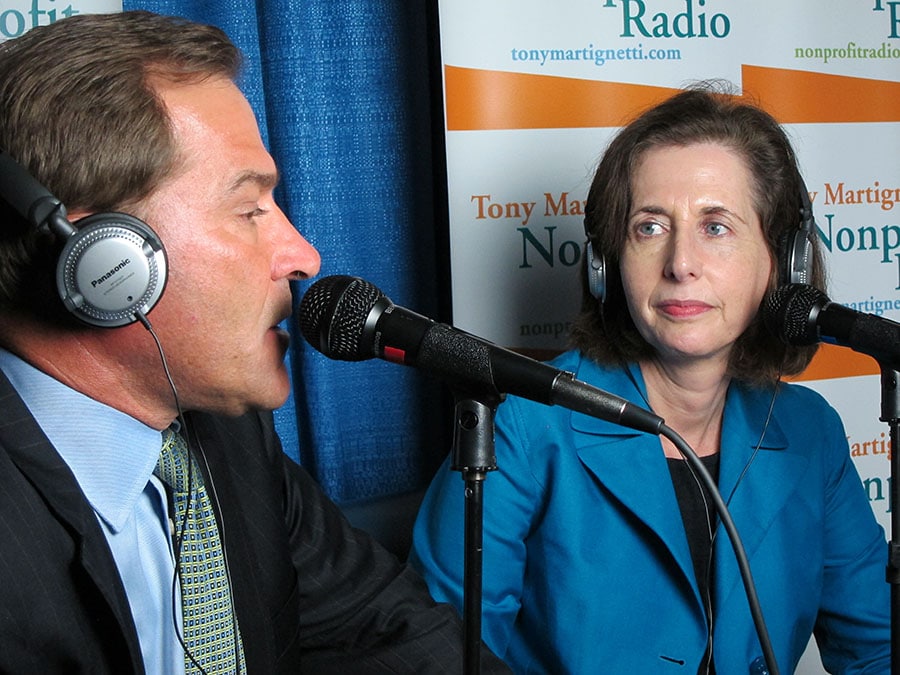
And welcome to Tony Martignetti Nonprofit Radio, big nonprofit ideas for the other 95%. I’m your aptly named host and the podfather of your favorite hebdominal podcast. Oh, I’m glad you’re with us. I’d suffer the effects of fuospiroketosis if you infected me with the idea that you missed this week’s show. Here’s our associate producer, Kate, with what’s up this week. Hey, Tony, here’s what’s going on. Nonprofit leadership with Stacy Palmer. The chief executive of the Chronicle of Philanthropy joins us with her thoughts on the challenges facing nonprofit leaders, especially females, and especially females of color. Stacey also reveals the bright spots in a recent leadership survey and promising opportunities around co-CEOs, sabbaticals, self-care, Tea, and humanity care. On Tony’s take 2. Hails from the gym. Mrs. Blood and soil revisited. Here is nonprofit leadership with Stacy Palmer. It’s a pleasure to welcome back Stacy Palmer to nonprofit Radio. Stacey is chief executive of the Chronicle of Philanthropy and led the organization’s transition to an independent nonprofit in 2023. She helped found the Chronicle in 1988 when it was started by the Chronicle of Higher Education. She was top editor of The Chronicle of Philanthropy from 1996 to 2023. Stacey is the host of Nonprofits now podcast. You’ll find her on LinkedIn and The Chronicle at philanthropy.com. Welcome back, Stacey. It’s good to see you. Delighted to be with you. Tell me about your new podcast, uh, nonprofits now. What are you talking about? How, how, how is it going? Well, I’m proud to join you in the world of podcasting, um, and it’s really fun to have these great conversations with leaders of all kinds and we really wanted to hear from leaders themselves rather than turning, you know, to people who like to lecture or talk about leadership, um, but talk to exceptional leaders about what they do, what makes them stand out, um, and we drew topics that we knew were of great importance to leaders, um, things like managing. Generational conflicts in the workplace, um, dealing with your board, dealing with finances, managing your executive team, all of the things that we all do all day, um, but as we were working on the podcast, we had a lot of turbulence in the nonprofit world as there were federal policy shifts and the economy is going up and down and who knows what’s happening. So we added in coverage to really cover that area as well, which wasn’t part of the original plan, but seemed incredibly essential to do. Uh, can you name a couple of your recent guests, subjects too? Yeah, so to talk about the economy and what people should do, um, we turn to Aisha Benson at the National Nonprofit Finance Fund. Um, and Mile Green, who’s at World Relief, and that’s one of the organizations that took a big cut when USIAD was suffering in the refugee resettlement program, and he talked about, you know, sort of what he did in his scenario planning that began well, well before Inauguration Day, um, and I should talked about all of the things that she’s seen nonprofits do that are really smart, um, and one of our other recent guests was Valerie Jarrett, head of the Obama Foundation. You know, who talked about how she builds a strong executive team and really, you know, got so much experience doing that when she was in the Obama White House and talked about, you know, how to keep people motivated, how to avoid that awful feeling sometimes that you’re not part of the team that you have, you know, um, and she really talked about inclusivity, diversity, how she chooses people on the team, make sure that they have a good fit. And one thing she said was, you know, anybody who says that their weakness. Is that, oh, there have been some places that just can’t handle all the talent that this person has, she said, they’re out the door right away, get rid of them. That’s not a good fit. Um, and having a sense of humor, super important, given all the work that we all do that’s so heavy, um, that we really all need to be able to be great colleagues to one another. She wants to make sure she can have a good dinner with you, not just get the work done. Yeah, I’ve always thought that’s, you know, I would have lunch with, have a beer with, yeah, yeah. I, I think, I think that’s a valuable insight to, to hiring and So congratulations on the, on the podcast. Hope it does well. It’s uh it’s available where all podcasts podcast. OK, it’s nonprofits now. Um, so we are focused on, uh, some nonprofit leadership issues that are top of mind for you and obviously you’re interviewing nonprofit leaders in in the nonprofits now podcast, so these are all top of mind and you’ve got some very recent anecdotes, uh, you know, cases to share. Um, but before that, the, uh, the Chronicle did a survey, or a study of leadership, and some of the, the numbers are, uh, not so. Not so uplifting. I would say, you know, in terms of job dissatisfaction, people leaving leadership, leaving the sector, not just leadership, leaving the sector, feeling overwhelmed, share some of the findings from that one of the things that is really clear is, you know, 96% of people love their jobs. I mean, CEOs are committed to their cause and the organization, so, you know, it’s not that they, you know, are dissatisfied with the work of trying to change the world, but they’re finding it unbearable to have these jobs in the way that they’re constructed. And so many of them are, you know, said that they would not be at their. organization they didn’t think in the next two years, and many of them were thinking about leaving the sector entirely and that brain drain is incredibly significant, especially at this moment when you know, we did the survey before all of the changes of the past few months, um, and you know, the fact that people were feeling so burned out, um, and so unable to continue and the sources come from A lot of reasons, people feeling that their boards weren’t helping them enough, um, that funders were not doing enough to support their work, that lack of multi-year general operating support really wears all CEOs down because they’re just chasing money all of the time feeling very insecure about things.draising demands 40% fundraising demands are a significant source of dissatisfaction in their job. Yeah, and just feeling like nobody’s there to help them along with that, um, and so, you know, I think board members could do so much to help the leaders of this organization. Foundations could do a lot too by changing some of the ways that they give money. I don’t know that they realize how much stress they’re putting on chief executives because I don’t think they would do it this way if they realize that some of their practices are driving great people out of the field. Now are you interviewing or uh plan to interview any uh well you mentioned Valerie Jarrett, the Obama Foundation. Are you calling to task uh foundation leaders? I mean, politely, of course, but are you, are you interviewing other foundation leaders, grant making? Yeah, in in the podcast, we didn’t do that because we wanted to focus squarely on nonprofit leadership and helping them along, but um. I take every opportunity I get to tell foundation executives that there’s a simple thing that they could do. It would be wonderful if they gave more and increased their payouts, but it would really be just as wonderful if they made sure that there was more multi-year general operating support. That’s really what it takes is giving that guarantee that, you know, the grant isn’t going to expire at the end of the year. It’s critical. Um, and, uh, particularly difficult leadership issues for women of color. Yes, yes, there was, there was a chronicle op ed piece, uh, it was January, I’m not sure when it was, but, um, you’ve, you’ve done some, you’ve done some reporting, uh, there’s been some reporting and you’ve got some, some, uh, some research as well. Women of color having a particularly difficult time in leadership. Yeah, and one of the guests we had on the podcast is Vanessa Daniel, who’s written a whole book that covers that topic. Now what she did was she interviewed 45 women of color who were successful, to say what made you successful, but what, while they had many victories and many wins. The challenges that they faced um were things that you don’t necessarily see other leaders in the sector facing. So, you know, one of the challenges often is that, you know, women of color often get picked to follow a leader who has not done a great job. And you know, so they come into a mess and they’re expected to fix it up and then it becomes something where they’re told that they’re the problem when they weren’t they inherited something that was very, very difficult. They have a board that doesn’t necessarily trust them or help them as much. Foundations once again sometimes do not want to give as generously until the person is more tested, um, and they do. Seem to have, you know, a higher standard, um, when it comes to looking at women of color, so that part can be very difficult and sometimes colleagues are not as welcoming as they ought to be, yet, women of color have done, have had some of the most amazing achievements, um, you know, certainly in social change that we’ve seen in this country. So one of Vanessa’s points is, you know, we should all be learning from them. Um, and so one of the things that she talks about is that women of color especially have 360 degree vision. They look at everything and they make sure that they’re bringing everybody along and their campaigns are never just, you know, single focus, but, you know, if they’re fighting for women, they’re fighting for people with disabilities, they’re fighting for all kinds of people all at once and they build movements much more effectively than other people do. Right, so the effectiveness is, is higher, at least equal or higher, but they’re under greater scrutiny, uh, and now, of course, with the, the, the talk from the regime about, you know, uh, disparaging anyone who’s not a, uh, a middle aged white male as a, as a DEI hire from helicopter pilot to, uh, you know, to, to, to soldier to, um, so you know, it’s even just brings either even greater scrutiny. To the, the population that’s doing better, but, uh, you know, finds, finds challenges, suffers challenges. Um, and I should correct myself too. I, you know, I, I said you have reporting. I mean, you know, I know you’re not the, I know you’re no longer the editor in chief of The Chronicle of Philanthropy. You’re the executive director of the Chronicle of Philanthropy.org, uh, uh, so, um, there’s a correction there. I don’t wanna step on Andrew. We had that, we had that show you and Andrew. I know. I just, it’s just natural for me to say you have reporting. You’re, you’re not doing the reporting, but the Chronicle still reports, you know, all right, um. Thank you for not, you, you didn’t, you didn’t call it out, but I’ll do it myself. Um, so yeah, you know, what was amazing is that you, what, what you led with that the job satisfaction is still so high. all this suffering and surprising factor to me because there’s so many things and we know. People are leaving, but you know, you ask these people and they say, I love my job. 9%, yeah, I love the job I’m doing. So the passion is there, but we’re, we’re killing folks, um, with constraints, with difficult funding models, uh, and now, of course, you know, all the funding cuts, if you, if you’re anything related to foreign aid. That’s very difficult. And then we’re seeing individual nonprofits and on the microcosm level, Harvard, Columbia, uh, Corporation for Public Broadcasting, National Public Radio. I mean, this, this microcosm. Attacks are, I, I think lead to, you know, potentially more. Exactly. I mean, when the administration is savaging nonprofits as being these bloated, inefficient organizations, it’s not just that we’re driving people out, who’s going to want to come and work for these organizations and especially the message that it sends to young people who might be considering careers and Nonprofit leadership, um, I, you know, obviously very idealistic generation that we have coming into the field, but they’re not going to find this in an attractive place when there’s so much denigration of their work and the future of federal funding is so insecure. So I’m very worried about the long term brain drain that we may have. It’s time for Tony’s Take two. Thank you, Kate. I’ve got another of my tales from the gym. We are revisiting Mrs. Blood and soil. Now. Her name is Val. Val, we know her as Val. Uh, she’s, uh, Mrs. Blood and Soil, you, uh, may recall, because the, my very first class in the gym, which was probably 2 years ago now or something like that, I, I wanted a spot in the class, uh, but it turned out to be her spot. But I had never been in a class, and I certainly had not been in that particular class, you know, they have many classes each week. And I didn’t know, of course, that that was her sacred spot. And uh she gave me some pushback. Well, I’ll just move my stuff. You know, Mrs. Blood and Soil, I, I didn’t know this was your space, uh, you know, so I moved aside and, and Mrs. Blood and Soil, uh, then, then named Mrs. Blood and Soil for that reason, uh, got her sacred space. Well, we since learned. That her, her name is Val, and she’s actually been quite nice. Had some very nice chats with her at the community center outside the classroom, talking about some classes, other classes that she takes that I do not partake of. I only take the one class a week. Uh, and she still has, she still does have her sacred space, uh, in that class. Um, so we just had some nice chats and she remembers my name, very thoughtful. Some people don’t, you can tell, you say hello to somebody, use their name. Hey, Kate. Oh hi. OK, you forgot my name. Uh, it’s obvious. No, that’s not true. Val remembers my name, very nice chats, very nice woman. That is not quite Tony’s take two because I must remind you that we are only 3 weeks away from show number 750, the 15th anniversary. This show launched in July of 2010 for Pete’s sake. 15th anniversary of nonprofit Radio. That is Tony’s take too. Kate Oh yeah, I forgot. Oh yeah, I supposed to give you a cue. Did you forget my name? Yeah, I just forgot your name associate producer. Tales from the gym, uh, the associate producer. Um, it’s great that you’re getting along with Val now. Yeah, we’re, uh, you know, I wouldn’t say we’re buddies, but uh we’re uh we’re uh we’re affiliate. We are, um. What’s that? Oh shit, there’s a word that I’m trying to think of, uh, acquaintances. That’s the word. That’s the word, acquaintances. Well, it’s better than spot stealer, so. Yeah, Mrs. Blood Soil, yeah, I’m not gonna say I was harsh when I called her Mrs. Blood and Soil because she was, you know, she was uh She was upset that she might not get her precious spot, you know, that week because this newcomer is interposing, interloping on my, my real estate, my 3 square feet that I must have for this class every single week. I thought that was kinda. Unkind to to be kind. It was, it was at least unkind. Mhm. Well, we’ve got Bou but loads more time. Now back to nonprofit leadership with Stacy Palmer. There are bright spots and there are opportunities for improvement. Talk about co-CEO, that’s very interesting. Yes, so that’s been a trend um that’s been developing in recent years where people decide that the job is just too hard and not sustainable, so having people share it, um, and often, you know, it will play to the strengths of various people. One person might be great at finance and fundraising and the other person might, you know, have a specialty in the program or the. and those kinds of things. Um, and usually you don’t find that in the same person anyway, so you know, somebody needs coaching usually in one part of that job. Um, and so some people have just decide to split it up. I interviewed people who at one organization that had 4 CEOs working together, um, which I found rather astonishing of how they make that work, um, but their organization had so many different kinds of programs. that they felt like they needed that and that they had enough strengths that way, and that kept them from burning out um and allowed them to balance work and family and all kinds of things. So that made them much happier. So this idea is becoming more popular. I see it also intergenerationally where sometimes um a CEO toward the end of his or her career, you know, brings in somebody who’s in their 30s or 40s and you know, grooms them. And then eventually the plan is that, you know, either they’ll decide to stay as co-CEOs and have a, you know, that relationship or it might be that it’s time for just to have the one CEO model, but that idea of using it as hands on mentorship is also really popular and I think a very smart idea. Yeah, that sounds brilliant for succession planning. CEOs for for for a period of years. I mean, there’s just no, there’s just no better. The job training. Yeah, but I did have one person who, you know, is doing that, who said before he got to the point of finding his co-CEO was turned down by several people on his staff who looked at his job and said, I would never want to do what you’re doing. So, you know, that’s the other problem that we have is that people who are in our see what the CEO is going through and I don’t want to have any part of it. Well, the CEO that’s for an organization that’s willing, I guess for a board that’s willing to take on that, but in terms of work, so it seems like a sensible way to make the more the CEO job more palatable, more appealing. Uh, you know, if we’re saying, as you said, you know, fundraising might be one person’s, 11 co-CEO’s strength, but not the others. So, you know, so fundraising is a significant source of dissatisfaction for a lot of CEOs, well, we can, we can make that easier by by having someone, uh, co-CEO co-lead who has that strength and then someone else maybe has more administrative strength or as you said, program or. You know, wherever community support, community liaison, whatever, whatever is essential for the, for this, the nonprofit to thrive, um, and then it also serves a diversity, uh, concern, you know, we can, we can have we can open up our CEO role to, I don’t, I don’t know about 4, I think 4 says that they make it work, but that’s yeah, they do that’s an outlier, about 2, maybe 3, but certainly 2, all these purposes get served, so that, that, that was very interesting, um. There’s also sabbaticals. These are becoming increasingly common. I know, I, I have a friend who’s a professor, and he came from the private sector every 5 years. He gets a 6 or 8 month sabbatical. It’s, he loves it. It’s remarkable. He travels, he comes back refreshed to the university. Talk about that, that, that trend in uh in our community. Yeah, so the idea of the sabbatical for nonprofits has been there for, you know, probably a couple of decades, but they don’t get as much support from foundations um or other donors as they could, so not every organization can afford to do that. um, but you know, certainly the people who have gone on these sabbaticals, um, their whole approach to leadership is often trans. For because they got a break to do something, you know, sometimes people travel, rest, do those kinds of things. Other people, you know, develop an idea for a new organization or think of new approaches to how they’re doing what they do. It gives them room to experiment, to think about things that they’re doing and the plus for the organization is that, you know, you can test out some people who are potential leaders. It’s another form of succession. Planning in some cases because often you have, you know, the person you think is a potential leader, you know, taking that while the CEO might be on a break, um, and so you can test that out or you can try an interim or some other approach to leadership, but you know it works both for refreshing and renewing the person on the sabbatical, but it has real advantages for the organization itself too. Again, yeah, the succession planning. Um, are you, are you finding nonprofits are investing in succession planning and, and not just for the CEO, but, you know, and there could be a chief development officers. Yeah, are we, are we spending enough time planning this and especially now with all of the crises that nonprofits have, I mean, one of the things um on the, among the podcast guests I interviewed, um, Baron Seger at World Food Program. Talk to me about how he’s really grooming his leadership team. He wants to get out to see donors much, much more. He feels like that’s absolutely essential for a leader to do in this moment because there’s so much competition for funding, um, but you know, he had to build his team first to be able to take over those kinds of things, and that is a form of succession planning of saying I’m going to be out of the office and away for a while, um, you take this over and you know, making sure that, you know, he’s Giving them guidance, but letting them make a lot of the key decisions, learn how to work together and we all need to find ways to do that, even if it’s not under the guise of succession planning but of dealing with this moment, we need to be able to give people a chance for new skills and invest in them. But I would say nonprofits have never been great at spending time on this topic just because it seems far away and with the worries of the current moment, I don’t think that that’s improving. Yeah. All right. Well, we need to focus as, as much as we’re saying, you know, sometimes I feel bad about making, uh, having shows and guests to talk about. You know, nonprofit leadership because I know how burdened they are and I feel like we’re, I’m just adding to their task right now add succession planning, which is not a, not gonna be a 5 minute or even 5 week process, you know, but to the extent we can, you know, think about your succession planning for all your, for all your key positions. And there’s also value in the, the folks who, who are, um, would be included in those plans, you know, they. See, they see opportunity. They want to see career growth and we don’t want to see people fleeing our organizations because they don’t think there is any possibility, you know, so that career pathing and really thinking about those kinds of things, and I think we all know that, you know, sort of I’m a boomer, younger generations are demanding it. We cannot take for granted the idea that they see a growth path at our organizations. We really have to demonstrate it to them. Yeah, that’s the, you know, it’s, you’ve been here for years, decades. OK, Boomer, it’s time to go. Um, I think that guest that you had, uh, Byron, I think you said his name, Food Program. I think he’s spot on about fundraising. I, I’ve always thought like 30 to 40% of a CEO’s time. I should be devoted to fundraising. I’ve worked with clients where the the chief development officer has chunks of the CEO’s calendar, you know, a week at a time and, and schedules either travel or people coming in, you know, whatever, but given big blocks of the CEO’s time to. To, to devote to, to meeting the important funders, individual and institutional, and maybe community, you know, government, whatever. I’ve always thought it to be minimum 30, 30% of a CEO’s time is devoted there, so I, I think he’s spot on. Um, as much as fundraising is a challenge for leaders, what did you say? 40% find it, uh, uh, a significant source of dissatisfaction. Uh, again, all right, CEOs, maybe your co-CEO can take that can take that time off you. But also what you know, I heard from some of the people I interviewed was, you know, board members can make such a big difference. I don’t know that they realize how much just their willingness to introduce all of us to people who have funding. We can carry the rest of it, but sometimes we can’t get in the door, um, and often our board members can’t. And can be really helpful. We need to ask them, but it would be wonderful too if board members would say, you know, here are some of the people that I know and I’m giving you access to my network. So, you know, that would relieve the CEO of some of the burden of the fundraising because because, you know, sometimes you can just spend a long time just trying to get an appointment with somebody. Yeah, yeah, and a board member can cut through that. Um, yeah, that’s a, that’s a whole other topic, you know, board. Having a savvy fundraising board or or even just half savvy, you know, and but you know, the, the, the stereotype is that I’m gonna have to ask people for money, ask my friends for money, and I don’t want to do that. But there’s so many things that board members can do that are not direct solicitation. It is not a direct ask. Just you just help me get there. yeah, help me get help us get to the stage of solicitation, but make the introduction. Bring your networks, maybe host something in your home, you know, a bunch of couples, you know, but we’ll do the lift, but we need the introduction. We need the entree. So, you know, there, there’s, yeah, we, I think that’s something else, and here we are adding to the CEO’s to do list, you know, but in terms of bringing the board along in fundraising. Recognizing that it’s not strictly asking for money. I mean, if, if there are board members who are willing to do solicitations, that’s fantastic because they’re, they’re chief investors in the, at least in time and hopefully in dollars in the, in the organization that’s outstanding, but there’s a lot you can do the boards can do beyond direct asks so engage, you know, engage them. Um, So what are you hearing from your guests about how they uh recharge aside from sabbaticals, you know, what are folks to maintain a balance and a healthy lifestyle? You know, it’s a great question and we decided that at the end of the podcast we that would be our standing question. Um, which would be to always ask them how they recharge and a lot of standard things that you would expect, you know, people, you know, definitely want to make sure they have regular exercise connection with family, um, and making sure that, you know, they do balance things that they don’t work themselves to death. They’re very, everyone. who we talked to was very conscious of it. Valerie Jarrett’s answer was, of course, some of those things she said she watched television shows she wouldn’t tell me about um because they were too stupid to be able to reveal, um, but she was willing to say that. But you know, she also said how she recharges and this feels to me so symbolic of people who go into nonprofit work especially. That, you know, some of those basic kindnesses that you do, you know, you’re walking down the street and somebody needs a little bit of help, you’re in the supermarket and you know, you help somebody do something. All of those things, you know, where we just reach out to other people, not formally in any kind of way, but we connect with other people and just how good it makes you feel to build that into, you know, taking time out and not, you know, looking at our phone and obsessing about what the next thing on our to do list is, but reaching out in Some way to help other people who do not have access to what we have, um, is, is genuinely the kind of thing that, you know, I think for a lot of people in this field is replenishment as well. Um and then we had one guest who said um that he is a swimmer and he was planning to take his board on a swim in the Bosphorus because he’s Australian and he was like just willing to go out there. And do the rough swims and I thought, OK, I’m not, I am a swimmer too, but I swim in regular pools, so that’s my way of recharging. Is that a high powered river in Australia, the Bosphorus? I think it’s actually someplace else. I’ll need to look it up but it was the site, but it is not an easy place to go swimming, it’s not a pool. OK, well, the high adventure, um, you know, get some adrenaline flowing, zip lining or something, you know, similar. Everything that people said to was like, they do try to take all their vacation and make sure that they demonstrate to staff that they’re doing that and also again, you know, the opportunity that this gives to other people to take on leadership jobs and also to just show that, you know, you are not irreplaceable, you know, somebody else can take over these pieces. It’s not just for the restoration, but it’s again like the sabbatical where it gives other people opportunities to do things. And it also does set a culture, you know, that I, I, the CEO takes, takes her time off. Uh, the CEO is not in the office till 8 o’clock, you know, it’s not always the last person to leave, so that I don’t feel that I have to be seen or I can’t be seen departing, you know, by the, by the leadership or something like that, um. I also love the uh the idea of just random acts of kindness, you know, like reaching something in a supermarket, you know, I don’t know, whatever, whatever it is on a plane, you know, board, uh, just, just civility, know, just common civility day to day, um, it is, it’s, it’s, it’s uplifting and it’s also just sharing, uh. Uh, sharing a love of people, you know, you’re just sharing your humanity. That’s what it’s better, I think. Um, anything else, any other like recharging? I love that you’re asking that as a standard question at the end of every show. That’s, I have to say what I’ve loved is that people are really ready with their answers, you know, some people do journaling um to make sure that they’re really capturing and the founder of an organization um that works with first generation college students says she really especially likes to ground herself. She herself was a first generation college student and she, you know, she talks, you know, in the journal regularly about like why she’s doing this work and why it’s important to her for her family and thinking about all of the things that matter to her, and it just grounds her in thinking about what she’s going to do all day. That’s an excellent example of just doing what rejuvenates you, whether it’s journaling or swimming, walking, reading, you know, whatever it is. Shooting, whatever it is that is, is up to you, uh, shooting targets. I was thinking of target shooting, yeah, um. Uh, yeah, you know, we have to, we have to, we do have to take care of ourselves. We do have to indulge ourselves appropriately and it’s not just like, you know, wedge, wedge it in when you can. It’s being intentional. I think that applies to everyone, not just, not just leaders, but you know, being, we have to be intentional about taking care of ourselves. We’ve had, uh, I’ve had Miko Marquette Whitlock on a few times, he talks about your meds, your um. Uh, mindset, uh, exercise, diet, and sleep, you know, minding your meds and not just making it something that you think of occasionally or you squeeze in, but being intentional about these things. Yeah, and one of the things that Vanessa Daniel talked about and she was writing especially about, you know, the challenges that black women face because they feel that they are held to such a high standard that they can’t ever stop. um, and you know, she had a health problem. Other people have had health issues because they were working themselves really almost, you know, to the bone and and having challenges is that as colleagues or board members or other people, we have to step in when we see that people are working so hard and say, can I take this off your plate? What can I do for you? Um, and so we all have a responsibility to one another to help. each other do it because if it’s the stress that, oh my goodness, this thing won’t get done that’s incredibly urgent and I’ll be letting down a funder or letting down a board member or doing something like that, we have to be able to help one another out. And so, you know, all of us who are listening to this podcast should be thinking about like, do I see signs of burnout or health issues or something among one of my peers, my boss, whoever, help them out. And you know it’s not only the, the, the that person’s health, but they may be health, they may be um caregivers or someone else, it could be a parent, it could be a sibling. Uh spouse, of course, you know, are we, are we seeing that? I mean, that’s, that’s a huge thing. I, you know, on my own staff, um, just unfortunately, we’ve seen a number of my staff members have had ailing parents in the past few months and all of them have needed extra time to be able to spend time helping with them. um, and you know, it’s not just the time off, but it’s the stress that they’re feeling about their parents. That are not in good shape. So, you know, it’s very visible. We’re all welcoming and talking about the children um of our employees and you know, celebrating the 5 year olds graduating from kindergarten, um, and that’s wonderful too, but we also have to think about those other sides. Yeah, and, and, you know, it’s, it’s not so apparent, you know, if, if it’s the, if it’s the employee themselves that has suffered an injury or an illness, you know, it may manifest itself. But, but just someone saying Uh, you know, my, my, my dad had a stroke and he lives close and I’m the, you know, I’m the, I’m the closest child. That’s, that’s, that’s all you might hear, but that’s enormous. It’s not gonna, you know, it’s not gonna bear on the, it’s not gonna be obvious, physically obvious, but, but that in itself, that sentence means, you know, we need to, we need to talk about time off, adjusting responsibilities, because otherwise the person is just gonna hold it in. Yes, yes, most likely. All right, all right. I guess we’re talking about humanity, you know, I mean, be humane to yourself, humane to others, uh, whether they work for you or they’re strangers, uh, in a supermarket or an airplane, you know, where humanity, all right, um. You see some bright spots in uh foundation leadership uh being more welcoming to women. Much more so. Yeah. Yeah, no, there’s been a very dramatic change um at a number of foundations um and you know, these are some of the trends that we see because of demographics, a lot of um foundation leaders were of an age to retire, so we’ve seen a lot of change happening um at foundations and you know, Many, many of the biggest foundations and you know, family foundations, other sizes, they have turned to younger leaders, often leaders of color um and people who have been in the nonprofit world. It used to be, you know, maybe you are a college president and you became, you know, the head of a foundation or, you know, you were some high powered business executive, but now these are people. Who have run nonprofits who know what it takes and you know if there’s anything that gives me hope that some of these foundation practices that wear um nonprofits out that it is going to change, it’s the fact that more people who hold these jobs of giving away money have also really spent a lot of time in the position of seeking money and that’s always helpful. Those folks understand what it takes, um, and they think differently about things. What, what else would you like to talk about nonprofit leadership wise? I, I’m an obnoxious, you know, I drove the conversation what we talked about or what would you like to flesh out more? Yeah, you know, I think obviously one of the things that I keep asking people is, you know, can we use the same playbooks that we used in COVID, um, maybe those of us who are here during the Great Recession, you know, how are those lessons. Still the most meaningful ones and so at least can we, you know, when we face all these challenges, can we turn to history and say what is it that works? Um, and I would say most people say yes, but this is a different moment, especially because so many nonprofits face legal issues and challenges to The work that they’re doing. And so, you know, now in addition to worrying about, you know, funding challenges or you know, in COVID, trying to think about how you moved everything online and you know, had remote workplaces, um, now, you know, you really just need to have your lawyer on speed dial and you need to be looking carefully at what you’re saying and doing. But at the same time, not buying into things that aren’t true. Unfortunately, I find some people in the nonprofit world think every time somebody declares, you know, oh, I’m going to yank the tax exempt status of Harvard, for example, well, it’s really hard to do that. Yes, it’s worrisome, um, and it’s not a good standard, but it would take an incredible effort because of all the laws that are in place. The president is not allowed to tell the IRS. To go yank tax status of somebody and yet these rumors keep coming about. um, so understanding sort of how the law works and that there is so much more flexibility and certainly one of the things that has, you know, I, I’ve watched in awe is Diane Yentl at the National Council of Nonprofits and how she’s been using the law on behalf of nonprofits, you know. Ready to sue the Trump administration as soon as federal funds for nonprofits were cut off. And you know, that is unusual for a nonprofit to be that courageous and willing to just take that on and continuing to do that. So, you know, those are absolutely, you know, the glimmers of hope that I see, but that whole kind of legal dimension is something that I think is really quite different. Uh, did you see Diane Yentl’s testimony before the congressional Committee on Government efficiency, uh, yeah. Talking about courageous. I mean, she was lambasted and and personal attacks that she suffered and you know, she absolutely has been a target for that. The other thing that I think that ran across the interviews, you know, I’ve done on this is just this feeling that nonprofit leaders don’t need to go it alone and shouldn’t try to go it alone. This is a moment to really reach out to other leaders who may have advice, who you may want to collaborate with, who you might want to advocate with, um, and that, you know, it really is essential for us all to find ways to work together because it’s easy when you know your organization is in trouble, struggling to just talk to your staff, your board and not necessarily get out and talk to others, but it’s We’re stronger when we work together, we get great ideas um and this sector needs in some ways to be more collaborative um in times of crisis because that’s not usually, you know, the strength that nonprofits have only because it’s so hard to get everything done, but really reaching out to others is crucial. Are there of CEOs. Or maybe other C-suite, you know, that, uh, like, you know, just er er I think a lot of people’s pony’s got a dog in this race that I’m suffering with groups like that? Yeah, you know, but I think that some people are basically sort of founding them themselves and you know. Networks of, you know, 3 to 6 CEOs that they have met, you know, and they meet regularly to talk about, you know, the issues that are on their minds, um, and you know, often it’s geographic, um, you know, because we can at least go have coffee or breakfast together, um, but then sometimes by cause, you know, you certainly can do this kind of thing on Zoom, but being intentional about it and then You know, I found, well, a lot of people like to do that with their nonprofit peers. Others also suggest, you know, just, you know, we learned so much from people who run other kinds of organizations, so whether they’re in business or government or whatever, um, you know, to be able to get lessons from lots of different people. Yeah, peers, peers especially, you know, the the other leaders understand. And you’re the problem you’re facing is very likely, not never, is likely never. It is likely unique. Exactly we all maybe feel it that way that moment of oh my goodness, this is incredible, and you know then you talk to somebody else and they’re like, yeah, I dealt with that 10 years ago. He’s what to do. Um, what would you like to leave us with? Um, I think, you know, I’m so glad that you asked me to talk about these issues. We need to be more open about the challenges that nonprofit leaders face and we need to find ways to support them, and I think all of us need to talk about it. I talked about foundations, you know, changing their ways, but big donors can also make a difference. We all know that individuals, you know, are responsible for most of the giving in this country, um. Helping them understand that the nonprofits that they count on, especially in these moments where we may lose government support for any programs, we’re gonna need nonprofits more than ever, um, and we need to be able to support the leaders who are running these organizations, make sure they have professional development, um, make sure that they have training opportunities, make sure that they do have opportunities for sabbaticals and those kinds of things. Um, so finding a way to get the message. out that this is a profession and it’s one that needs to be supported, not something where people are just volunteering their time. It’s not like, you know, just and volunteers are incredibly important, but that’s not what these are professional jobs, enormous responsibility and if they don’t do what we’re all counting on them to do, our communities will be so much poorer and so trying to help the donor world. at large understand that importance of leadership feels really critical to me. So anybody who has ideas about how we can spread that message, and I am eager to do that because I do talk to donors who often are very, very eager to support, you know, the arts or social services or health or those kinds of things, and they’re rarely are they thinking about the people who make those things happen, and we need them to do that more. You’re the, uh, you’re the apt host for uh for nonprofits now because you’re, you’re talking all about nonprofit leadership with nonprofit leaders. uh, Stacy Palmer, chief executive of the Chronicle of Philanthropy and host of the podcast Nonprofits now. Thank you, Stacy. It’s good to see you. Thank you, delight to talk to you. Pleasure. Next week, our 25 NTC coverage continues with we’ve been hacked and smart data storage. Yeah, you said that last week. Uh, no, but it, I got this uh Stacy Palmer interview. She’s a, she’s a big deal uh in nonprofit circles in our community, so I wanted to, wanted to get this one in. So, but next week, Uh, for sure. What you just said, we’ve been hacked, uh, and smarts data storage. I, I, Boy Scout promise. If you missed any part of this week’s show, I beseech you to find it at Tony Martignetti.com. Our creative producer is Claire Meyerhoff. I’m your associate producer Kate Martignetti. The show social media is by Susan Chavez. Mark Silverman is our web guy, and this music is by Scott Stein. Thank you for that affirmation, Scotty. Be with us next week for nonprofit radio. Big nonprofit ideas for the other 95%. Go out and be great.
Stacy Palmer & Andrew Simon: The Chronicle of Philanthropy Leaders
Stacy Palmer is CEO of the now nonprofit newspaper, and the editor-in-chief is Andrew Simon. We talk about the transition from privately held to 501(c)(3); their plans for growth; the mission, values and priorities guiding them; new content that’s coming; improving mass media’s coverage of our community; the presidential election; potential threats to the sector; and a good deal more.
Donorbox: Powerful fundraising features made refreshingly easy.
We’re the #1 Podcast for Nonprofits, With 13,000+ Weekly Listeners
Board relations. Fundraising. Volunteer management. Prospect research. Legal compliance. Accounting. Finance. Investments. Donor relations. Public relations. Marketing. Technology. Social media.
Every nonprofit struggles with these issues. Big nonprofits hire experts. The other 95% listen to Tony Martignetti Nonprofit Radio. Trusted experts and leading thinkers join me each week to tackle the tough issues. If you have big dreams but a small budget, you have a home at Tony Martignetti Nonprofit Radio. View Full Transcript
And welcome to Tony Martignetti nonprofit radio. Big nonprofit ideas for the other 95%. I’m your aptly named host and the pod father of your favorite abdominal podcast. Oh, I’m glad you’re with us. I’d be stricken with pika if you made me swallow the idea that you missed this week’s show. Here’s our associate producer, Kate with the highlights. Hey, Tony, here’s what’s up the chronicle of philanthropy leaders. Stacy Palmer is CEO of the now nonprofit newspaper and the editor in chief is Andrew Simon. We talk about the transition from privately held to 501 C three. Their plans for growth, the mission values and priorities, guiding them new content that’s coming, improving mass media’s coverage of our community, potential threats to the sector and a good deal. More on Tony’s take two with a lackluster host. You get a late holiday wish were sponsored by donor box, outdated donation forms, blocking your supporters, generosity, donor box, fast, flexible and friendly fundraising forms for your nonprofit donor box.org. Here is the chronicle of philanthropy leaders. It’s a pleasure to welcome this week’s guests, Stacy Palmer is CEO of the chronicle of philanthropy. Andrew Simon. Is editor in chief of the chronicle of philanthropy. You’ll find them both on linkedin Stacy Andrew. Welcome to Nonprofit Radio. Thanks for inviting us. Thank you for having us, Tony. Absolute absolute pleasure. Um Stacy, I’d like to start with you. It’s been about 2.5 years. It was June of 2022. We last talked. Uh You had, you were making the transition or had made the transition from privately held company to nonprofit status. I, you were awaiting the IRS approval of the nonprofit status. That was June of 2022. Uh I know you’ve gotten that bring us up to date on the Chronicle of philanthropy as a nonprofit. Yeah. So we’ve been operating for 18 months as a nonprofit and every day we learn something new about what it takes to build an organization. And so I feel much closer to all of our readers and all of the challenges that they face, which I knew would happen as we sort of made this transition. But, you know, we’ve gotten through our first audit, we’re doing our 990 we’re doing all of those kinds of things and we’re really trying to figure out how do we re invent ourselves so that the Chronicle of philanthropy will be something that serves our audiences really well for decades to come. Uh What have you uh especially learned as a, as a CEO of a nonprofit. Go, go a little dive a little deeper into what it’s been, how much closer you feel to the audience now. Yeah. You know, I mean, I’m now actively doing fundraising. I’m working with a board, you know, all of the things that people would tell me, this is a challenge I face. This is something that’s wonderful. This is something that’s difficult. Now, I feel it viscerally every single day. Um, the biggest for us has been technology and how to make sure that we have systems that really help us, you know, show the audience, you know, all the things that they want. We have legacy systems. I think every nonprofit is facing those kinds of problems. Um And we need to make sure that we move as quickly as we can into new ways of serving our audiences. And that part, it’s just taken longer than I would have expected it to just because it’s complicated and it’s expensive. And so you need to figure out ways to do. But, you know, I think the really fun part for us is we often are asking ourselves, how do we think about serving the audience? What do they need without having to worry as much about, you know, what our for profit owners were thinking about and they were very generous and very wonderful, but they definitely needed to make sure we were making a profit. Now, we think about how do we plow that into more services to better serve non profits? That’s extremely freeing and that’s the part of the nonprofit world that I love. So it sounds like uh described as your program work you finding takes longer than you expected. Uh It’s costly, there’s fundraising against it. OK. Uh And you’ve described this as AAA period of transformation and growth. And uh how does, how does uh having hired uh Andrew as editor in chief fit with that? It absolutely enables it. Um Because he brings skills and perspectives that our newsroom didn’t have before. Um So why don’t we let him talk a little bit about his background so that you can all know what he brings to the chronicle of philanthropy? Ok. Let’s do it that way. I was going to actually ask you why did you hire Andrew Simon? But I’ll let him do it in the next Andrew Simon. Why do you believe you were hired? What, what, what, what have you brought? Well, you know, um in some of the early conversations with Stacy, we both talked about how the Chronicle can really serve audience by helping leaders see around the corner, right? Understanding the trends, understanding what’s happening now, philanthropy in the nonprofit world, but making sense of it and really helping to guide readers a little bit with our journalism and our reporting about um what to expect next. And in previous roles, I’ve been fascinated with this idea of how can we help readers and leaders see the future? I at a previous job. I was at a business consulting company. We’re uh doing stories on climate solutions. I, previous to that, I worked at gris.org, a nonprofit news site devoted to climate, climate solutions, climate justice and in both of those roles, it was similar, it was sort of making sense of the news now. And how does that help guide leaders in their decision making going forward? So I think Stacy and I were kind of uh excited about the prospect of doing more of that. The chronicle has certainly done that for years. But the idea of doing more of that and coming into this role is what really excited me. Well, what are some of the trends that you’re looking at? Uh We just, I mean, we just had a presidential election. I mean, that’s a, that’s a, that’s a wide open question. Uh But take, take it where you go and take it where you like. And, uh you know, we’ll, we’ll, we’ll drill down some, I see the post election world on a, on a few levels. There’s certainly helping leaders navigate the changes to tax policy and regulation. There are certainly the missions of many nonprofits um that could be under threat. So there’s that level, I, I also think there’s a, a hovering over all this is just uncertainty, really an unpredicted, potentially unpredictable time for leaders, whether you’re on the grant making side, whether you’re a nonprofit leader, whether you’re a fundraiser. And I’m wondering how we can help our leaders and readers navigate this uncertainty, right? So I feel like there’s uncertainty hovering over all of this, right? So you can raise questions about, well, will this mission be affected? What are the ramification of these tax policies regulation changes? Which is very important? But then how do you navigate the uncertainty going forward? The the chronicle has an interesting role I do. Is it fair to say that it, it’s an advocate for the nonprofit sector community or, or is it, is that, is that inappropriate? And it, it needs to remain neutral about it? It’s, it’s primary readership. Yeah, it’s a great question. And, you know, obviously we believe nonprofits are incredibly important to society or else we wouldn’t be in this business of covering and serving them and helping them do better. But we also raise questions when they’re not doing the kinds of things that society depends on them to do. So, you know, I, somebody once described us as the good friend who tells you when your slip is showing and it’s an awkward expression. But it’s sort of the right way to say, you know, I think, you know, it’s important to say that we care deeply about this sector. We think it’s horribly undercovered. We think that that’s one of the reasons it’s not as effective as it should be. We think people are terribly fragmented and it’s our role to connect people. Um You did an interesting blog post or talking about the fact that everyone needs to come together as a sector in this time when there are really big challenges. And, you know, we see already some of the things going on on Capitol Hill where there’s legislation, you know, that a lot of nonprofits are allied against those kinds of things where people need to come together and defend the rights of nonprofits to free speech and advocacy and those kinds of things. It’s really important for them to see themselves in, you know, the pages of our article so that they all know what’s happening. Some will agree, some will disagree, but at least they should be connected to each other to fact based information. So that’s what we’re trying to do. And I think another thing that we’re thinking a lot about um is how do we fix some of the systems that are broken about the nonprofit world. Um I will say that, you know, there’s been frustration forever about lack of operating support, lack of multi year grants. So we saw some of in the pandemic, we saw some changes there, but it seems like there’s a slide back on the very things nonprofits need. So in those kinds of ways, choosing that we’re going to talk about those things, you might consider that advocacy. But we think it’s just important for us to put a spotlight on things that otherwise wouldn’t get the attention. Like, like your slip is showing. Ok. Um, what about the, the mass media coverage? Um, I, I don’t know who’s better to answer this, but you have, you, have, you had at least maybe still do a fellowship program, training other journalists outside the community that, you know, we don’t exist only when there’s, uh, uh, uh, a $500 million fraud foisted on the people by a Veterans Affairs agency. You know, where do we stand on helping mass media better coverage better cover the sector? That’s a really important part of our mission. So every year we take on four newsrooms that we work with intensively over the year, we partner with people in our newsroom who can help them do an excellent job of learning how to cover the field. And we’re really trying to help them focus on, you know, who are the nonprofits and foundations that are serving their communities, what are they doing, what’s happening, what would happen if they disappeared? Um And to really better understand that. So, you know, to be sure some of the fellows we’ve done have found some fraud and abuse in their communities and they’ve reported on that, but we encourage them to look more deeply about what’s going on. Um And to show that, you know, one out of every 11 Americans works for a nonprofit that means that people who are reading their content listening um to them, if it’s, you know, on broadcast networks, you know, those are the kinds of folks that, you know, really want to understand how nonprofits work with the threat, sorry to them, what the opportunities are. Um And we should cover it just like we cover business or any other sector. So we try to argue that we would love to expand this program. So one of the things we hope as a nonprofit that we can do is draw ever more attention in this time when local journalism is suffering a great way to attract audiences is to cover nonprofits. That’s what readers and listeners and viewers all want to know about is who’s solving problems in their communities. And it’s the nonprofits Andrew then are these fellows working with you uh uh on the editorial side? Right. Well, they’re editor of fellows. So they, they certainly work in their respective newsrooms throughout the country. But what we do is our editors and writers will work with them, mentor them, review their stories, help them bring larger concepts to life. And then we also, as a matter of fact, I think we have one of these sessions today. I’m not mistaken as we record to where we’ll, we’ll have um we’ll share our expertise in a kind of learning session where we’ll, you know, share tips on investigative reporting or collecting data sets. Um and hopefully help guide the fellows in those types of ways I see. All right. So they, they remain in their, in their respective newsrooms Yeah. Ok. Ok. Um Yeah, data, I mean, there’s a, there’s a trove of data about the nonprofit sector that I, I think doesn’t get the attention that uh that, that folks, that journalists need to know uh about what’s out there, what the government collects, what, what some of the agencies collect. Yeah. So one of the fellows is actually working on a project to try to figure out where the most charitable cities are, which is a vexing thing to do. We’ve done those kinds of projects too, but the data is not ideal for being able to ask those questions. But we’re really trying to figure out what makes certain stand out. Why is there more philanthropy in them? And then on the flip side, why are there the philanthropy deserts? Um and what can be done about that? So, you know, that’s one of the ways that we’re training them to use data. And of course, we do the very basics like making sure everybody can, you know, glean information from the nine nineties, you know, make sure they really understand how to read them those very basic things. It’s time for a break. Imagine a fundraising partner that not only helps you raise more money but also supports you in retaining your donors, a partner that helps you raise funds, both online and on location. So you can grow your impact faster. That’s donor box, a comprehensive suite of tools, services and resources that gives fundraisers, just like you a custom solution to tackle your unique challenges, helping you achieve the growth and sustainability, your organization needs, helping you help others visit donor box.org to learn more. Now, back to the chronicle of philanthropy leaders, Andrew. I’d like to pull on the thread a little more about uh the uh the presidential election project 2025. I mean, there are, there are some nonprofits that are specifically named in the document like uh the like uh national Public Radio, uh public Broadcasting system PBS, you know, named, called out to be defunded. Um That Planned Parenthood should have its, um, it’s, it’s Medicaid funding withdrawn as long as they’re providing abortion care. Uh What, you know, what’s the, what’s the role of the Chronicle in, in making this clear? I don’t know, uh you know, playing the role of the good friend, but, you know, seeing that the, the, some of the, some of the, some of the good friends are uh, are under like explicit threat. Where, where is the Chronicle fit there? Sure. Well, it, it goes a little bit back to this theme of uncertainty and it’s not to say that some of these threats shouldn’t be taken seriously, aren’t real. But again, hard to know if and when some of these changes would happen, I think our role is to try to identify the ways in which nonprofits can stay financially healthy and stable. Again, through, through tough times, you know, it’s why we have multiple reporters dedicated to fundraising. It’s why we have uh multiple writers talking about leadership and, and navigating, you know, hard decisions um in volatile times like this, you know, not to say that is, um this is not perfectly analogous, but certainly there was uh COVID-19, you know, not that, that many years ago. And this was before I got to the Chronicle, but this was the newsroom coming together with our nonprofit intelligence team, which I know that’s a wonky title. But you know, that’s our uh unit that’s really devoted to um you know, helping uh leaders in, in a professional development capacity. So, you know, the team just got together and tried to again, help figure out, ok, under these um unprecedented, really challenging times, what should fundraisers consider, how do leaders navigate and lead their organization? What does the remote place uh workplace look like? So there will be certainly new challenges in this era. And again, it’s not to say that the next era is exactly like the Coronavirus era and yet these could be challenging volatile times. And I think there are certain themes that we can cover that should be able to apply to most nonprofits. Not all, one of my big reflections of this role so far is the variation in size and scope and mission of nonprofits is so vast that we, we do, we are thoughtful and need to continue to be thoughtful about not offering one size all fit solutions that we do need to gear our coverage um around just, you know, as best we can on that huge variation of nonprofits. But nonetheless, we are looking for trends and things that again, we think should be of interest to at least the majority of the readership. Do we have? Uh I’m saying we, I’m a, I’m a, I’m a member of the Chronicle philanthropy. Uh Is there a Washington DC reporter? Are we able to cover what’s, you know, what’s happening around, you know, discussions around the, the, the sector in, in Washington, you know, we started off being based here. Um And so for many, many years when we were under the Chronicle of higher Education, all the reporters worked from the Washington DC area. Um we had a couple that, you know, were able to be in other places, but for the most part, we were all here. So we start with a really strong base of covering Washington. I will say though that there was a point where I had a lot of the reporters focused on Capitol Hill and the White House, the IRS doing all those kinds of things. Um And so there would be different people assigned to all of those things, but as the federal government sort of pulled back on doing very much that was interesting um for nonprofits writ large, some of, and I would assign the best reporters to those tweets and they would come up to me and say there’s not enough to cover. Can I please have something else to cover in addition to covering what’s going on in terms of policy? So, we’re, you know, in one of those pendulum shifts now where we’re going back to the people who had the expertise in covering it. But, and I think now we’re really, you know, given some of the things that, um, you know, the Trump administration that JD Vance has said about, you know, where nonprofits are going to be, you know, in the sights of possible legislation. We’re in a heavy period and I’m thrilled that we have expertise that people cultivated long ago. Um, but it really does come sort of in and out and I think where we also need to pay a lot of attention to is, you know, state and local politics is going to become even more important and that’s an area where, because we’re small, we haven’t spent as much time. So I think that’s one of the areas where we’re going to need to grow. Iiii I see the need. Um, and, yeah, I hadn’t even thought of right state and local. I mean, the, um, so much, you know, is being pushed down to the States. Uh, and, and, and a lot of issues, um, I’m concerned, you know, I’m, I’m, I just personally and professionally, I’m, I’m concerned about our sector and, and, and pieces of it. That have missions that are, uh, in the sights of, you know, and I think it goes beyond 20 25. Yeah, it goes beyond that, you know, so, regardless of what your politics are and what you care about the missions, the fact that we’re talking about pretty serious federal budget cuts of any kind. I mean, nonprofits get more of their revenue from government than they do from anything else. And so, you know, I think that if any of those things go through the sector could be in a pretty difficult period. So that’s especially the way we’re watching it is, you know, um not even just, you know, obviously there are particular missions that are in the target, but really anybody that gets funding from government entities could be at risk financially. So that’s why when Andrew was talking about helping navigate uncertainty, make sure people know how to lead and fundraise. It’s in incredibly important. Um We were founded soon after the Reagan administration was leaving office and that was a time when there was a burst in professional fundraisers being developed because there were all kinds of budget cuts and organizations needed to double down on their private fundraising. So I, and that will never make up for how much the government provides, but it’s going to be crucial in these next few years, I think. Uh So what am I missing Stacy? I mean, uh when I see the giving usa report each year, it’s like, uh individual giving is 75 or 76% of, of overall giving to nonprofits. But you’re saying government, that’s just private giving. If you look at the budgets of nonprofits, you look at like the Urban Institute kind of study. So colleges, hospitals, social service agencies, that overall budget shows that most of the finances um are through some kind of a government subsidy and people don’t think about it that way. We think of nonprofits and we think of the private giving side and that, that’s usually important and some groups, you know, that’s 90% of their income, but for others it’s a much smaller portion. Ok, thank you. All right. All right. Um All right. Maybe a little lighter, uh, a little lighter topic. Uh What about, uh, what, what, what are we gonna be seeing priority wise in terms of, uh, other content? We webinars podcasts? I don’t know, Andrew. Is that on the editorial side or, or is that not? I don’t know, or? Yeah, I, I can certainly speak to multimedia and, you know, Stacey might be able to talk a little bit more about, um, you know, webinars and, and, and in that unit, um, we’re, we’re excited about meeting readers where they are. You know, I think Stacey already alluded to the fact that, you know, yes, there are some challenges as we transition to being an independent nonprofit organization, but with that comes opportunity. So it’s interesting, we had a discussion yesterday among the leadership team. And it’s sort of like we, we know we want to use different multimedia tools and channels to reach our audience. But we also want to become more sophisticated on understanding of, you know, what are the tools that will reach them most effectively? Right. You know, is there a hunger for podcast? Is there a hunger for short social videos? Right. So there’s a sort of a measure of work of saying, yeah, we, we want to meet readers where they are, but how do we do that? And one of the most effective ways we can reach readers in that way. So it is exciting though. We, we do have hopefully, I can say this publicly. We do have a podcast underway which Stacey might be able to talk a little bit more about uh which we’re extremely thrilled about. We have begun experimenting a bit more video, particularly on social media. We have a terrific um social media manager who is really willing to experiment and guide us in those ways. We, we want to do some small things or things that seem small as uh for example, have our writers just, you know, go on camera and talk for 60 seconds about uh the great reporting that they do. It’s something that other publications do. So I think it’s sort of starting kind of seemingly modestly in these ways and experimenting again, seeing what resonates with our audience and then hopefully leaning in more uh to what we learned is effective. I had the honor of uh hosting fundraising fundamentals for the Chronicle for about five years. Uh when back when uh Peter Pena Pinto was your web editor, Stacy. And uh that, that was always fun. A little short form, uh short form podcasting 10 minutes every two weeks or maybe once a month. It’s time for Tony’s take two. Thank you, Kate. You would have thought that last week, I would have said, uh Happy Thanksgiving. That’s a pretty natural thing to say during the week of Thanksgiving. But uh I didn’t, I didn’t say it because I didn’t think of it because we record the week before when you have a lackluster host. This is what you end up with a late Happy Thanksgiving holiday. Wish you deserve better. I, you do. You do iii I wish the host was better. We’re stuck with lackluster. I hope you enjoyed your Thanksgiving took some time for yourself. Time to relax, rejuvenate. So there’s a whole fourth quarter coming up. Well, we’re in the midst of the fourth quarter, the, the tail end of the fourth quarter coming up. I hope you took some time for yourself, your family, your friends, Happy Thanksgiving late. That is Tony’s take two Kate. We hope you enjoy your turkey. Well, we’ve got bookoo, but loads more time. Here’s the rest of the chronicle of philanthropy leaders with Stacy Palmer and Andrew Simon. What about, um you know, professional development opportunities through the, through the chronicle? What, what, what do you see there? Yeah, that’s a really important part of what we do and we see our role as in very much helping nonprofits do their jobs better. A lot of our webinars focus on fundraising, but we’re branching out into doing more things on leadership. The podcast that Andrew mentioned is going to be focused on leadership and gonna talk to terrific leaders about the ways that they overcome the challenges that they face. Um And I’m eager to have listeners of this podcast, um share any ideas and thoughts about both topics and guests and those kinds of things as we feature them. Um So I would say the next big area that we’ll get into, you know, has to do more with leadership. We’re really concerned about the fact that, you know, we did a survey that found that a lot nonprofit leaders love their jobs, but they’re really frustrated in them. And, you know, many of them are planning to leave their roles um in the next two or three years and about a third of them are thinking about leaving the sector altogether. That’s a brain drain we can’t afford right now. We need to groom more leaders. Um I’ve talked to people who say that they offer, you know, co leadership opportunities sometimes to younger colleagues and the younger colleagues. Look at them and I would never want that job. Why would you think that anybody would want that job? It’s not a good job. Um You know, that’s really damaging to the sector when great talent doesn’t even think that leadership um of a nonprofit is the kind of role they want to take. So we see ourselves as helping to deal with that problem. So I think you’ll see a lot more from us on that topic, Andrew, you reported on that the leadership transition. I think it was just earlier this month. Can you uh can you pull on that a little more? Talk about the, the next generation and, and the exodus of uh the uh the, the existing. Sure, absolutely. Yeah, we had a, a writer, Alex Daniels um do a recent cover story on the uh transition at many foundations in leadership and it, it’s, it there, we’re, we’re in a moment of change. It’s, it’s pretty indisputable, right? Whether it’s uh J PB, the Ford Foundation, Hewlett um um foundations of that size. And then, you know, other foundations too that may not be um kind of quite as uh reputable as those, but still um really important foundations in the space. And, yeah, what Alex realized in his reporting is that this next generation of leaders, um they’re often um people coming directly from the nonprofit world, right? They’re not necessarily coming from academia or the corporate sector. So they’ve uh lived the daily lives of what it’s like to lead a nonprofit and work in a nonprofit. Uh They’re often women, they’re often people of color, women of color, um which also represents a shift, um just in the demographic, but also in the ideas. Um and the innovation that they could bring to, to some of these entities. So it really feels like a big moment of change and it, it speaks to something I’m really interested in as I’ve gotten into this role is as we alluded to earlier about kind of seeing to the the future, I think even outside of foundation leadership, you know, what is the future of the sector, who, who’s going to be calling the shots, what, what are the biggest challenges they are facing, right? Where, what are their, what are their work back, work backgrounds look like? As Stacey just mentioned, um how does the sector prevent burnout? Right? How does the sector support these leaders? And again, now going into an era of potentially more unpredictability, um How does this next generation kind of thrive? Um And, and not, you know, meet um some seeming insurmountable challenges. I think the burnout is real and some of the other things that Stacy mentioned. So, um I, I would say it’s personally exciting that that shift is really exciting, but there are real challenges that um these young leaders will have to confront. It’s an interesting tension, you know, with the election is based on, you know, make us great again. We’re going backwards to some, some time that’s undefined and, you know, I don’t know how many decades or generations back, but yet we’re talking about a new generation of leadership, uh you know, looking, looking forward. Uh II, I see some, II, I see a tension there. I don’t know, maybe that’s just a, a general, you know, uh rather concern of the community. But I don’t know. I, I see tension between moving backwards and looking forward. I think there are some nonprofit leaders who having been through the first time Trump was elected and all the, you know, having survived the pandemic, um they were already pretty worn out. And so this idea of going through it again, that’s why I’m really worried about the number of departures that we’re seeing. Um So, you know, one of the things that we found in our survey too is that, you know, the problems of polarization is what’s really hitting nonprofits hard. You know, it used to be that when you ask people what their problems were, it was about, you know, making their budgets, raising enough money, worrying about their staffs and those are still big problems, but now they’re really trying to figure out how to deal with a divided country, sometimes divided workplaces. Um So that’s just added another challenge to a nonprofit leader’s job. What else should we talk about that? I, that I, uh I haven’t asked you about what, what, what does, what do you want to share about, uh the, the chronicle going forward the transition, please? I, I can’t, I can’t anticipate everything. No. You know, I want to go back to a question you asked earlier because I, it, I think it was a two part question. I think you were asking sort of, what do you see coming down the road, both related to the election results and, and maybe not so much. So, I feel like I answered the first part, but not the second part. Um There are trends and shifts in the sector that are really interesting um that we uh we, we’ve been covering already, but we’ll continue to cover. So, and some may be related to the administration but not so much, you know, for example, uh technology and A I and what are nonprofits learning about the technologies? Right? There’s a lot of hope. There’s a lot of promise. There’s a lot of excitement, there’s a lot of really interesting applications uh you know, from fundraising to uh organizational efficiency in operations. Um But then there, there’s fear which is just a um there’s risks. Uh So how do nonprofits navigate A I and other technologies too? For example, cybersecurity, right? So, uh that, that is a thread and a and a story we’ll be covering. Um There’s certainly the, the future of race-based grant making and de I efforts at nonprofits. This one does feel like it could be, you know, tied to again this next e whether or not it’s a threat to the administration or not, but certainly in this, in this new world that we’re in. Um what does that, what does that look like? Right. If, if you’re a nonprofit and you’re say, working specifically uh in a sector where you’re helping uh to uh support um marginalized groups, uh people of color, what does that look like? What if you’re an entity who’s interested in supporting your own de I efforts? And yet it feels like maybe the funding um is starting to dry up from grant makers in that area because of the de I backlash, you know, that, that is a real issue and storyline that um again, I think, you know, multiple nonprofits will be confronting. I also think it’s, and I’m learning more about this as I learn more about the sector, but the effect of Melinda French Gates and Mackenzie Scott, right? This their uh their unrestricted giving. Um I think with Mackenzie Scott a little bit more mystery in terms of um the process there with Melinda French Gates uh really leading into uh gender equity, women leadership. It, it’s all really fascinating to have these two high stakes players who have really burst onto the scene. Uh We know our readers are really interested in their moves. We have the, we have the receipts to show it and it’s for good reason, you know, they’re they’re really two power players in the space right now. So there’s, there’s, there’s, there’s something interesting emerging there both with respect to their approach to giving and how they give and then also following the issue areas and in the missions in terms of where their dollars go. Yeah, I think what’s so exciting about watching them is, you know, for years and years and years we’ve had covers that say, you know, philanthropy is not paying enough attention to women donors, where are the women donors? Are they going to start giving it a big way? Um And so many women have been influenced by what they’re seeing from Mackenzie and Melinda and Melinda Gate. It has also made deliberate attempts to make sure that other women are giving. Um and, you know, doing matching grants and other kinds of things. So I think we’re going to see a really big new era in which women play a much more important role in big philanthropy. So that should shift things um in a really fascinating way for us to watch. That’s interesting, Stacey. So women uh non billionaire women are feeling empowered by the Mackenzie Scott and uh and French Gates work. Absolutely. Um you know, and you know, one of the things that Linda French Gates did was offer some matching grants to women who are affluent. Um and you know, encourage them that if they channeled more of their giving to women’s causes, she would match it. Well, that kind of thing unlocks a lot of interest because all of a sudden women would say, wait a minute, there’s somebody else who thinks that these causes really matter. I think we all know the role model effect is incredibly important in philanthropy. Um So, you know, seeing that people are doing things, seeing how they can change the world through their gifts um is incredibly important. So we shouldn’t look at it just as you know, the billions of dollars that Mackenzie and Melinda have even though they’re huge, but it’s their impact on. There are women that, you know, is incredibly important. And we also know from the research that women influence um more than men, you know, what the Children in the family do and usually men listen to what the women in the family are saying about the causes that they want to give to and those kinds of things. So, you know, I think this movement is going to have a lot of ripple effects. Andrew. Uh Well, first, thank you for answering the second half of my question which I I obliterated and forgot about. So um that’s, I’m, I’m a podcaster and not a journalist. Uh What say, say a little more with you about uh artificial intelligence. We, we’ve had several shows on this. We’ve had folks from uh N 10 like Amy Sample Ward and, but also authors like Afua Bruce. Um You know what, say a little more about what, what, what you’re, what you’re looking at, what, what, what you’re thinking about around, uh, around A I and nonprofits. Sure. Uh, the first thing I would say is, uh, for those who are listening, please do follow the work of Sarah Hian Rashida Childress. They, they are two of our reporters who’ve been, um, covering a, I pretty closely, at least in recent months and I’m sure we’ve had reporters, um, before I got here on that beat as well. Um It’s, you know, it’s been interesting again, in certain cases, some of the technology companies have been directly trying to, you know, I think with seemingly with the right intentions, help, you know, support and underwrite um A I experimentation with nonprofits, right? So that does feed again some hope and optimism that A I can help uh certain nonprofits operate more efficiently, uh innovate. So there’s excitement there. But as I alluded to before there, there are the risks that come with A I, there’s that it, it’s not a perfect technology yet. So I think that’s an interesting tension too, right? That uh where we have technology companies and those who are creating the technology, you know, really uh encouraging it, the use of it for nonprofits and the implications there. And then on the fundraising side, there was a recent story about an A I fundraiser, you know, to the point where there is an avatar that uh a potential donor sees and is interacting with and helps them guide, helps guide them through the note to the donation process. And there’s just something that’s interesting and wacky and even a little scary about that. Right. And yet is this where we’re going with fundraising? Is this where nonprofits are gonna go? Will this be the future? I think it’s a question at this point but a fascinating one as a, as a over the top, uh, relationship uh fundraiser II I it’s, it’s hard. It’s a question. I know you’re, you’re not answering, you’re asking, you’re asking a question, but even the question hurts me. Uh uh And I work, I work in Planned Giving so I work with uh folks in their mostly seventies, eighties and nineties, you know, and uh the thought of them being guided by, uh I don’t know, fundraising avatar is, uh I mean, these are folks writing checks, you know, and not, not even, not even credit, they don’t trust online even, you know, just a simple, putting my credit card in an, in a, in an online form. Um All right. Anything else that uh you wanna leave us with either of you? I would say a word about the commons and that body of work that it’s a, it’s a project that started uh back in April and a lot of credit to Stacy Palmer, senior editor Drew Lindsay and others on the team for getting it off the ground and the intention of the commons. It was really for the chronicle to take a close look at polarization. Philanthropy’s role in it both in uh the solutions that are available. But also has philanthropy been detrimental has been causing and ceding polarization in in any way. So really asking some hard questions around again, Philanthropy’s role in in polarization but also talking about ideas and solutions and what’s happening that is helping to bridge divides. And in this current moment, we’re hoping that it really provides value to our, to our readers, right? That it, I mean, say so you feel free to chime in here back when you launched the commons. I I imagine there was thinking about, well, what does an ex administration like, what does A Y administration look like? And then also the calculus are being we might have been facing polarization regardless of, of the election outcome. And certainly here we are and I’m sure our readers are, are reading about this notion of a resistance. And uh there are really, there are real questions around, you know, will funders support um a resistance. I say that in quotation marks, I mean, some are using that word, some are maybe not using that word will some be a little more hesitant to fund a resistance. I think there’s some emotional drain right now from, from some members of the resistance. So there are just some fascinating questions about democracy efforts, polarization efforts. Will they continue to receive support and yet the the vibe for lack of a better word is that it’s still tense right now. I don’t know that polarization is going away anytime soon. So I I just would encourage readers to not just follow the comments but contribute ideas, you know, write us notes, tell us what you think. We received a, a really interesting letter in our, one of our first post election reaction pieces, which wasn’t so specifically about the comments, but I think it captures the spirit of the comments where our election, one of our election reaction pieces had the terminology was progressive. Nonprofits are, you know, really terrified because of the results and conservative ones are celebrating. And there was this powerful short letter from a nonprofit leader saying, I don’t know, I, I don’t call myself progressive and I don’t call myself um conservative either, right? That there, there are, there are organizations working somewhere in between and what, what does the election mean for us? You know, we, we, we’re, we’re sort of feeling a little nervy too and yet I wouldn’t call our mission progressive per se. So it’s just, it’s a long way of saying that I think polarization it, it’s here. Um It’s vexing for I think both grant makers and nonprofits and we’re here to hopefully help uh leaders, you know, guide them through it. What’s the structure of the commons? I, is that something folks can participate in or I’m not familiar with it. So it’s a special section on our website um that you can see on the navigation bar that collects all of the opinion articles, deeply reported pieces. We do something called linkedin Commons in conversation. You know, right after the election, I talked to Joel Goldman, the head of Democracy Fund who’s working on these issues. Um Right after Thanksgiving, I’ll be talking to Judy Rudoff about the series that she’s been doing America at a crossroads. So, you know, we have all kinds of things happening in the commons focused on this issue of, you know, how can nonprofits play a role in healing divides of all kinds, not just politics, geography, race, gender, age, all of the things that are dividing this country. And when we started the comments, we knew that, you know, it was a little bit dangerous to launch it in April only because we were afraid that it would suggest that it was just a project for the election. We knew this country is so divided that this is going to be a very long term effort. Um And nonprofits and foundations need to work on. So we’re committed to doing that. We very much welcome ideas from the audience. Um There’s a linkedin newsletter that people can sign up for in addition to a special edition once a week that comes out in our philanthropy today newsletter. Um All of that is available free to people to be able to sign up for um and circulate. But that’s, I think an expression of how we see ourselves as a nonprofit now that we’re more actively engaged in tackling some of the big problems that are facing the field and saying here are the tools and solutions to deal with them. So, you know, what we’re looking at too is, you know, what is the next comments? What is the other topics that will go into um with a deep dive? Um So we welcome suggestions on that too. And if our listeners want to make suggestions, where do they do that? Um Best thing is to write to Andrew or to me, um I’ll give my email address first. I’m Stacy dot Palmer at philanthropy.com, Andrew dot Simon at philanthropy.com. And then we also have a, a general letter to the editor type inbox. It’s editor mail at philanthropy.com. So any of those places are great. Ok. We have direct lines to the uh to the CEO and the editor in chief. All right, I want to thank you both. Thanks very much. Thank you so much for your interest. We appreciate it and for all the work you do for the sector. Oh, it’s, it’s, it’s a pleasure. Uh uh a labor of love. Next week, the art and science of fundraising with James Meisner. If you missed any part of this week’s show, I beseech you find it at Tony martignetti.com were sponsored by donor box. Outdated donation forms blocking your supporters, generosity, donor box, fast, flexible and friendly fundraising forms for your nonprofit donor. Box.org. Our creative producer is Claire Meyerhoff. I’m your associate producer, Kate Martignetti. The show social media is by Susan Chavez. Mark Silverman is our web guy and this music is by Scott Stein. Thank you for that Apple mission Scotty be with us next week for nonprofit radio. Big nonprofit ideas for the other 95% go out and be great.
Stacy Palmer: The Chronicle of Philanthropy Will Go Nonprofit

The Chronicle is taking a bold step, from privately held to nonprofit. Why? What does that mean for journalism that covers our community locally and nationally? What can you expect for webinars and professional development? Editor Stacy Palmer answers all the questions.
We’re the #1 Podcast for Nonprofits, With 13,000+ Weekly Listeners
Board relations. Fundraising. Volunteer management. Prospect research. Legal compliance. Accounting. Finance. Investments. Donor relations. Public relations. Marketing. Technology. Social media.
Every nonprofit struggles with these issues. Big nonprofits hire experts. The other 95% listen to Tony Martignetti Nonprofit Radio. Trusted experts and leading thinkers join me each week to tackle the tough issues. If you have big dreams but a small budget, you have a home at Tony Martignetti Nonprofit Radio. View Full Transcript
Transcript for 597_tony_martignetti_nonprofit_radio_20220627.mp3
Processed on: 2022-06-23T13:04:40.019Z
S3 bucket containing transcription results: transcript.results
Link to bucket: s3.console.aws.amazon.com/s3/buckets/transcript.results
Path to JSON: 2022…06…597_tony_martignetti_nonprofit_radio_20220627.mp3.893170859.json
Path to text: transcripts/2022/06/597_tony_martignetti_nonprofit_radio_20220627.txt
[00:01:46.74] spk_0:
Hello and welcome to Tony-Martignetti non profit radio big non profit ideas for the other 95%. I’m your aptly named host of your favorite abdominal podcast. Oh, I’m glad you’re with me. I’d bear the pain of borelli assis if you infected me with the idea that you missed this week’s show, the Chronicle of philanthropy will go non profit The Chronicle is taking a bold step from privately held to non profit why what does that mean for journalism that covers our community locally and nationally? What can you expect for webinars and professional development editor, Stacy palmer answers all the questions. non tony steak too. This is show # 597. We’re sponsored by turn to communications pr and content for nonprofits. Your story is their mission turn hyphen two dot c o And by 4th dimension Technologies IT in for in a box. The affordable tech solution for nonprofits. tony-dot-M.A.-slash-Pursuant D Just like three D but they go one dimension deeper here is the Chronicle of philanthropy will go non profit it’s my pleasure to welcome back Stacy palmer to non profit radio she is editor at the Chronicle of philanthropy. She’s been editor since the chronicle’s founding in 1988. Stacey welcome back to nonprofit radio
[00:01:49.19] spk_1:
delighted to be with you again it’s
[00:02:21.34] spk_0:
a real pleasure thank you, Thank you um and I want to Disclose to listeners that I was a podcast publisher For the chronicle of philanthropy for about four years I published their fundraising fundamentals podcast. So Stacy early May you, you had a little announcement, a little, a little thing. You leaked something out about the Chronicle going non profit So what’s this? What’s this little bit of news about?
[00:03:34.74] spk_1:
Thank you for asking about that. So we’re very excited about the fact that we’ve been working on a growth plan. Um, and one of the things that we realized we wanted to do more of is to influence how nonprofits are covered by the mainstream media. And so we are doubling down on a lot of the work we do to help nonprofit professionals, but also expanding our mission to do even more to make sure that other journalists are paying attention to nonprofits and foundations and giving them really the attention that they deserve. Um, so our mission is growing and our staff is growing. Um, and as a result of that, we decided that it was time for us to move out of the organization that now houses us, which is the Chronicle of Higher Education. We’re going to go independent and part of going independent is deciding that a non profit structure makes more sense that way. We’ll be in tune with what our readers are experiencing and doing every day. Um, and so, you know, it was sort of two separate decisions, how do we grow and what status do we want to have? Um, and we examined it pretty closely and decided nonprofit status was right for us. So now we have the I. R. S examining our requests to become a charity. So we are not officially that yet. We are in that waiting period.
[00:03:47.34] spk_0:
All right. You’re not just gonna be attuned to what nonprofits are going through day to day. You’re going to be enjoying it, enjoying it and suffering it with them. So there’s gonna come a day when there’s gonna be a donate now button on the Chronicle of philanthropy website.
[00:03:58.94] spk_1:
We haven’t decided what we’re doing about that piece of it, but money from foundations, mostly
[00:04:17.04] spk_0:
foundation. Okay, sure. Um, and you are going to be executive director of the new the new non profit Okay. How does that coincide with being editor of the Chronicle?
[00:04:21.91] spk_1:
So we’ll be hiring an editor to take my place. Um and obviously I’ll be working really closely with that person. Um, but we need to make sure that we have somebody else who is day to day thinking about our coverage. Um, so that I can do all of the things that the nonprofit needs to make sure we run well and do things and you know, develop these other partnerships. So I’ll be doing a lot of other things other than editing every day.
[00:04:49.24] spk_0:
Interesting. So that’s a huge transition for you.
[00:04:51.72] spk_1:
It is, it is
[00:04:52.66] spk_0:
gonna be you’re gonna be a nonprofit executive director
[00:04:58.84] spk_1:
Exactly. Learning how to do it. And one of the things I realized given the nature of our coverage. While we do a lot of advice. We also cover a lot of the ways in which things go wrong with boards and executive directors and those kinds of things. And so now I’m really putting my attention on what makes things go right. Um and realizing I need to learn a lot more about that,
[00:05:39.64] spk_0:
I see a stack of books that books about nonprofit management. No, I don’t know. All right, okay. So you’re you’re committed to increasing collaborations, increasing staff. You know, I think listeners are very interested in what this significant transition means for them as as readers as consumers of your content. So what what do you see around these collaborations? The staff increases?
[00:07:53.94] spk_1:
Yeah, I would say for nonprofit professionals, there are several things that are important about what we’ll be able to do. Um one is that we know we need to provide more tailored information depending on what job you have what size your organization is. And we have been doing a fair amount of research. Um some of it got interrupted by the pandemic to better understand what our audience needs and especially as the field is changing. Um so one of the things we want to do is provide much more tailored information. So, you know, newsletters that are geared to the kind of job kind of organization. Um making it easier on our website to find things our webinars, you know, that you can decide whether you need an advanced level webinar or beginner level webinar. We have people at all stages um and their organizations of all sizes. We, you know, provide information to one person organizations and to organizations that are as big as Harvard the nature Conservancy, those kinds of organizations. So we need to serve everybody according to their own needs. So our growth is going to be geared at, you know, making sure that when you have a need, you can turn to the Chronicle of philanthropy and we will be better able to serve you rather than right now. We’re a bit of a one size fits all kind of publication and we know that needs to change. The other thing we’re really looking at is how do we make sure that we reach the next generation of nonprofit professionals, a lot of people who have grown up with the Chronicle um we deeply appreciate, but we know we need to expand out to all the people who are coming into the field. That probably means more video, more audio podcast. Yea, um that will go back into doing things. So as we step up, we plan on expanding the skills that we have in the range of ways that we can reach people. One of the things that have just been enormously popular, especially during the pandemic are our live briefings um that are freely available, gathering experts to talk about really important topics. Um and we’ve been just delighted by the response to those. It’s a very easy way for people in one hour to get a lot they know on a specific topic. So we’ll probably expand those kinds of things too. So people shouldn’t think of us as just this old fashioned print publication. We’re not that anymore, but we’re going to be even less of that, I would say in the days to come.
[00:08:13.04] spk_0:
So you see greater investment opportunities than then you saw as a part of being owned by the Chronicle of Higher Education. Yeah,
[00:08:55.74] spk_1:
I mean part of it was just the capabilities that we had with it being within that organization were 1/6 the size of the Chronicle of Higher Education. So that just meant that we couldn’t grow as much as we wanted to. Um, but the, this is a very friendly separation, the Chronicle of higher Education, I knew that we needed to grow and basically encourage this because it was the only way that we would be able to serve our audience well. And one of the things we found, you know, a lot of our readers are in higher education and that’s it’s so natural that the Chronicle of higher Education spawned the Chronicle of philanthropy, but colleges and universities are now very different than not many nonprofits. And so the things that we used to have in common about serving our audiences, we don’t find those with the case as much and sometimes they’re so different that, you know, if we do something that the Chronicle of Higher Education does and we try it with our audience that just falls flat and vice versa. So that’s one of the reasons we decided that it’s better for us to go independent.
[00:09:41.24] spk_0:
You know, I’ve been seeing for years the decline in, in non profit coverage. So I, you know, I remember when Stephanie strom had been non profit beat the new york times and I think it was Melanie West had donor of the day in, in the, in the in the Wall Street Journal. I mean there were, there were, there were non profit beat reporters and I don’t know of one now any anymore.
[00:10:01.84] spk_1:
Well now there is, this is interesting actually. I mean the Times has David Fahrenthold who’s covering non profit fraud and you have nick Kulish who is covering billionaire philanthropy and those are the two areas that the Times has said is what it needs to cover and that’s the vote on the things that matter most. So
[00:10:09.35] spk_0:
did
[00:10:09.82] spk_1:
not know that when you know, we decided to go ahead, we started our planning long before those appointments were put in place, but I feel like that’s a call to action of all the other things that news outlets need to cover and especially one of the things we’re very excited about is working with all of these non profit news organizations that are sprouting up to cover either specific communities or look at specific issues, the marshall project, you know, looks at criminal justice for example, talk looks at education. Um, there are all of these nonprofits, you know, that are just starting to figure out what their coverage areas are and we want to make sure that they embed coverage of non profits as part of what they do all day. So that’s where we’ll be working most closely
[00:10:56.53] spk_0:
interesting. So you mentioned, even on the local level,
[00:10:59.14] spk_1:
yes, definitely.
[00:11:00.36] spk_0:
Much more local than like propublica or Center for investigative journalism.
[00:12:51.64] spk_1:
And you know, propublica has done a lot to go local as well. And so we’re following what they’re doing in terms of some of that, but you know, philanthropy is so local. Um, and that’s what people really need to understand these things. Um, and so that’s why we, we would like to work there. Um, you know, we will work nationally to. Um, but one of the things that we started last year um, is a fellowship program for local journalists. And so we have four fellows that are working on various projects. We’re teaching them how to cover philanthropy in their communities. So there’s a nonprofit news organization in Boulder that’s looking at all the money that came in after the Wildfires there to the Community Foundation and asking questions like how do, who decides how that gets spent? Where does it go? How do they raise money? What do they do? And it’s an unprecedented sum for that Community Foundation to have that flowed in because it was the nature of the disaster was so intense. But we were really excited that they had a pitch where they actually knew what community foundations were, they wanted to explain. You know, that this is how it works, um, and investigate that sort of thing. So we hope that assuming, you know, these fellowships go, well, we’re in the early stages of it, but then we’ll do a lot more of that where we work intensively with local organizations today in journalism. There are a lot of these one off seminars on nonprofits. Some of your listeners may have been asked to speak at those things where, you know, an hour on what makes nonprofits important or something like that. Well, that doesn’t have a really long lasting effect in changing the coverage. Um, and we’re hopeful that by spending an entire year with these news outlets that that will make them decide this is important and this kind of coverage needs to continue and we hope that it will be more sophisticated coverage than we’ve all been used to seeing. I think, you know, I know the number of nonprofits that send me notes every once in a while, say, can you believe this news organization set X or y or Z. And they clearly don’t understand how nonprofits work. And so we want to do something to change that.
[00:13:09.14] spk_0:
Alright. I’m still bothered by the fact that the new york times hyphenates. We
[00:13:12.50] spk_1:
we follow New york times style. So I get the angry letters about their style all the
[00:16:52.04] spk_0:
time. It’s time for a break. The only one of the show turn to communications have you got your crisis communications plan in place so that you know who’s responsible for message creation. Is it the one person or is it a couple of folks a committee who needs to approve that messaging who’s authorized to speak on behalf of your non profit who’s gonna brief internally and who’s going to brief external audiences. There’s more to a crisis communications plan than that. Turn to knows what all belongs in there and they can help you create yours so that you’re ready. When the crisis comes. Turn to communications turn hyphen two dot C. O. Fourth dimension technologies. Their I. T. Solution is I. T. Infra in a box. It’s budget friendly. It’s holistic. You pick what you need and you leave the rest behind. That makes it your I. T. Buffet but why is this a budget friendly buffet because you pick only what you can afford from the buffet selections, your budget can’t afford shrimp and lobster, have the tuna salad, no rack of lamb just get the mint jelly, choose what’s right for your I. T. Situation and your budget. Fourth dimension technologies. tony-dot-M.A.-slash-Pursuant D. Just like three D. But they go one dimension deeper. It’s time for Tony’s take two. This is show # 597 woo. But don’t celebrate because the big celebration is coming in. Just a few weeks, three weeks to be exact because that’s when The 600th show is Coming out on July 18 of course we’ve got the live music coming from Scott Stein, you gotta have that with the live playing of cheap red wine and a couple of other songs that he will do for us, naturally the co host for every milestone show, Claire Meyerhoff, she will be with me, we’ve got our esteemed contributors, Amy sample Ward and Gene Takagi, they’ll be with us as well. The sponsors are coming sponsors turn to communications four D technology, they’re all going to be with us. So it’s the blowout show coming in just a couple of weeks, three weeks to be exact, the 6/100 it’s on its way. That is Tony’s take two, we’ve got boo koo but loads more time for the Chronicle of philanthropy will go non profit with Stacy Palmer, we’ve got the boo koo because I grouped the sponsored messages and the tony state two together. You see how it’s all structured for your benefit so we can do the boo koo. It’s it’s hard, I feel bad when it’s just a just just a butt load when you’ve got the boo koo but loads then you know your set, I mean, I mean that’s the ship when you got the boo koo. So that’s where we are, you, you you’re doing something now with the so thinking nationally now with Associated Press their partnership with them. What’s that
[00:17:01.94] spk_1:
about? So the lilly endowment made a very generous grant to our organization, Associated Press and a group called the conversation, which does terrific work to get um scholarly articles out to the public in very accessible ways. So we’re all working together to put the spotlight on philanthropy. So the Associated Press hired to reporters um who are now covering philanthropy, we’ve hired three reporters who, and so as part of a collaboration, we worked together um, to provide more coverage is aimed at the general public. You know, a lot of these stories appear for our readers, but you know, when we when those reporters are looking at it, they’re saying what’s of interest to local news organizations, what’s gonna cause um a local outlet to republish this kind of thing. And really the Associated Press obviously is global. Um, so what’s of interest to them. So the fact that we have now added five reporters focused on helping the general public understand it’s just enormous. I mean, what we were just talking about before is how the coverage has dropped so much. Um and the fact that now we have people paying attention to this all the time. It’s just fabulous. Our articles appear on the Associated Press feed. We published some of the Associated Press articles and we were working on some ambitious projects together. One area that we’re looking in, especially right now is gun violence and we started this, you know, long before Vivaldi and Buffalo, um, to put the spotlight on what philanthropy and what nonprofits are doing to curb gun violence. And so you’ll see a lot of stories going in depth on that topic over the next year.
[00:18:41.64] spk_0:
You, you promised to build a public commons for debate. How can people, what does that look like?
[00:20:02.54] spk_1:
I would love to hear from listeners, um, what they would like to see that we’re in the earliest stages of developing that. But I would say, you know, as, especially when I talked to funders, the thing that bothers them most and that they’re working on and that they want to solve. And they would like us to be a part of it is bringing together the polarized sides in philanthropy itself. I mean obviously they’re working to bridge the divides in the country. Um, but philanthropy has a lot of challenges talking to itself, um, lifting up voices that often aren’t heard. Um, conservatives often feel that their ideas are run over by progressive philanthropy. Um, you know, there’s great concern that there’s not enough attention to rural voices to people of color to younger voices. There are just so many challenges of getting people to express their views to hear each other to do well reasoned essays to debate each other. Um, and to figure out where they have common bonds, which they have a lot more of than they realize, but our work is going to be to help people overcome that. Um, and also, you know, we plan to cover that area to what are the non profits and foundation efforts that are successfully bridging divides. So they’ll be, you know, a multipronged effort on that. But we really would love to hear from as many people as possible about what, what gaps they see that we can feel. We don’t want to duplicate what other people are doing. Um, you know, we should be additive. So whatever we can do on that front, we’d love to do.
[00:20:24.04] spk_0:
Gosh, I I hear a lot of opportunities for podcast since you mentioned it. That’s that, that’s, that’s a rich one I think.
[00:20:31.32] spk_1:
Yeah, absolutely is more
[00:20:34.09] spk_0:
live events. You, you anticipate more those, you, you they’ve been well reviewed. Your, I know your webinars do well.
[00:22:17.24] spk_1:
Our webinars, our, you know, our webinars are geared at professional development and very, very well attended. Um, and you know, we bring in, you know, we work hard to get experts who, you know, know what they’re talking about can give real great case studies and examples and help, you know, help people understand what it is that they need to do in an area maybe that they’re not familiar with. Um, so those are very popular and then the live briefings are a little bit different. Um, in that there will be a topic, you know, one of the ones we’ve got coming up, um focuses on a new report that’s come out about how to reach diverse donors. And we’ll be spotlighting some of that research, for example. So there are a lot of different opportunities. I don’t know whether we’re getting to the point where we’re gonna be able to return to in person events. We hope so at some point, um, we’ve got some inquiries from folks that want to do some things in the fall. I I just don’t know health wise whether that’s going to be a safe thing to do. Um, so we expect to be virtual for a while, but we definitely do a lot live. And this partnership that I mentioned with Associated Press in the conversation, A component of that also is live online briefings. So, you know, we’ve done a number of different topics will be getting into climate philanthropy will do something on the gun violence package I mentioned. Um, we did, you know, as soon as the Ukraine war erupted, we did something to help people think about both the short term and the long term aspects of giving because we didn’t want to have, you know, there was such a rush to give, which is wonderful, but we know in all disasters you need to think about the long term. And so we gathered some experts who could talk about why it’s smart to start thinking about that now.
[00:22:33.54] spk_0:
So, you know, I’m hearing, uh coverage and professional development expansion of the the expansion of the work for the nonprofit community, but also, you know, in these partnerships and the fellowships, you know, expanding coverage about the nonprofit community to the, to the general readership.
[00:24:01.84] spk_1:
Exactly. And obviously for nonprofits, that’s usually important because they aren’t getting the attention or understanding they deserve. So while you know, you can talk about those things being different, they sort of our version of the same thing is we see it as an extension of how do we better serve nonprofits? We help get their stories out. And one of the things I think the Chronicle has always been very good at doing is helping nonprofits tell their story. Um, I wish nonprofits invested more in being able to do that themselves. I hope maybe we can help them in more ambitious ways than we do now. Um, but a lot of times when Chronicle reporter contacts and nonprofit, it’s the first time that they’ve had a chance to gather the photos to get the examples to get the data and the evidence that they need to show why what they’re doing is super effective and worth other people knowing about that often then allows them to take the story to their donors, to other people to know about them. Um, and so, you know, I think the more we can do with that to help get the word out about what nonprofits are accomplishing get people engaged in that. Um, we hope that that helps, it’s another part of the democracy and divide building, you know, is that if people knew that nonprofits are solving more problems, we hope that that allows the nonprofits themselves to be more effective.
[00:24:13.54] spk_0:
You’ve got some ambitious goals that you published double revenue and subscribers in five
[00:24:42.34] spk_1:
years. Yeah, we expect to be able to do that in part because what will be investing in is a staff that spends all of its time thinking about those things right now, we don’t have that. Um, and so, you know, once we add more people who focus both on our business and technology, we think it will be pretty easy for us to expand our revenue. We’re very excited that we have strong foundation support, but we want to make sure that we’re earning our own way, um, and that were sustainable and have very diverse revenue sources. Um, and so that’s what we’ll be working on building like every Good non profit needs to do.
[00:25:03.24] spk_0:
And then right on the heels of that comes the conversation about transparency and the separation between uh, fundraising and, and editorial. So why don’t you reassure folks?
[00:26:12.94] spk_1:
Yeah, no, that’s I thank you for raising that. What’s part of what we’ll be working on really intensively over the next few months before we become a nonprofit, um, is to strengthen some of the guidelines that we have now that we use when we’re accepting gifts and disclosing right now, we’re very good about that. We receive a very small amount of foundation support right now, and we’re grateful for all of it, and we always disclose it, but we want to be more transparent about how we make decisions about stories. Some foundations have asked me questions about, like if they’re supporting us, can they still pitch stories to us? Um you know, and how do we handle that? We probably will do webinars and other sessions where readers can ask us questions about Our coverage and make sure that if they see anything that bothers them, they can let us know. Um I think, you know, we’ve had nearly 35 years of publishing in this field, I think our integrity is pretty strong, but we want to make sure that we keep it that way and that there’s no perception of any influence. And one of the things I’ve loved in the conversations I’ve had with foundations seeking their support is how conscious, they are that they no way want there to be any perception that they’re influencing our coverage. And, you know, a few foundations, if they said no to us, it was out of that concern that they think that it’s impossible to help, you know, that perception is gonna be a problem and they didn’t necessarily want to be part of that, and I really respect that.
[00:26:30.49] spk_0:
Is it. Is it much different than the separation between advertising and editorial.
[00:28:18.04] spk_1:
Glad you asked that No, it’s not. And we have always had to be conscious of, you know, influences, you know, a lot of our advertisers provide services to the nonprofit field or their foundations that want to, you know, talk about a specific project, you know, and they’re doing it with their advertising dollars. Um, so it’s not different. You know, the other thing people often get in a not about advertisers or foundation support if we alienate our readers are subscribed or revenue is hugely important. And the fees that webinar, you know, each person is individually paying a subscription and it may not feel like a huge amount of money, but it adds up to being a significant sum source of our support and the reason for our being so if we do anything that tarnishes that we are in trouble. So that’s who we put first is our readers, um, and thinking about their needs. And I have found that, you know, as we’ve been going into this nonprofit work, I have become much, much more aware of the challenges that nonprofits face. I mean, I knew it from our coverage, but you know, I do, I already feel living it every day. Um, I understand much better what challenges they face. And I think that will be a good thing for all of all of my, all of the audience and for all of our staff, which will get to know that more transparency is something that is very different than the private company we’ve worked for. So, you know, we’re excited about, you know, really, you know, doing our 1st 9 90 making sure that it’s clear doing annual reports, all the kinds of things that we haven’t done before. Um, but we know that we need to meet the highest bar in terms of transparency. So we’ll be looking at that and I hope others will hold us accountable for some reason we fall short, but we’re gonna try to do our best not to
[00:28:23.64] spk_0:
what’s on your mind as you’re, uh, and uh, an imminent executive director. You know, what kinds of, you know, what’s keeping you awake? What are you thinking about?
[00:29:27.54] spk_1:
Oh, all of the things related to the transition. Um, as you can imagine, it’s, there’s just a lot of work to make sure that we do this really well. Um, and that my staff is really excited about what we’re doing. So, you know, the next thing we’re doing, um, is, you know, really sort of outlining our values as a team because we will have this new organization that we can build. Um, right now we follow what the Chronicle of higher education does. Now we get to say what happens when we build our own culture and our own organization and how do we do that? Well? Um, so, you know, it’s pretty thrilling to be able to reinvent an organization that’s as old as ours is, we’ve got the strong backing of the Chronicle and the organization that we have, but we are reimagining almost everything and and that’s just the most thrilling thing possible. But it is scary when you say what keeps me up at night say, which piece will we get to first? We have a lot to do. We have an ambitious agenda. Um, and how do we make sure that goes well?
[00:29:34.00] spk_0:
You already have your board, you have a core
[00:29:37.35] spk_1:
will be expanding the board when when we actually get charity status from the I. R. S will expand the board, but we have four independent board members now. Um, and then two people from the Chronicle of Higher Education are also on the board. So that part we’ve done and we’ll be expanding later.
[00:29:55.14] spk_0:
What would you like to leave listeners with Stacy?
[00:30:36.64] spk_1:
I really welcome all the suggestions about how we can serve the field better and what this transition means. If you had a chance to say what the Chronicle needs to do more as we grow. We want to hear from our audience about what’s most important, what do you need most um, and what can we do for you? So please um feel free to drop me a line. I’m Stacy dot palmer at philanthropy dot com. I don’t always answer as fast as I’d like to as tony learn setting up this podcast. But I do read my mail pretty carefully and I really would, we’ll probably do some sessions to actually, you know, webinars or other things to open it up to readers but feel free to drop me a line anytime I I truly love to hear from people about what we can do to serve you better. All
[00:30:40.34] spk_0:
right, and again, Stacy dot palmer at philanthropy dot com.
[00:30:43.54] spk_1:
Exactly alright,
[00:30:44.69] spk_0:
Stacy dot palmer, thank you very much.
[00:30:46.60] spk_1:
Thank you All right to be with you. Thanks
[00:31:48.84] spk_0:
very much next week. The future of fundraising. If you missed any part of this week’s show, I beseech you find it at tony-martignetti dot com. We’re sponsored by Turn to communications. Pr and content for nonprofits. Your story is their mission turn hyphen two dot c o And by 4th dimension technologies I thi infra in a box, the affordable tech solution for nonprofits. tony-dot-M.A.-slash-Pursuant four D. Just like three D. But they go one dimension deeper. Our creative producer is Claire Meyerhoff. The shows, social media is by Susan Chavez. Marc Silverman is our web guy and this music is by scott stein. Mhm. Thank you for that. Affirmation scotty, You’re with me next week for nonprofit radio big non profit ideas for the other 95% go out and be great

From The Chronicle of Philanthropy, Drew Lindsay uncovers the details from his two recent articles reporting on the impact of political polarization on nonprofit fundraising.
We’re the #1 Podcast for Nonprofits, With 13,000+ Weekly Listeners
Board relations. Fundraising. Volunteer management. Prospect research. Legal compliance. Accounting. Finance. Investments. Donor relations. Public relations. Marketing. Technology. Social media.
Every nonprofit struggles with these issues. Big nonprofits hire experts. The other 95% listen to Tony Martignetti Nonprofit Radio. Trusted experts and leading thinkers join me each week to tackle the tough issues. If you have big dreams but a small budget, you have a home at Tony Martignetti Nonprofit Radio. View Full Transcript
Transcript for 578_tony_martignetti_nonprofit_radio_20220214.mp3
Processed on: 2022-02-11T19:45:46.468Z
S3 bucket containing transcription results: transcript.results
Link to bucket: s3.console.aws.amazon.com/s3/buckets/transcript.results
Path to JSON: 2022…02…578_tony_martignetti_nonprofit_radio_20220214.mp3.730624931.json
Path to text: transcripts/2022/02/578_tony_martignetti_nonprofit_radio_20220214.txt
[00:02:25.84] spk_0:
mm hmm. Hello and welcome to tony-martignetti non profit radio big nonprofit ideas for the other 95%. I’m your aptly named host of your favorite abdominal podcast. It’s the valentine’s Day show. I hope you and your valentine or valentine’s can snuggle a bit and do something special together or at least share that you’re special to each other. Oh, I’m glad you’re with me. I’d be thrown into para que sis if I had to hear that you missed this week’s show fundraising amid polarization from the Chronicle of philanthropy. Drew Lindsay uncovers the details from his two recent articles reporting on the impact of political polarization on nonprofit fundraising on tony stick to an example beyond polarization into conspiracy theory. Last week I said Amy sample ward would be on this week. You have no idea what it’s like working with these big time celebrities. There was a calendar mistake and it would be indiscreet of me to say who made the mistake. Amy, we’re sponsored by turn to communications pr and content for nonprofits. Your story is their mission turn hyphen two dot C o here is fundraising amid polarization. It’s my pleasure to welcome to nonprofit radio Drew Lindsay. He is a long time magazine writer and editor who joined the Chronicle of Philanthropy in 2014. He previously worked at washingtonian magazine and was a principal editor for teacher and M. H. Q. Which were each selected as finalists for a national magazine award for general excellence In 2005. He was one of 18 journalists selected for a year, Long Night Wallace Fellowship at the University of Michigan. You should be following him. He’s at Drew Lindsay C. O. P. If he was Drew Lindsay COPD that would be chronic obstructive pulmonary disease. But he doesn’t, he doesn’t have COPD. He’s at the Chronicle of philanthropy. So Drew Lindsay C. O. P. Welcome
[00:02:35.66] spk_1:
Drew, appreciate it.
[00:03:24.84] spk_0:
My pleasure. Thank you. We’re talking about two of your very recent articles in the Chronicle. one is donations in the balance fundraising in the age of polarization. The other is advice for fundraisers caught in the middle of political battles. I’d like to start with a quote from, from the second of those. And then, uh let’s let’s talk about what’s going on, quote at the extreme our episodes where blocks of disaffected donors protests and organizations position or work. But fundraisers report that even casual encounters with supporters can lead to challenging conversations about political and social issues. End quote. What does your reporting tell you what’s going on? Drew
[00:05:00.44] spk_1:
Well, it’s interesting how this story even came about in the sense that um for that I’ve been asked to do for six months. Very deep stories on fundraising. What’s going on. So, I’ve been talking a lot of sources, a lot of fundraisers, a lot of consultants just generally to see stories that I should pursue. And almost as sidebars, um, these individuals had mentioned and oh yeah, this is going on. This is sort of we’re encountering this daily. Um, and I also saw there were some stories where some of these, um, sort of collisions of politics in a sense popped up and became news stories. Um, so I decided this was sort of worth the story for us. And I think, um, importantly for us, I think we write for a audience that is largely fundraisers in the sense I have often is that they’re not very connected with each other. They often think their work and their problems and their challenges, they sort of face a little bit of isolation. So we wanted to talk about the daily experience as best as we could to sort of in one sense, make nonprofits, their leaders and fundraisers realize, hey, we’re not alone. It’s not like we’re doing anything wrong. Um, at times it’s that we’re encountering this because the way the country is and, and the way things are playing out. So that was our goal with this story, um, is to offer a glimpse. I don’t by any means suggests that my reporting covers at all and that this is happening nationwide. I do think it’s common enough that people are going to count encounter maybe just in a casual conversation and maybe something bigger. But we wanted to show that happening.
[00:05:21.54] spk_0:
Yeah. You know, you say in one of the pieces that non profits are bringing together large numbers of people who just reflect society’s divisions and the country is divided polarized. So nonprofits are sometimes in the Crossair. Um, you know, let’s talk a little about, you know, social media and what, you know, how things can inflame, you know, so quickly. And, but the anonymity behind that
[00:06:31.54] spk_1:
to, I think one of the interesting things, some of the veterans that I talked to about this issue said, you know, the, the country has, you know, this is not new to fundraising in the sense of encountering donors or others who disagree with the organization for some reason, but, and there are examples in the country’s history. Talk to one fundraiser who have been, you know, working since at least the civil rights movement, he said, she said, this is, you know, this, it’s been part of what we’ve dealt with a long time. I think there is some sense that social media um accelerates this intensifies. It amplifies it, um, that, you know, people are, as we all know, people are very quick on social media to be in their own camp one and two to react to whatever they see in the moment. Um, without measured thought without context. Social media itself is not a great, um, you know, a great means of conveying nuance of conveying, you know, um, deep background and context. So I think people are reacting sometimes too quickly to things that are not put forward in the right way, which just inflamed the situation in a sense.
[00:06:46.64] spk_0:
And then you have the anonymity to it. Also, you quote, you quote someone who wonders if the people there, that she’s talking to day to day, you know, it might be trolling anonymously, you know, and and inflaming
[00:07:55.34] spk_1:
I think that’s true. I think it’s unsettling for people that you don’t know. Um you can be sitting in a development officer communication office and you are putting forward messages from your organization and you can have um, what’s called clap back people reacting on social media to what you’ve done and you really don’t know. Is this a supporter? Is this, uh, alumni that is upset? Or is this someone from the outside? Is this someone who has no connection to the organization whatsoever will happen to see this and reacted. And so it’s a little hard as a um, you know, steward of your organization to understand how to react to those kind of things, because it may just be somebody who’s Who isn’t again, isn’t a supporter and doesn’t even know much about your organization just responding to those 160 characters in the tweet. Yeah,
[00:07:56.50] spk_0:
it could just be a troll threatening to stop giving who’s never has given and and maybe never even heard of your organization until they
[00:08:48.84] spk_1:
Yeah. And I think some of the in the advice piece, I think some of the folks really tried to help put that in perspective, that you can’t just assume that because you have a mini firestorm on social media, that that is all your supporters, that if someone on social media declares, I’m never giving you this organization again, that may not be true and maybe something I thought about it in the moment and so to try and also that it it often doesn’t represent had several organizations. Tell me, you know, something that happens on social media that probably doesn’t represent our whole constituency. It’s it’s maybe a small minority and you need to keep that in mind as you react as you respond. That isn’t all what’s on social media doesn’t represent your whole supporter base.
[00:09:45.14] spk_0:
It’s time for a break. Turn to communications. Thought leadership. Do you or your nonprofit want to be seen as leaders in a public dialogue, not merely participating in a conversation that involves your work. Wouldn’t it be delightful? Wonderful to have media call you to get your opinion on breaking news. It takes time to learn that credibility to build those relationships. But it’s eminently doable. Turn to can get you there, turn to communications. Your story is their mission turn hyphen two dot c o now back to fundraising amid polarization. Yeah. You you say the group at M. I. T. The Free speech
[00:09:47.61] spk_1:
Alliance,
[00:09:55.04] spk_0:
You know, they based on your reporting or at least up until your reporting. You know, they had something like 500 followers but Almost 150,000
[00:09:56.36] spk_1:
alumni,
[00:10:10.64] spk_0:
but but a vocal a tiny minority but but vocal inflammatory and that you know that leads to um the potential of donations being used as a one of your 11 of the folks you quote says as the donations can be a screw that’s
[00:11:14.84] spk_1:
turned. Yeah. Yeah. And I think that’s um I think that’s one of the things that surprised me about it is that I knew that that you know, people sometimes talk about on social media and letters or you know, they’re responding, there’s an organization to a message that they may say in that individual response I’m never gonna give. It was interesting to me to see that some critics of an organization now have taken it and become more formalized since uh the M. I. T. Case. You you mentioned um the Free speech Alliance has not taken this step, but they are considering forming a donor advised fund in which they would encourage um supporters of their free speech issues to instead of giving to M. I. T. They would give to this donor advised fund. And then it would in a sense, be held as leverage as they try to convince the university to to pursue certain free speech principles that they adhere to. So um that somebody gets surprised me is that in some cases it’s become a little more formalized in terms of how you used donations as leverage.
[00:11:23.24] spk_0:
Yeah. You saw this at Washington. And lee also,
[00:11:55.44] spk_1:
that’s correct Washington lee the free speech group there um has I think 10 to 12,000 supportive followers. I won’t say supporters that, you know, they, when they sent out an email, they have a base of about 10,000 and they have encouraged repeatedly to their supporters to withhold their contributions to the university as a means of getting the university to pay attention to them. They feel the university we disagree that they feel they have not, their views have not been heard. And so they are trying to, in a sense, use donations as a way to make the university pay attention to them. Um, so
[00:12:15.24] spk_0:
yeah, at Washington and lee, it’s around the, the treatment of general lee, the, the administration took his name off the chapel and that, that seems to have incited ignited the, the, the organization called the general’s readout. That’s correct. I guess they’re the Washington and lee generals.
[00:13:05.94] spk_1:
And I think it’s, I think Washington is an interesting case study of this in the sense that, um, you know, it’s an older institution. Um, it has that history going back Washington lee or in the name and its current, there are a number of, of um, individual supporters, faculty alumni who would like them to consider dropping lee from the name of the institution itself. So they have that pressure at the same time as an institution, they made the decision to take the name of lee off of the sort of central chapel to the college. It’s now called the university Chapel. So, um, this, this generals readout is not, is not, I’m happy with the decision to drop leaf from the chapel name, but others are not happy with the university because it’s not taking lee out of the college name itself. So, um, in a sense, they’re feeling this pressure on all sides
[00:13:27.44] spk_0:
on 11 side believes they’ve gone too far on the other side believes they haven’t gone far enough. That’s correct. And then, and you know, non profits are caught in the balance. Um, and your reporting suggests this is, you know, across all missions. I mean, we’re talking right now about education, but you’ve talked to folks in the arts, social services, Environmental.
[00:16:32.74] spk_1:
It’s true. And it’s, um, that it was interesting to me and I think, um, the social scientists I talked to David Brubaker, um, sort of put this in context, in the sense that, you know, nonprofits, any, any organization in the country at this point, schools in particular, you’re seeing a flash point, any, any organization or group in the country that is bringing together large groups of people behind a mission. Um, it’s sort of subject to this because the nature of that mission now gets called into question. So yes, you see. Um, uh, so I think that’s one thing I think there’s another viewpoint we ought to consider in that, um, there are, there’s some pressure on groups, in a sense of taking it, you know, I’ll just say it’s their outside their lane, you know, since they may be doing environmental work, or they may be doing health work and if they take up an issue or cause um, I think the one that’s most, most, most top of mind for me is an environmental group, um, stands behind Black Lives Matter or takes up an issue like that. They even have some liberal supporters, people who are part of their constituency, kind of them saying you’re an environmental group. I’m not, I’m not supporting you for your stand on Black Lives Matter and supporting you for your work in the environment. So, um, I think it’s it’s across a lot of different cause areas, um, perhaps most, I would say it’s most intense, perhaps at schools, colleges, universities, um, in some sense, those are places where supporters feel a real personal connection to those institutions and they, in a sense, have much more invested in what they’re doing and how they’re doing than say, uh, supportive for a health group that is behind its mission to reduce produce cancer, to do certain things. So, um, and, and there’s a sense of belonging to those institutions. And so, um, a lot of talking to schools and colleges, that sense of belonging is sometimes hurt when or change, that’s their their relationship with school changes, um, when they feel like the mission is now, or the school has gone off and done something they don’t agree with. So, um, colleges and universities also see themselves as um, societal change agents in a sense. They may be seeking a change in, in the society that some of their online may say, Well, that’s not something I see as a positive. So I would say it’s most intense that I was surprised. Um, David Rubin acre put me onto this. Um, the number of clergy and churches that feel because of Covid caught in the middle in a sense and that they are, you know, obviously, you know, bringing large groups of people together. And the question of whether you have in person services, worship group meetings, kinds of things, whether you wear masks and things have become real contentious to the point that, Um, David pointed me to the survey, four and 10 pastors recently surveyed said they are considering leaving the field and this is a real distension. This dynamic is a real problem for them. So
[00:16:42.83] spk_0:
yeah, the masking is in churches is interesting, but I could see it in theater groups
[00:16:47.74] spk_1:
too. Yeah, absolutely.
[00:20:41.24] spk_0:
We’re gonna, we’re enforcing masking for the safety of our, of our patrons. Well, you’re going too far, you’re giving into fear. And then if they don’t have a masking requirement, then you’re not keeping us safe and we’re not. So for that reason we’re not going to come to the right to the congregation or to the theater. Yeah, It’s time for Tony’s take two drew and I are talking about political polarization, hurting nonprofits. There’s a story this week that goes even more extreme. It’s more extreme in what’s driving the pro driving the impact and in the impact. I can’t think of anything more benign than butterflies except maybe tofu butterflies at least you know, have have independent flight tofu, you shake the plate and just jiggles. So tofu might be more benign than butterflies, but butterflies are pretty darn benign. Not according to some conspiracy theorists who claimed that the National Butterfly Center, a nonprofit in Mission texas is a refuge of human smuggling and child sex trafficking. There’s no evidence to support any of these claims. It’s a, it’s a gross conspiracy theory. Sounds very much like the, the pizza parlor and pizza gate in Washington D. C. With the, with the theories the National Butterfly Center has had to close because they’re concerned about the security of their staff. I mean, I presume the butterflies would be safe, although maybe the butterflies are the ones, maybe they’re spiriting aliens across the border. Uh, so the center has had to close because of these concerns about safety. It involves the border wall. There’s, there’s a segment, there’s a segment of the border wall that’s near the, the butterfly center and, and the center objects to the wall being built through their property. That’s what seems to have given rise to the, to the theories claimed to be happening at the National Butterfly Center. So you know, you can, you can find that it’s again, National Butterfly Center in mission texas. It has been in the news just this week. So you know, Drew and I are talking about trends. I mean he’s a journalist. He, you know, he has dozens of people that he’s spoken to. I see this one case. I’m not saying it’s a trend. It’s not one case doesn’t make a trend, but it’s quite disturbing. And you know, it could happen to any nonprofit really. I mean, I don’t see how an organization can be exempt and I can’t think of one that’s more innocent than a butterfly center. That is Tony’s take two. We’ve got boo koo but loads more time for fundraising amid polarization withdrew Lindsay listeners, you may notice a change in sound quality. That’s because we lost the internet connection and uh, I’m now on my phone. But non profit radio perseveres through technology, uh, disruptions and disappointments. But there’s no, there’s no, we’ve, I’ve been at conferences and had the lights turned off around me. So there’s no, there’s no stopping. non profit radio Drew, you had mentioned racial equity statements and black lives matter, but it could be something as seemingly innocuous as an auction item that incites people.
[00:21:40.34] spk_1:
Yeah, I think Auction finishing. I talked to some, some consultants and fundraisers in the west or some rural areas where 10 or 15 years ago, no one thought twice about Putting in, um, say an afternoon at the gun range as an auction item or auctioning off a piece of weaponry or some sort of accessory. No one thought twice about it now, 10, 15 years later with school shootings and other things starting raising the profile and issues concerning gun safety. Those are really questionable. Yeah. At the same time they’re part of the culture in some of those rural areas. So fundraisers think really wrestle. I think, you know, there are other things. Even something as basic as a holiday, email or video for any given holiday particularly say around the christmas season is a real cause for anger for people. How do you, how do you, um, write something that isn’t offensive at the same time? It’s not gonna gonna still has meaning still has something some some back. So, um, yeah,
[00:22:15.34] spk_0:
all right, interesting. You know, interesting times. Uh, important. I think just for consciousness raising. So uh, nonprofit leaders are aware that there’s the potential out there. So let’s, let’s talk a little bit about advice for, for fundraisers, which, you know, draws from your second piece. And the first idea is that prepare.
[00:24:01.44] spk_1:
Yeah. And I think a lot of the folks that I talked to really want to put notice leaders on notice that this is part of your job as a nonprofit leader as an advancement leader is to consider this and prepare your staff. Um, part of, you know, the advice is often that a position the group takes or a new program or something needs to be firmly explained and put in context of the organization’s mission. And um, you know, that can be done at a high level. But the thinking and strategy behind it needs to be conveyed to the gift officers. That needs to be conveyed to the donor communications staff to steward folks. They all need to be prepared for even perhaps have talking points prepared for individual conversations with donors for putting out their own communications so that, you know, a stepped in organization takes that is rooted in mission. Those routes have to be made very clear to folks. Um, so that’s a little bit on leadership. I think leadership also has to look at gift agreements and look at, um, what those policies call for, what gives it that can accept what’s the contingencies for them. Um, that was something everybody suggested that the groups ought to take a second look at in in lieu of this kind of political context out there. Um, I think there’s also some sense that, um, Gift officers in particular needs some process put in place for them. That if they have really awkward, uncomfortable, even sometimes offensive conversations with donors that they have recourse, they have a process. They know what, how the organization will handle those situations. You can’t leave your Gift officers out there alone to deal with this and manage it on their own, that, that they have to feel supported backed up. So a lot of this starts with leadership and proper preparation.
[00:24:32.14] spk_0:
And your reporting suggests there’s there’s a shift away from donor centrism and, and into, uh, you know, you’ve, you’ve alluded to it a couple of times that the mission and values of the organization, that, that in the past this might have been something that organizations rolled over on just to appease appease donors, especially major donors, but not so much anymore. You’re seeing a trend away.
[00:25:17.94] spk_1:
Well, I, I think, um, and you know, put this in context, I think there there’s donor centrism that people embrace, say, 15, 20 years ago, some veterans in the field talked about, there might have been a time where the donor could call the shots on these things and this is a long time ago, but people have begun, I think, to move away from that strict and embrace of donor centrism and there was some sense that, you know, the gift that someone is giving you is for the mission and purpose of the organization. And again, your conversations have to tie whatever you’re doing into that mission and purpose of the organization. Um, so it’s perhaps, um, A little bit of a shift away from the focus on the donor and what they’re doing for the organization as opposed to here’s what the organization is doing. Um, so I think that’s true. And, and again, it was the veterans mainly talking about this and that there was a time again, 15, 20 years ago where donors called the shots. So
[00:25:46.24] spk_0:
and that also helps the organization root the, the controversy in, in its own, in its own work. And so that this is not, you know, just a reflection of the times. It’s not a whim that we, you know, we, we read a headline and we’ve taken a stand, but this is rooted in our, in our work, what we
[00:27:04.04] spk_1:
believe absolutely that and that folks may, you have to make clear when you make a change or you make a position, similar things you really have to read and strategy in your mission because people can too often see you as reacting to the headline, putting a finger to the wind, trying to react to the times. And you know, it’s one of the things about social media that was interesting in my conversations with both you for to hear two things you hear, you know, um don’t, there’s a temptation when you’re getting for the flap clap back on social to sort of pull back and not do as much and folks that, you know, you can’t do that. You’re not, you’re not, you know, you’ve got to continue to advance and promote what you’re doing in your cause. But at the same time you have to consider that social media is an incredibly condensed prism through which to view something and if you need to do the work to tie something into mission and to provide context and nuance, Keep dynamometer going to social social has to be done very carefully so that you can make the connections that are necessary for people to see how this ties back to your mission. Um, so that’s it sort of contradictory advice in the sense of you want to keep doing social, you want to resist the temptation to pull back, but at the same time you gotta be careful what you do and really craft it well. So,
[00:27:18.64] spk_0:
and then likewise, you know, having difficult one on one conversations with donors don’t, don’t shy away from them as well as its the advice you were
[00:28:09.04] spk_1:
hearing. Well, it was really remarkable and a lot of fundraisers, you know, there are some challenging and difficult conversations and um really they need to hear out from people some borders what the concerns are. And again the conversation is bringing about to explain calmly and, and you know, um, without reacting defensively, in a sense to how this ties to mission I think um, I was surprised and that a number of fundraisers talked about those difficult conversations actually leading to a deeper relationship with a donor and sort of getting you beyond some superficial sort of things and getting the donor perhaps to understand more about the mission of the organization. So that part of the advice that don’t shy from these conversations is there can be a real benefit from. Um, so, but at the same token, there are some people are gonna walk away, but that there are some benefits,
[00:28:28.04] spk_0:
it wasn’t it the ceo of the Salvation Army who told you that that when, when he has these conversations, they almost almost uniformly lead to, uh, an understanding across on both sides.
[00:28:52.64] spk_1:
Yeah. And I think that that suggests there has to be a process in your office for when perhaps you get an email back or you get, um, some sort of response or negative reaction to seek out a personal one on one conversation, those can often, you know, people are disarmed by those and suddenly you see each other as humans and things change, the dynamics change.
[00:29:08.24] spk_0:
So yes, considerably right, right. 11 thing that came out of the reporting that I was, I was surprised that was the idea of in these conversations sharing your own personal views.
[00:30:15.34] spk_1:
Well, attention that since the peace has gone out, that’s the most reaction I’ve got from people and some suggesting and that’s not what you should do. I think, um, I think as the piece suggests that there are some fundraisers who really feel like their job is not to censor themselves that, that in a sense, you know, they’re putting their whole self into the job and for them to censor. Um, I think perhaps one way to look at it is, you know, your personal view of why this fits within the mission of the, the, you know, I don’t think you need to sound off on things that are completely unrelated to the topic, but if you have a view of an organization position or program or what it’s doing and how it matches with your beliefs and what the organization should be doing. That’s a way to frame it. Um, as opposed to, you know, you know, if this conversation strays into say gun rights, it’s not like you have to pop off on that just because that’s how you feel. But try, you know, you don’t eliminate your personal, um, views when it comes to things that are really related to the organization and is said to make you a a more three dimensional person for for the donor, if you explained how your views high end to why the organization is important to you.
[00:30:22.94] spk_0:
Yes, you’ve, you’ve said it a couple of times relate how it relates to the, to the mission and values of the organization,
[00:30:28.74] spk_1:
right?
[00:30:29.27] spk_0:
Um, being willing to apologize when you when you do make a mistake.
[00:31:38.34] spk_1:
And I think that, um, you know, there are a couple example of, of organizations that perhaps did something that touched off something they did unintentionally. And I think, um, and again, I’ve had some response since the piece has been out, but being upfront declaring it a mistake, not trying to wrap it in some sort of pr gauze as if really this is what we intended and oh, you’re, you know, you the donor or not understanding how we came out, you know, just sort of upfront be upfront about it. I think some readers that I’ve talked to since the piece came out suggested that if a donor is offended by something, it’s not, there isn’t necessarily a mistake on your part and you shouldn’t be automatically apologizing for something. It’s, I think the piece and I probably didn’t frame it correctly is suggesting more where, um, you know, the organization truly has made a mistake in terms of language or something. And again, the the idea is to be upfront, um, to not try to hide that just leads to erosion of trust. Um, but by the same token, not to assume that every time someone objects to something, you’ve done that it is your mistake. Um, so if that makes sense.
[00:31:47.65] spk_0:
Yeah, yeah. And that’s a fundamental of crisis communications to and if if the organization has made a mistake,
[00:31:55.14] spk_1:
absolutely
[00:31:55.83] spk_0:
be out front with an apology,
[00:31:58.26] spk_1:
you know, right,
[00:32:04.34] spk_0:
yep, control of the, of the narrative. Um, and then, you know, finally you alluded to it earlier, but I’m gonna flush it out of it. Not to panic if people say they’re gonna withdraw their support.
[00:32:40.44] spk_1:
Yeah, I think that’s the case, and again, it’s it’s numbers and particularly looking at noise on social media or noise of, you know, phone calls or response, you know, keep in mind, um, you know, that you have a very large constituency and supporters, um, I know of, of a couple of nonprofits that had, um, something touched off, you know, phone calls or social media and they felt compelled then to write to their entire constituency about it. And then long behold their entire content. You know, 90% of the constituency had no idea what anybody was talking about. And all you’ve done is raise it to their attention. So keep the criticism, the protests, the concerns raised in context of your broader, um, set of supporters.
[00:32:58.24] spk_0:
What’s some of the other reader feedback that you’ve heard?
[00:33:46.34] spk_1:
Uh, it’s been it’s been good in a sense. I I described this as you said it to a glimpse of what’s happening. And, you know, I never in our reporting want to suggest that this is universal or anything we’re describing. And I really didn’t want this to be seen as a glimpse. Um, and, and this is not that people are seeking me out. But if I continue to talk to people for other stories, they will mention this story and said, oh, yeah, you know, you’re right, this is happening. And it’s often the what you and I have talked about in the small ways that this sort of tension is creeping into everyday work. There are some cases where individuals have mentioned, yes. Because of our stand on this, a million dollar donor walked away and, you know, that’s this is a reality. So, um, I’ve heard it just in casual conversations that I’m doing reporting on other stories. That a confirmation in the sense that this is an issue for a current in front of mine for a lot of people.
[00:34:20.44] spk_0:
All right, well thank you for making us aware and sharing some of the advice advice based on your reporting. Again. The pieces are in the chronicle of philanthropy donations in the balance fundraising in the age of polarization and advice for fundraisers caught in the middle of political battles. He is Drew Lindsay at Drew Lindsay C. O. P. Thank you. Thank you very very much.
[00:34:22.03] spk_1:
No, thank you for your time. I enjoyed it.
[00:35:36.44] spk_0:
My pleasure. Next week For sure. Amy Sample Ward returns to talk about the 2022 nonprofit technology conference. Talk about celebrity culture. But I will work through it. I’ll work through their booking agent, attorney Pr staff virtual assistant. I will get them here if you missed any part of this week’s show, I Beseech you find it at tony-martignetti dot com. We’re sponsored by turn to communications Pr and content for nonprofits. Your story is their mission turn hyphen two dot c o. Our creative producer is Claire Meyerhoff shows social media is by Susan Chavez. Marc Silverman is our web guy and this music is by scott stein. Okay, thank you for that. Affirmation scotty Be with me next week for nonprofit radio big nonprofit ideas for the other 95% go out and be great.
Which channels are earning nonprofits the best returns on their fundraising dollars and where will investment expand in 2017? Consultant Peter Panepento authored The Chronicle of Philanthropy’s report, “Fundraising In A Multichannel World.”
Tiffany Neill & Ann Crowley:Smart Email Marketing
Tiffany Neill & Ann Crowley at 16NTC
It’s one of the successful channels and it takes more than good copy. Our panel from the 2016 Nonprofit Technology Conference takes on the full process of a successful email campaign. They are Tiffany Neill, partner at Lautman Maska Neill & Company, and Ann Crowley, vice president of membership and online strategy for Human Rights Campaign.
Top Trends. Sound Advice. Lively Conversation.
You’re on the air and on target as I delve into the big issues facing your nonprofit—and your career.
If you have big dreams but an average budget, tune in to Tony Martignetti Nonprofit Radio.
I interview the best in the business on every topic from board relations, fundraising, social media and compliance, to technology, accounting, volunteer management, finance, marketing and beyond. Always with you in mind.
Transcript for 301_tony_martignetti_nonprofit_radio_20160805.mp3
Processed on: 2018-11-11T23:34:14.673Z
S3 bucket containing transcription results: transcript.results
Link to bucket: s3.console.aws.amazon.com/s3/buckets/transcript.results
Path to JSON: 2016…08…301_tony_martignetti_nonprofit_radio_20160805.mp3.394246179.json
Path to text: transcripts/2016/08/301_tony_martignetti_nonprofit_radio_20160805.txt
Hello and welcome to tony martignetti non-profit radio big non-profit ideas for the other ninety five percent. We have a listener of the week pulawski joshy. She messaged me that non-profit radio was one of her first shows when she started working in the sector and she loves my solitude video more about that in tony’s, take two so pulawski thank you, olivia joshy, thank you for being with us and congratulations on being our listener of the week. Oh, i’m glad you’re with me. I get hit with a bad case of mathos thomas iesus if i merely smelled the fishy idea that you missed today’s show multi-channel fund-raising survey, which channels are earning non-profits the best returns on their fund-raising dollars and where we’ll investment expand in twenty seventeen. Consultant peter panepento authored the chronicle of philanthropy is report fund-raising in a multi channel world and smart email marketing it’s one of the successful channels and it takes more than good copy. Our panel from the twenty sixteen non-profit technology conference takes on the full process of a successful email campaign. They are tiffany neil, partner at lautman, maska, neil and company, and and crowley, vice president of membership in online strategy for human rights campaign between the guests on tony’s take two solitude and major announcements that i should’ve made last week. We’re sponsored by pursuant full service fund-raising data driven and technology enabled, you’ll raise more money pursuant dot com and by we be spelling not your seventh grade spelling bees for charities, we be spelling dot com glad to welcome back peter panepento he’s, a freelance writer and principle for panepento strategies, a communications consultancy working with non-profits foundations and companies that serve the sector. He’s, a former managing former assistant managing editor with the chronicle of philanthropy, you’ll find him at panepento dot com and at p panepento peter panepento welcome back. Great to talk to you, tony. And glad teo. Glad to be back on the show. A pleasure. Pleasure. I love your name. Because it’s so musical and a literate ivo i just love it. Peter panepento i like saying very, very fortunate with monica. I didn’t like it growing up, but i love it. Oh, yeah. Now the obliteration. Of course. I love liberations. But you know it’s, just it’s. Very musical. I love it. And ah, little italian pun, eh? Bread pento is repent. So did you know you have? Surely i’m sure that you’ve surely you’ve translated your name before having you. Oh, absolutely. Yeah. Yeah. So repentant bread. I don’t know. Have you sinned? And you’re baking bread in independence or what? I don’t know what that means. But i think that for another podcast completely, i think so. You don’t talk about well, okay, then. That was in that. In that case, we talk about this for twenty minutes, then on multi-channel fund-raising gets about three. Okay. Um, you know, i love move your name. Okay. Oh, yeah. Go ahead. You know, i mean, it’s always great when we get martignetti together. It’s a great combination of names that’s true and don’t i love the way you pronounce martignetti thank you. Thank you. Um, so, multi-channel fund-raising this, uh, this report based on a survey tell us about this. Yeah. So i started working with the chronicle late last year to take a real close. Look at how non-profits and specifically fund-raising departments are making, uh, making sense and investing in the explosion and the number of channels that they have at their disposal for fund-raising aziz. You know, and i’m sure a lot of listeners know we’ve we’ve really seen ah, really expansion of a number of options that fund-raising shops have to talk, teo acquire and solicit donors, you know, from everything from email, social media, online’s mobile. I’m all of these new channels are giving folks a lot of options, and there were also rendering a lot of other channels are absolute, so we wait really set out to try tio talked to non-profits and survey them and find out how they’re shifting their reese is and which which of these channels are more most successful to them? And what we did was we ended up working with a survey firm, campbell rinker, out of california, and we got responses from nearly five hundred non-profits of all sizes. Hoo hoo provided some really interesting insights on how these spring and what they might be in the fundraisers. Did you do cement? Irv uses part of this too? Yes, once we got the results back, i i reached out and spoke teo quite a few fundraisers across the country, from both local small organizations to some really big national charities to okay, cool now, um the headline is that the the old school one toe, one solicitation, my voice just cracked like i’m fourteen again hyre is ruling in in terms of effectiveness, yes, and i would imagine it doesn’t surprise a lot of folks to know that even with all of these different channels that we have that the most effective and the most popular form of fund-raising still is the one on one half, and when we we spoke to fundraisers about you know which channels they used the most and which ones were most effective, we found that personal solicitations were not only the most still the most popular and more than nine out of ten charity say that personal solicitations are are a part of their fund-raising mix now, but that also that they are still the most effective in terms of r a y and in fact, seven out of ten organizations in the survey said they’re becoming more effective than in the past. So with all of these different channels that we have to communicate with each other now, and maybe even because of that, all of these channels exists. Um, one on one the you know, the art. Of a person asking another person directly that they, you know, presumably built a relationship with remains the most effective form of fund-raising now, this does this include online one toe, one like i’m we’re doing a, you know, a peer-to-peer campaign does that does that include this? Or is this familiar? Peer-to-peer separately and okay here was actually did very well as well. In fact, half of the organizations in the survey said that peer-to-peer fund-raising is becoming a more effective form of fund-raising for them than it has been in the past, you know, it it doesn’t quite have the same level of popularity that personal solicitations do, but you know, those peer-to-peer campaigns and and, you know, the act of having, you know, one donor askanase other donor for for support for their favorite charity is is has been and is continuing to be very effective, okay? All right, i got you. All right. So the so the personal solicitation we’re talking about is the old school calling on the phone or meeting and and making an ask right that we’re talking about personal, so okay, okay, alright. Cool. That’s the headline, but there’s a lot more. To cover s o, peter and i were gonna go out for a break. When we come back, we’ll cover all the rest of this multi-channel fund-raising survey. Stay with us, you’re tuned to non-profit radio. Tony martignetti also hosts a podcast for the chronicle of philanthropy. Fund-raising fundamentals is a quick ten minute burst of fund-raising insights, published once a month. Tony’s guests are expert in crowdfunding, mobile giving event fund-raising direct mail and donor cultivation. Really, all the fund-raising issues that make you wonder, am i doing this right? Is there a better way there is? Find the fund-raising fundamentals archive it. Tony martignetti dot com that’s marketmesuite n e t t i remember there’s, a g before the end, thousands of listeners have subscribed on itunes. You can also learn maura, the chronicle website, philanthropy dot com fund-raising fundamentals the better way. Dahna welcome back to big non-profit ideas for the other ninety five percent. I feel like doing live listener love right this minute, and there are a lot from texas, so i wanted very much thank j c and joan, the hosts of the previous show. Twenty first century entrepreneur forgiving non-profit radio, a shout out that was very gracious of them and it looks like a lot of their texas listeners hung in there. Houston, austin, sugarland live listener loved to you, let’s. Bring it right here to new york, new york, new york, bronx, new york, queens, new york live listener love to all five boroughs, even though staten island and and who’s, who we missing staten island in brooklyn, are not not with us this minute. They certainly have been in the past. So extend the live love even to the to borrow is not represented and focus on the three that are bronx, manhattan and queens gillette newjersey live listener loved to new jersey that’s ah that’s fairly new i think charlotte, north carolina love north carolina live listen loved head they headed there and lincoln tonight oh, lincoln’s in north carolina also. Thank you. Cool love. North carolina, you know, i’m on emerald isle ah, three weeks out of each month, let’s, go let’s, go abroad. Mexico, mexico, monterrey, mexico live listener loved to you. That would be a good afternoon. So we would say, argast artis, when a star dies precisely romania, iran, cambodia live. Listen, her love to you, love, ah, cambodia, don’t think we’ve seen you before in southeast of asia. Welcome on biron and romania. Also korea, you know, always so, so gracious, south korea, always with us on your haserot comes a ham nida and china always always at least one from japan, although i mean china, although we’ve got multiple today, ni hao and multiple from japan as well, so grateful for that live listen love to japan, konnichi wa. Peter panepento we’re going to get to the rest, i mean, don’t forget the affiliate affections and podcast pleasantries, of course, but peter panepento is waiting patiently, their hearing, breathing heavily science coming durney live listeners does this clown has give it a rest already in romania, they know you were a man of so many languages well, so many listeners, yes, only a few languages, but but there’s, this this show cut across states, counties, continents, we’re everywhere. All right, um, okay, anything else you want to say about the personal solicitation being the most way we covered that you think, well, i think i think one one point i thought of during the break there was that, you know, as i spoke to some fundraisers about this, i think one of the takeaways on this is just the fact that with people being so tied to their, you know, mobile devices and so connected online that they actually really appreciate the personal connection mohr when they can get it, and that is actually, you know, working in the favor of organizations who are investing in, uh, more on the ground face-to-face fund-raising there, you know, donors really appreciate that x for personal touch probably now more than ever before, and that applies also to millennials. I’m finding that, um, the misconception there is a misconception that millennials don’t want to meet anybody, they just want to do all their giving and shopping online and, you know, they love events they love coming out now, i’m not sure about the personal solicitation meeting, i’m not i’m not going quite that far, but in terms of gathering’s face-to-face meetings, events, you know, as long as the thing is fun, they love getting out absolutely and a big thing for millennials to is authenticity and there’s nothing more authentic than you know, shaking somebody’s, hand and looking him in the eye and talking teo and that’s that’s a really i value that the millennial generation is bringing to the table on dh articulating quite a bed. And i think as that generation matures and they actually become more likely to be ableto give it higher levels, i think those personal solicitations air going toe going to continue to be really important for those dahna relationships i get so many invitations for just usually une male coffee or lunch coffee line you know from people from millennials twenty thirties on, and i’m happy to do it, you know? I mean, if they want to sit with fifty four year old that’s their life, you know? So what am i going? No, but there’s a misconception that we need to beat that down. And the last thing about personal solicitation, i see you have this outstanding graphic about future investment. And ninety nine percent of charities that answered are goingto either spend the same or invest more in personal solicitations next year. That’s absolutely right. And, you know, that is really on an important stand, i think. It’s it’s, um, almost, you know, almost surprising just how overwhelming that is and help those two thirds of them are actually planning to increase their investment. And in personal solicitations, nominally, they’re investing in that they’re going to be increasing their investment in it, which is which is really powerful. Yeah. Agree. All right. Excellent. Um, direct mail doing very well. Yes. Direct mail. One of the really interesting things that came out of this survey. Wass the shift in attitude toward direct mail. I remember. And we had some discussions about this. A few. Years ago to tonia, i remember that, you know, direct mail is is, you know, in danger getting phased out of some organization. Were you really wondering whether or not they should just kill the of the the direct mail letter in investing all digital? And what we’re finding is that direct mail is not only remaining the third most popular channels for multi for multi-channel investment, but that it’s also ah channel, in which organizations are starting to step up their investment again after years of scaling back in it. Um, we found that almost a third of organizations that they’re planning to invest more resource is and direct mail over the next year by-laws than they have in the previous year and and that’s actually at a faster rate than things like email in social media in terms of increased investment over the next year. Yeah, you have a quote in the in the study that its still a world where people were thinking print first and digital second in planning campaigns. Yeah, i mean, even with all of the increased investment that we found in digital channels, latto you know, direct mail remains really, really popular and builders still respond to what a particularly the more mature donors, too, you know, are used to giving that way and remain a very important audience for non-profits so important to recognize our our top two channels, our traditional what might have been called dinosaurs, you know, years ago as social media emerged, but they’re not dinosaurs, they’re not. If they’re dinosaurs are not extinct yet because they’re talking about we’re talking about face-to-face and direct mail? Absolutely. And and and not only are they not going extinct, they’re they’re making a bit of a comeback. So what does that make them? Uh, i don’t know what we have. Ah, was i mean, i know that maybe they were the share of ah share. Tio that’s. Very good. I just picked up one of her dvds a couple months ago with this she’s got his flamboyant pink outfit and the cover the dvd is, is it called a hologram? Or you you turn it, you know, you you turn in the light and you get different images of her. I think i picked up for a light. Well, sorry share. I picked it up for like, a book, but i had to i had to just have it for the cover. I loved it. I loved. Um okay, so maybe the share. Yeah. Um all right, so don’t abandon traditional methods. Ok? So let’s move into the more current and social media also strong also strong. Not always this strong, but organizations are really continuing. Teo double down on their investment in social media. Um, we sell that sixty percent of organizations over the last two years have put more resources into social media, and they’re reporting that they’re planning to continue to to to invest more in it. More than half of the groups in the survey said they plan to invest maurin social media over the next year. And this really comes despite the fact that for a lot of organizations, they’re they’re having a hard time really articulating what the return on that investment is. Yes. So they’re not necessarily seeing direct dollars coming in the door through social media. But they are still thing enough value and where they want to continue to invest more in it as a as a donor acquisition tool and dahna communication stole. I see ninety seven percent are going to spend the same or mohr you said, as you said, over half spending mohr and, like forty four percent spending the same why why is it still getting increased investment? Um and so much attention so much the share of resources if we are having so much trouble identifying r a y well, it’s interesting, i spoke to a number of organizations, including some really sophisticated groups like make a wish and and the less association who say that even if they can’t put a direct dollar figure on what’s coming in, they’re they’re noting that social media is a great channel of bringing new people on their websites and getting them to sign up for e mails and other things like that. So that’s one thing and other is that it’s becoming increasingly necessary for organizations, particularly on facebook, to get noticed, you actually have to invest in promoting their posts and, you know, actually, you know e-giving facebook and lincoln and twitter um essentially at you no at investment, tio have their post get noticed by doing that, not only are they getting more clicks and like, they’re also getting some better, some better metrics back from those platforms, in terms of how people are engaging with their posts to sow some of that, i think is out of necessity, you know, you can’t keep the same level of investment and get the same results on facebook if your charity anymore. So, you know, some groups are putting ad money against it, where in the past they weren’t doing that right? I hear a lot of frustration about facebook because the organic reaches so small now and so much smaller than it used to be, and and you do have to put ad money against it if if you want to keep that reach high. Yeah, it’s purely i hear a lot of frustration, okay? And another part of your message is that there are other ways of measuring success besides strict return on investment. So if you’re getting more people signing up your email list, if that’s an action that you’re asking for, you’re seeing more unique visitors to your sight may be to the donation page on your site, even if they’re not translating to donations there are there are other methods of measuring return on social media other than strict dollars absolutely, and that’s i think the really interesting point that and and way of expressing it, tony, is that, um, you know, it may not lead to a direct donation, but those those folks that you’re engaging with on social networks are, you know, that that might be their first weigh in the organisation for them to be communicating with you in other ways, and you may actually be getting success through some of the other fund-raising channels as a result of you making that initial contact with a potential donor on a social network. You have you have a graphic in the survey that that covers the different methods of measuring success besides the ones we’ve talked about growth over previous efforts, long term donorsearch al you net yield per donor. So those are some other method, good, right? Right? And, you know, in on top of things, just like revenue raised and donors acquired, which are, um, kind of the obvious wants some of these other ones are metrics that organizations are starting to use mohr regularly to try tio to figure out how these different channels are performing and how they can make better decisions about where to invest later, yeah. You know, it’s, just yeah, you have to be able to say more than, you know, you just got to be there, but i mean, intuitively you do because there are just so many billions of people on facebook on four billion or five billion or something twitter, i think is over a billion users, um, you gotta be able to say more than that, it’s just it’s a lot of people, and so i like that the survey got moves like seven different six different methods of measuring return, not just yet. I think that, you know, what we’re starting to see is that organizations are becoming more sophisticated and how they’re measuring how they’re measuring these different things, and they’re putting mohr effort into actually trying tio better understand, you know, dahna behavior and their own in their own efforts at acquiring and, you know, building relationships with donors, how would you characterize non-profits as a group, we’re generalizing in terms of technology, adoption, do you feel like they’re slow to adopt? They wait for the corporate side to do it? Or do you feel like they jump in a little quicker, but not fully understanding and maybe that’s ah, maybe that’s to their detriment. That’s an interesting question, and i think, you know, if if you when you asked that question five or ten years ago, i think the consensus in the non-profit community was that, you know, that we were slow to adopt and that we were really reticent to to invest in new things and trying new things with technology, i think that’s starting to shift, i don’t necessarily think that we’re, you know, as a zone industry, we’re going to be rivaling silicon valley in front of of our willingness. Tio tio, jump in feet first, things that we don’t really know online, but, you know, there’s been enough success out there, and there have been enough for thinking organizations that have in front runners on some of these technologies that that it’s, you know, that the case can be more easily made toe boards and too, and the top leadership in organizations that it’s worth experimenting a little bit with new things and trying them out, but seeing where they go and you know, the digital capacity is still probably not where it needs to be with a lot of organizations but it’s a lot deeper now than it was even a few years ago. Andi, you only have to look at things like the growth of of interest in the non-profit technology conference every year and just the amount of social media and online activity that’s happening across the sector now. Let’s, talk about mobile, you call mobile a conundrum. Yes, um, and this was an area where a number of groups actually dove in and tried to invest in mobile and text to give early on and found out that they weren’t really getting the results they wanted to. So they’re starting to scale back a little bit in in their investment and mobile. Now. So, you know, of the groups that are actually using mobile, only forty percent say that their efforts were more effective in the past year than they were yeah, in the past year than they were the previous year they’re started there’s a really, um, there’s a real struggle out there for organizations to really figure out how to best use mobile other than using it as a you know, kind of, i know of ah, you know, a modified way of looking at their websites. There, there aren’t a whole lot of really successful mobile e-giving campaigns that that organizations air finding to be useful, important to point out that only thirteen percent of the respondents are actually using mobile and of those of those platform, you know, you know, in talking to organizations for the reporting on this, we’re finding that groups are finding some pretty creative ways to use mobile, even if they’re not using it as a standalone channel. Um, i spoke tio, the top fundraiser at the quietness institute in rochester, new york, which is a which is a private high school there, and they have actually done away with their traditional phone, a phones where a woman i would gather and do a night of calling teo their classmates and i have kind of replaced it with almost like a texting and facebook base kind of outreach for using the same idea everybody gets together with their mobile phones that starts texting classmates that they knew and hitting those short donations or or messaging them through facebook on their mobile phones. Hill yes, she didn’t count that as mobile fund-raising but it’s still using mobile devices for for, you know in-kind of using the unique powers of mobile devices fund-raising and hybrid ing that with the peer-to-peer za peer-to-peer ask itjust happened, happens by text exactly exactly so in some cases, we’re seeing these channels, you know, maybe falling in one bucket, but but they actually utilize technology that might be included in another bucket of in terms of how they’re measured. Peter, we have just a little less than a minute left, and i want to wrap up with the management of all these multi-channel methods is now multi department that’s, right? That’s one of the other interesting storylines coming from the surveys we asked, you know which department is in charge of all of these different all of these different channels? And in which cases is that more than one? And you know, by and large, you know, the development shop is still very engaged with with all of these different channels, but, you know, depending on the channel, usually between a quarter to assist of them are being managed by multiple departments means that there’s some, you know, they’re both being held accountable for the results of of those campaigns and it’s becoming a much more collaborative. Environment now where the development of the development department really needs to be working a lot more closely with you, with communications, with marketing, with technology to make sure they’re being success. Peter panepento follow this guy on twitter for pizza because you’re gonna learn a lot at at p panepento and he’s at panepento. Dot com peter, thank you so much. Thank you. And the surveys also free and for download that philanthropy dot com slash multi-channel fund-raising for anybody who wants to check it out in more detail philanthropy dot com slash multi-channel fund-raising cool. Thank you again. Thanks a lot, tony. Smart email marketing is coming up first. Pursuant, they’ve got free research for you. Also another free research report. It’s their report optimize your donor pipeline. You need to raise more money. You need a fat pipeline of pipeline that’s a pipeline of potential donors coming in that’s a piece today. This report is going to help you do that. It’s going, build, retain optimize your daughter pipeline it’s free optimize your donor pipeline it’s at pursuing dot com and then click resource is we’ll be spelling again. You need to raise more money host we’d be spelling spelling bee. This is not your mother’s spelling bee this’s, not even your seventh grade spelling bee. We’ll be spelling bees have live music and dance, stand up comedy prizes in lots of categories, not just best speller. That would be so mundane and there’s, a spelling bee wrapped up in all this. The ceo alex career. I hope you were with me last week for the three hundred show he was on the line, called in. Check them out, we be spelling dot com and b is b e. For tony steak, too. Solitude. You are doing very giving work day in, day out, saving lives, changing the world. You need to take time for yourself. And i encourage this. Nearly every summer, i think my effort, my campaign. This summer is encapsulated in ah, in my video encouraging you to take time alone, my solitude video and it happens to be the first video with a full cast. You could figure out that that is at tony martignetti dot com. I’ve got major announcements announcements that i was so excited last week that i forgot to make first pursuing continuing their sponsorship, pursuing to staying with us so grateful to ceo trent ryker and all the people i work with that pursuing holly snell and and down hillary, etcetera, grateful for their continued sponsorship at pursuing thank you so much. Also brand new. You may have heard of the stanford social innovation review you may know that ssr has a podcast page getting hundreds of thousands of your tickets and downloads each month. Well, guess what, the newest entrant there’s going to be non-profit radio, thank you very much. Stanford social innovation review you’re going to start to be ableto here non-profit radio on the ssr podcast page that’s going to be starting shortly. Very excited with that that’s. A big name. Stanford, california. Come on. I mean, come on. And that is tony’s. Take two podcast pleasantries. I disassociated the podcast pleasantries from the live listener love and that’s okay to do. I think they can stand independent of each other, but the pleasantries go out to the people listening in the time shift, whatever you’re doing, whatever device, whatever time you are listening pleasantries to you are over ten thousand and the affiliate affections they could stand with the podcast pleasantries or the live listen love, or they could stand alone because the affections air strong, they could stand independent if they needed to, and maybe they will. But for now, they’re associated with the podcast pleasantries because i am sending affections to our am and fm affiliate stations and listeners throughout the country. So glad that you’re with me on the traditional the old but still critical, just like the face-to-face solicitations system solicitations, the am and fm media still important affections to those listeners. Here is my interview on smart email marketing, a very important channel from the non-profit technology conference. Welcome to tony martignetti non-profit radio coverage of sixteen ntcdinosaur twenty sixteen non-profit technology conference at the convention center in san jose, california second session of the of the conference and i’m with tiffany, neil, and and crowley tiffany city closest to me is a partner at lautman, maska, neil and company and and crowley is vice president of membership and online strategy for human rights campaign. Ladies welcome. Thank you. Thank you. Your session topic is what you mean. There’s more to email, more to mail than just writing copy for a fund-raising email so we’re gonna go way beyond just good copy out let’s see, tiffany, what you believe is the dahna shortcoming that a lot of non-profit or shortcomings latto non-profits have around email marketing. I think a lot of organizations spent a lot of time thinking about that first message that people are going to receive, and they don’t take a lot of time thinking about the total experience that that person is going to have once they choose to engage with that email so they don’t think about it in terms of the supporter, the donor who’s receiving that message, they just say, i am sending this wonderful email and they will just do exactly what i want there’s a whole process, there’s a whole process begins within gay exactly through your well written email. Exactly talk a little about subject line, etcetera, but yeah, we want the whole lot the whole process. Exactly. I mean, i can ignore every email in my inbox if i want to that’s my prerogative, and i think a lot of times non-profits just assumed because human rights campaign, which is a wonderful organization, is sending a message that everyone’s going to open it and respond. And did you feel that you needed some help around your email channel? I think we’ve been very fortunate in our ability, tio send out e mails and get people to respond, but that’s, mostly because our issue has really been on the front lines of of the, you know, what’s happening in the last few years, but i do believe it is getting harder to get folks to open our emails and engage once we’ve gotten past marriage equality, the response rates were starting to see a slight decline, okay? And you do have i mean, it seems like human rights campaign would have headlines nearly every day, if not way have refugee crises around the world, and i’m just scratching the surface you work there, but now there’s a lot to talk about. Yes. Although hrc only works on lgbt issues in the u s o okay, all right, so then refugee crisis worldwide is appropriately okay, very good. Still all right? So after marriage equality, okay, so then you didn’t have so many headlines drop correct? Yeah, just got a little bit more of a challenge, although right now we’re experienced experiencing a lot of states, trying to revoke a lot of the rights that have been voted in so it’s, still very pertinent and happening and that’s, our job is to get people toe, stay with us and engage in the same level that they had been. Okay, let’s, stay with you. And i’m sure we first approach are thinking about une mail campaign that were you want? Yeah, i mean, i think it depends, is it is it fund-raising or is it sit advocacy? And if it’s advocacy is that because something is currently going on right now that you need to engage your list in? And if the answer to the advocacy question is yes, then we always ask ourselves, what is the theory of change if we send out this e mail and we ask arlis to do something? What is going to come out of their action? So for instance, we are in the middle of trying to get congress, in particular the judiciary committee, to hold a hearing for the vacancy of the supreme court, and we’ve been asking our list too directly email mitch mcconnell and hold a hearing so there’s a clear theory of change there. So if it’s fund-raising and you guys, you know, organizations feel like they need to send out e mails to raise money is which we all do then really think about what the messages and his tiffany alluded to earlier, not only what the message is initially, but what the visuals are, what comes after they send in money? Is there a proper thank you, there’s? Just various steps to the process. Okay, again, a long process, but sounds like starting with what is your goal exactly? Call ultimately there’s some call to action that’s, right? Is it? Fund-raising isn’t volunteering write a letter. Writing is calling. Raise it. Signing a petition? Yeah. Calling the governor. Yeah, that that’s exactly right. I mean, we really stop and think about every situation and if something is needed and we feel like we can make a difference in particular in a state, for instance, then then we’re going to do it. Okay, okay. All right. So, tiffany, after we’ve got our goal set, where do we go? Where we go from there? Well, i think where i mean, really where it starts from us. Who is that message going to be from? And i think that that sender is something that, especially with hrc, we spend a lot of time thinking about in testing different senders to make sure that when someone’s looking at a bunch of emails in their inbox, they want to open this it’s it’s from somebody that they feel has something to tell them that they need to respond to sew that it’s that’s the first part is to figure out who’s this message going to be from okay, who it’s from and i guess maybe this is subsumed in what you were saying and but who’s it going to? Yeah, we’re subset of our constituency is going to get get this. All right? We’ve got we’ve got our center. We’ve we’ve tested and testing of course, important throughout this process. How does that work if you’re trying to listeners tryingto inaugurate a campaign. How do you test them and kick off at the same time? Well, it’s, i mean, these work together it’s great with a sender. Because we can send ten percent of the message out and send half of that ten percent one centre and half of that ten percent another center in whichever sender gets more opens. Then we send that out to the rest of the constituencies. So those kind of things we contest really in real time so that we know we can get the immediate response subject line forward, subject lying falls in that for the preview text. The thing that people see in their inbox before they actually opened the message. Those first few words, all of those things we test on the outbound message, especially with things that are time sensitive. We want to get those test results back quickly so that we can implement it. And if people need to act quickly, we get we get to them right away. We spent a minute on something that’s. A little bit of a peeve. Which is seeing in that preview to view this message better, right? If it’s not rendering right in your mobile version. Click here. Right? Is that a terrible waste of landscape? Yes, absolutely. Yeah, yeah. Oh, yeah. I know what it’s called. What? The preview pain. Okay, and actually we in our presentation today, we actually touch on that because i don’t think it’s one of those things that organizations are moving so quickly, maybe they haven’t thought about that the experience, but for us, hrc our list is younger than a lot of other organizations and therefore there’s ah hyre usage of their mobile when they’re reading our emails. So we do everything mobile optimized, figuring that our folks are reading it on the phone. They’re moving quickly. We’re going to say it in the preview text what we want them to do or what the issue is, and at that point, they’re going to decide to open it and go take the next step or not, when you have your session, would you please tell the audience that this ticks me off? Well known, everyone will say, tony is very annoyed by that. Come back with one thirty four and render your your support for a proper preview checks but it’s one of the things that hrc does well is there’s an army of testers, and every tester has a different mobile device. So what may work on apple may not work on android, so, tony, if you have a different phone, yours may break up in someone else’s won’t. So we do all of that testing before the message ever goes out to consider, you know, even at work, someone was workout of outlook and some of us work out of google and things were under differently and while maybe annoying, i’m always the outlook girl, so i’m always like, it looks funny on that look and, you know, so for the seven other outlook, users were going toe we’re going to see it, right? Okay. All right. What? What else? So let’s, stay with this a couple seconds. What else can we easily test? Got sender subject line preview text? What else? Simple detect. The other thing that we test is in the call to action the words that appear on the button. We’re asking people to do something and really wants to test. Click here. We’re calling it the nineteen nineties tests, but we’ve found that saying, tony, you know, act now versus just act now versus, you know, change, change this do their job. And then i see more organizations using chip in exact and contribute exactly, and those air easy things, the test and you can test it on small number and then see how many people take the action that you intended them to and then roll that out said earlier, we’re testing to maybe just ten percent of the way debate test quantities frequently, but yes, i mean, in general it’s, about ten percent of the total, okay, seems like a good relationship. You’re going back and forth? Yeah, frequently on. Okay. Absolutely. Yes. Next to each other. It’s civil. Yeah. No, no, no. Tiffany and her team at law men are terrific. And we really view them as extensions of the human rights campaign staff well and to the point about subject lines and is frequently a sender of the hrc emails. And one saturday, there was an e mail from an and it was an official hrc email. But the subject line was i know it’s saturday, but and we all open it very quickly because we assumed it was work related and something? Yeah, it worked. It worked. It really was an accident. You know, it was everyone just forgot that that was going out that day at ten a m on saturday and that that was the subject line. All right, the best stuff comes from improvisation, it’s straight, solid improvisation. All right, so we’ve done some simple testing and what’s our next what’s our next step in this campaign? Well, i’m a big believer in the visuals, so if you can have a picture in the call out box, i’m also big believer, frankly, in the call out box, i feel like the call out box is the next step. After the preview text, you get somebody to open it because the preview texas either intriguing enough or important enough, it feels to me that most people then go to the call out box, and so if you’re looking at the email, the call out box can be in the center for us, it’s often to the right and it’s literally a boxed section and it’s it’s in my mind. It’s the headline it’s the action in a nutshell we want you to do x because of why and it’s it’s a shortened version if you want to read more there’s the whole email text that you can read and learn more about what the issue is. But the call out box is going to tell you what we want you to do. Why? And it’s gonna have ah, click it’s going to have a button to or link to click and immediately do the action or send in the money. So this is for somebody who’s, maybe just previewing. They read this cold outbox, but ultimately it’s the same action as if you got to the middle of the full tech that’s a bottom of a check that’s, right. Same action. And you sew for us too. We have a link or button often throughout the email throughout the call out box. I mean, we really make it easy for people to immediately we take action versus going through the entire thing. Do we have statistics on how popular the call out boxes versus going by showing further into the text? We would be able to know the amount of klicks from the call outbox versus the other clicks. Yeah, we could measure it. I don’t think we have. Just you found the flaw in the progress. You’ve done some consulting work this morning that we shouldn’t tell that it is a new toast way. Not like that. We’ll put that on the testing list meeting to the session. Exactly. Your audience would not have heard. You know, if you had not been here before. Yeah, before this, before the session. All right. No charge. Thank you. Thank you. Thank you. Through with no it’s. True it’s. Good point, actually. Very gratifying. Doesn’t happen often. Melkis. Okay, let’s. See, uh, all right. So we get past our email were also obviously testing different body of the text right now that this is more that’s. More elaborate. Yeah. It’s. More elaborate. And we it’s funny. We’ve tested some copy things, but often what will test is copy heavy versus image heavy things that are are more substantial. That are gonna move the needle a bit more. We try not teo. I mean, there’s tests that are interesting. And then there’s tests that we want to do that are really trying to get people tio to move the issues forward. And so we haven’t tested a lot within the copy itself. Unless it’s specifically the call to action that’s interesting now, because this is what i think people focus on the boat they dio so their focus is misplaced. It’s okay to say, well, i want i want people to approve we want people to improve, i’ll just speak for us. I mean, for hrc, i don’t think that is where our focus should be, which is why it’s not there for other organizations. It may be different, and we have tested for other organizations that may have a cause or a mission where they’re trying to figure out their messaging and in that case, figuring out how they want to state their case for support that’s a critically important tests to do and then something that should probably be done over several email messages where you have control groups getting a similar theme, or if you have a mission that has several different components. You spoke earlier about international work trying to figure out what part of the world people care about that’s, something that is worth text testing heavily with hrc there’s really don’t appreciate you bring up my one thing i said wrong well, see and overly latto that, with my brilliant way, gave you the brilliant oil pockets. No, no, you gotta remind people that i begin. What it does not get the i was right hat. So yeah, but that i mean, for some groups that’s, critically important for hrc that’s. We have so many other things past, so, yeah, okay, yeah, i would say that’s. True, all right. Like what you’re hearing a non-profit radio tony’s got more on youtube, you’ll find clips from stand up comedy tv spots and exclusive interviews catch guests like seth gordon. Craig newmark, the founder of craigslist marquis of eco enterprises, charles best from donors choose dot org’s aria finger, do something that worked neo-sage levine from new york universities heimans center on philantech tony tweets to he finds the best content from the most knowledgeable, interesting people in and around non-profits to share on his stream. If you have valuable info, he wants to re tweet you during the show. You can join the conversation on twitter using hashtag non-profit radio twitter is an easy way to reach tony he’s at tony martignetti narasimhan t i g e n e t t i remember there’s a g before the end he hosts a podcast for the chronicle of philanthropy fund-raising fundamentals is a short monthly show devoted to getting over your fund-raising hartals just like non-profit radio, toni talks to leading thinkers, experts and cool people with great ideas. As one fan said, tony picks their brains and i don’t have to leave my office fund-raising fundamentals was recently dubbed the most helpful non-profit podcast you have ever heard. You can also join the conversation on facebook, where you can ask questions before or after the show. The guests were there, too. Get insider show alerts by email, tony tells you who’s on each week and always includes link so that you can contact guests directly. To sign up, visit the facebook page for tony martignetti dot com. If you have big dreams in a small budget tune into tony martignetti non-profit radio i d’oh, i’m adam bron, founder of pencils of promise. So now let’s move next stages. We’ve we’ve refined our email as best we can. Nextstep is in a landing page. Yeah, yeah. Okay. I want to speak to what retested test every landing pages. You know, it’s interesting. I mean there’s, different landing pages. So for hrc, if it’s asking for a donation, they’re landing on a donation page and we spend a lot a lot a lot, a lot of time and energy and testing and thinking through exactly what they’re going to see when they get to that landing page. One of the air, the donation page. Because one of the things that hrc does very effectively is trying to get people to make monthly gifts. So we try to look at the donor experience of saying what’s going to encourage me to sign oppa’s a monthly donor. So we test what the text is. We test what numbers, aaron, the different donation options. We test it and there’s a brand new donation page for hrc. So that whole process, if it’s an action, then it’s a landing page where you’re asking people to take that action, and in the that case, we just try to go for clarity, making sure that it’s very clear what you’re being has to dio and as an said, making sure that theory of changes prominent so that people understand when they take that action there, having a positive impact on the issues they care about landing yeah, i mean, listen, first off, it’s tough to get people to open your e mails that’s number one so now you’ve gotten them to open it. You’ve gotten them to read it, you’ve gotten him to click to the landing page or to the action page or to the asian page, you have them so you don’t want to lose him at that point, so it in our minds, if they’ve gotten through to that point and let’s, say, it’s a fund-raising email make it as simple and as quick as possible to just have them, you know, hit the button and charge the credit card don’t spend a lot of times reiterating everything you’ve just said in the email and if it’s an action page, same kind. Of thing clear concise we’ve laid out the case for you. This petition is going to go to the governor for x, y and z reason click here so, you know, if you already got him where you want him, you’ve gotten them to take out the wall don’t oversell it basically, yeah, well, i make it consistent with the experience. I think one place where some organizations fall down is they’ll have that go to just a generic landing page or a generic donation page that doesn’t in any way reflect the experience they were having, so it won’t have i mean, we worked to make sure that the headlines are the same as in the emails they received in that sort of thing. So that’s, one of the reasons that we put the session together is because we were looking at the industry of things that people could be doing better than hrc does really well and go from there, i feel so strongly about consistent, consistent conversation with the reader that if we offer, say, a premium in the email for certain amount let’s say it’s, thirty five dollars and then they land on the contribution page. And it doesn’t mention it again, or we don’t start the thirty five dollars, unlike guys, we’ve just said this is going to cost thirty five dollars, then they land on the donation page, and we don’t make that reference again. So for me, it really is about the user having authentic conversation with your reader with your list and having a consistent, authentic conversation reassuring, yeah, i read this on the last page, but now it doesn’t say it anymore. Exactly five dollars like today and up in the wrong painting. Am i going to get what i wanted? It’s it’s, very it’s really important. Okay, okay, consistency, conversation. Um, after landing page, we have ah share page or some kind of post post post action post action and that’s, especially one of the other opportunities that hrc takes advantage of is if if the main action is to get people to sign a petition or call their congress person or something like that, there’s always a follow-up action where they’re given the opportunity to give because, as an said, if you’ve captured someone so deeply around this issue that they took the time to read the email to click it to fill out the petition they are most likely to want to embrace you even more and make a gift so that’s a really opportunity to encourage people to give that a lot of organizations miss out on and if it’s a donation, once people have donated, we want them to feel good about it. So we give him the chance to share the issue or to sign a petition or take take another step so that the experience continues. You always say, thank you, obviously, andi. So if this is tiffany said if they’ve taken an action, you know, get an email that said, okay, great, your actions been sent to the governor or whatever it is now, would you like to do more? You know, here’s an opportunity to give a donation. It’s not heavy handed, it’s just they’re given the opportunity many people don’t, but we’re often surprised at the amount of money that comes in from a post action shopped donation page. Yeah, yeah, yeah. Pleased, very pleased. Yeah, and it doesn’t cost anything extra to add that step. Really? So so i never i never thought they were that successful. I guess i’m not obviously, don’t go by me. Yeah, and it depends on the issue. I mean, for some people, certain issues, they’re goingto be more important in the argon and not only take the action, but then donate for others. They’re just they’re comfortable with just taking the action, but but always give them the opportunity because you never know. Okay, you you’re spending some time in your session to talk about on order responder? Yeah, what are we talking about? First, i’m gonna keep you out of jargon jail, but i’m the one who said it. I don’t get you let you get me out of jail. Is that message that people automatically get through email once they’ve taken an action or made a contribution? And ah lot of email providers are set up to kind of send those auto respond messages and some organizations. All that auto respond message says is, thank you for taking an action with the human rights campaign. We think through what that says so that it is, as an says, consistent with e action, they just took it follows the experience they just had and a lot of times that will also give people another chance to act they’ll get a chance to do something else when they get that latto responder that that message that they get right away and his and said it always says thank you, yeah, usually so the order responded immediate, this is the immediate follow-up yes, right, right, okay, we didn’t talk about including video mentioned all about images. What about use of video in the email? Are you doing that more often as it isn’t working? Not in not in the email directly because it affects the affects rendering? I believe right now can it hurt delivery box is going to show up what people say on mobile, it doesn’t, because the hrc has found that they have when they actually embed the video within the email, the all of the open rates click through rates that sort of thing fall just because of potential rendering issues on different people’s individual technologies. So what we do instead is yes, so we’ll have an image of a video and with a narrow so it looks like you’re hitting the play button, but it actually takes you two in our case youtube, which is where we’ll and embed the video and that all that way they can see it and it’s a quick transition transact transition from that email to the video. Okay, and then within that video, we way try toe have words so that if people are viewing it without sound, they can still get the essence of what the piece wass eso last year, for example, at the end of the year, hrc had a very successful year. Last year, marriage equality was it was done by the supreme court. There were a lot of good activities, so to give their members the chance to participate, members were encouraged to send in their photos of the year and to make a urine video. So we thought, i don’t know, i thought maybe a couple thousand people. I don’t know how much you thought would do it. I thought maybe two. Three thousand. Yeah, i didn’t. I didn’t expect much, but we got seventeen thousand pictures. I mean, people were so excited to be a part of this. It was really i got phone calls from members saying i sent in my pictures. Could you please include them? I got permission from the photographer to include them. We got an ambassador calling, we got boardmember is calling. I mean, this ended up being so important, it really surprised me. So then when we put that video together, we had words throughout it sort of highlighting what the different groups of photos were, but we really let the photos speak for themselves. But the overall campaign, we had to really think of three because there were so many more pictures than we thought there would be. We created a siri’s of photo albums on facebook and then had other emails wherein post actions or things like that people were encouraged to then go to social media sites see the rest of the pictures because clearly we couldn’t put seventeen thousand pictures on a video or it would just be like a michael bay movie, and you were able to make it very, very inclusive. Yeah, yeah, it was clear to us that to not include i mean, everyone took it so so seriously that we wanted to honor that that feeling for them and include him wherever we could. All right, we’re gonna we’re gonna leave it there. Great. We’re gonna leave it with inclusiveness, okay? Like for human rights campaign? Yes, perfect. Now that twenty martignetti learned what human rights campaign does. I don’t mind it’s. Okay, if i do it different. But that xero durney neil isa, partner lautman, mascot neil and company and crowley, vice president membership in online strategy at human rights campaign again, ladies. Thank you very much. Thank you. Think, stoney. Sharon. Thanks, tony martignetti non-profit radio coverage of twenty sixteen non-profit technology conference. Thank you so much for being with us. And thanks to everybody at and ten the non-profit technology network next week, master google adwords and master your decision making. If you missed any part of today’s show, i beseech you, find it on tony martignetti dot com. We’re sponsored by pursuing online tools for small and midsize non-profits data driven and technology enabled pursuant dot com and by we be spelling not your seventh grade spelling bees for charities, we be spelling dot com our creative producers claire meyerhoff. Sam liebowitz is the line producer. Gavin dollars are am and fm outreach director. The show’s social media is by susan chavez. And this music is by scott stein of brooklyn. Scotty, how come you weren’t listening today be with me next week for non-profit radio. Big non-profit ideas for the other ninety five percent. Go out and be great. What’s not to love about non-profit radio tony gets the best guests check this out from seth godin this’s the first revolution since tv nineteen fifty and henry ford nineteen twenty it’s the revolution of our lifetime here’s a smart, simple idea from craigslist founder craig newmark insights orn presentation or anything? People don’t really need the fancy stuff they need something which is simple and fast. When’s the best time to post on facebook facebook’s andrew noise nose at traffic is at an all time hyre on nine a m or eight pm so that’s, when you should be posting your most meaningful post here’s aria finger ceo of do something dot or ge young people are not going to be involved in social change if it’s boring and they don’t see the impact of what they’re doing. So you got to make it fun and applicable to these young people look so otherwise a fifteen and sixteen year old they have better things to do if they have xbox, they have tv, they have their cell phones me dar is the founder of idealised took two or three years for foundation staff to sort of dane toe add an email address their card it was like it was phone. This email thing is fired-up that’s why should i give it away? Charles best founded donors choose dot or ge somehow they’ve gotten in touch kind of off line as it were and and no two exchanges of brownies and visits and physical gift. Mark echo is the founder and ceo of eco enterprises. You may be wearing his hoodies and shirts. Tony talked to him. Yeah, you know, i just i’m a big believer that’s not what you make in life. It sze, you know, tell you make people feel this is public radio host majora carter. Innovation is in the power of understanding that you don’t just do it. You put money on a situation expected to hell, you put money in a situation and invested and expect it to grow and savvy advice for success from eric sabiston. What separates those who achieve from those who do not is in direct proportion to one’s ability to ask others for help. The smartest experts and leading thinkers air on tony martignetti non-profit radio big non-profit ideas for the other ninety five percent.